
Key Points:
- Tsinghua University AI patents now lead globally, surpassing top U.S. institutions.
- Strong national backing and industry ties drive breakthroughs in chips, robotics, and AI models.
- Its rapid rise is reshaping global tech competition and AI standards.
Tsinghua University AI patents have surpassed major U.S. institutions in artificial intelligence patent filings, marking a significant shift in global technology leadership. New data released Nov. 18 shows the university outpacing Harvard and the Massachusetts Institute of Technology in the volume of AI-related patents, reinforcing China’s rapid expansion in advanced research and commercialization.
Rising Patent Momentum
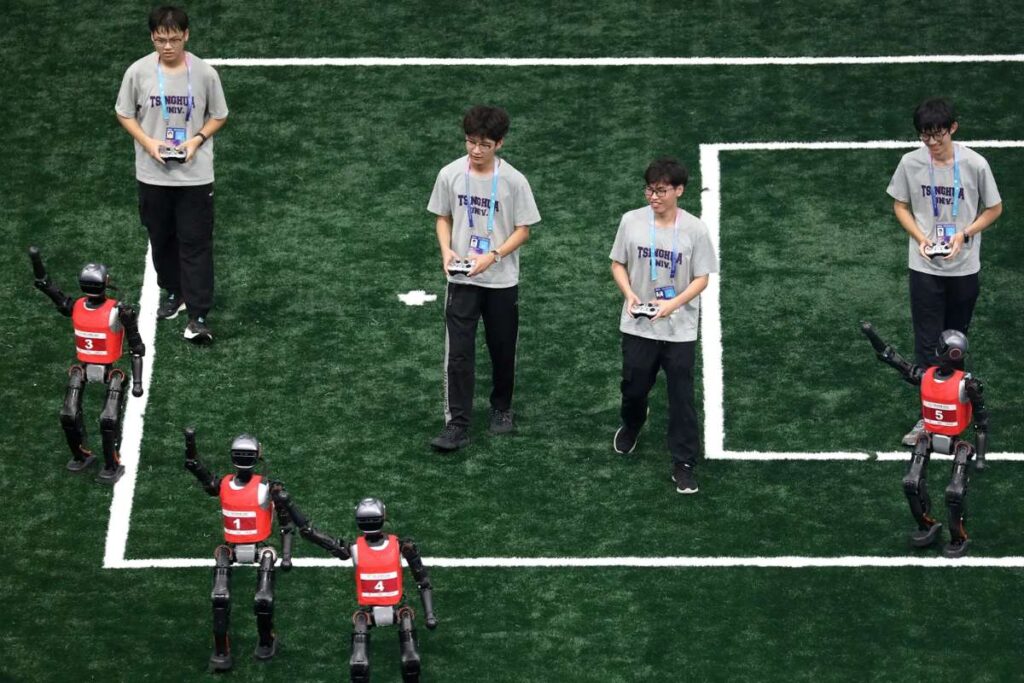
Tsinghua has filed about 1,200 robotics-related patents in the past year and dozens more in fields such as 3D image modeling and photonic computing. The university’s portfolio, which adds to the growing list of Tsinghua University AI patents, includes patents for an optical artificial neural network chip, an identity authentication system co-assigned with Huawei Technologies Co., Ltd., and a micro spectrum chip designed for high-precision sensing.
Researchers attribute the momentum to concentrated national investment and expanded university-industry collaboration. The university has become a leading source of AI engineering talent in China, producing graduates who move directly into national laboratories and major technology firms.
“Tsinghua has built an innovation pipeline that supports both foundational research and practical deployment,” Michael Wade, director of the TONOMUS Global Center for Digital and AI Transformation, said. He added that China’s strategy emphasizes efficiency and commercialization rather than building the strongest theoretical systems.
Breakthroughs Across Computing Fields
Tsinghua’s research teams have advanced multiple areas of artificial intelligence. Engineers developed optimization techniques to speed up neural-network training for large data sets used in autonomous driving, security applications, and industrial automation. In reinforcement learning, a team introduced multi-objective algorithms aimed at robotics and energy management systems that must balance several operational targets at once.
Another group designed perception algorithms for self-driving systems, improving real-time decision-making. In 2020, researchers also proposed a new method of training optical neural networks, called Fully Forward Mode, that removes the need for GPU-based digital simulation. The related Taichi-II chip performs physical computing operations with lower power consumption.
In the field of language models, Tsinghua researchers created a cumulative reasoning framework to improve performance on complex logic tasks. They also introduced an autonomous learning system known as the Absolute Zero Reasoner, which uses verifiable rewards to generate and solve tasks without external data. The university’s work on YOLOv10, a real-time object-detection model, replaces the traditional non-maximum suppression step and aims to improve accuracy in high-speed environments.
Effects on Global Tech Competition
Tsinghua’s rapid progress has implications for the competitive positions of technology companies in China and abroad. Firms such as Huawei, Alibaba Group Holding Ltd., and Tencent Holdings Ltd. frequently source talent and research partnerships from the university. Co-assigned patents show a growing integration between academic research and commercial deployment.
Observers note that the developments challenge the long-standing dominance of Western companies. Alphabet Inc., Microsoft Corp., and Meta Platforms Inc. now face increased competition in areas like energy-efficient computing, autonomous driving, and large-model reasoning. Future product roadmaps relying heavily on GPU infrastructure could shift if photonic computing systems prove commercially viable, strengthened in part by expanding Tsinghua University AI patents.
International experts continue to debate the relative quality of Chinese patents, but many acknowledge a narrowing gap due to improved academic standards and deeper cooperation between universities and industry.
Broader Impact on Innovation Trends
Tsinghua’s rise reflects China’s broader goal of becoming a global AI leader, first outlined in national plans released in 2017. The university’s patent volume and applied-research focus support national efforts to strengthen the domestic technology supply chain and expand global influence in setting standards for emerging technologies.
Applications from Tsinghua’s research are already visible. Work on traffic-management algorithms with the Beijing municipal government forms part of smart-city planning. Advances in medical AI support early detection of conditions such as Alzheimer’s disease, offering potential improvements in diagnostics and public-health planning.
Analysts expect continued progress as Tsinghua expands its interdisciplinary “AI+” initiatives across engineering, biology, and environmental science. Energy-efficient computing platforms and improved reasoning frameworks for language models are likely to remain priorities.
The university’s trajectory also raises questions on ethics, data governance, and AI oversight. Experts emphasize the need for robust standards as autonomous systems gain broader use in public and commercial sectors.
Ultimately, the rise of Tsinghua University AI patents signals a shift toward a more multipolar AI landscape. As patent competition intensifies, institutions worldwide are expected to accelerate research, seek new partnerships, and adapt to rapid changes in hardware and algorithm development.