
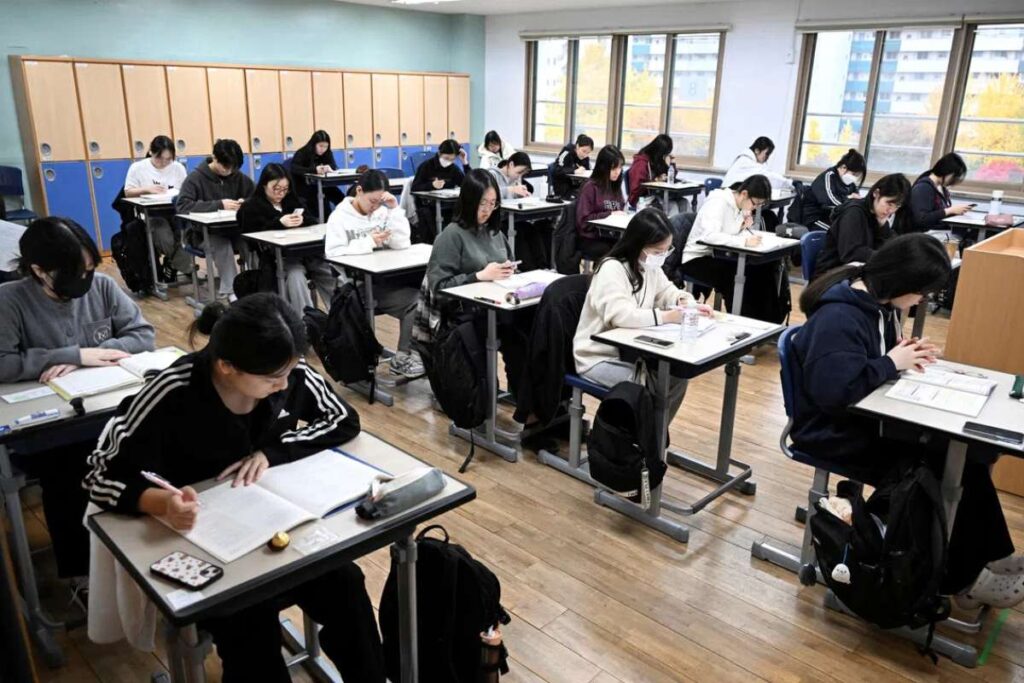
Key Points:
- Suneung exam difficulty caused controversy, leading to the resignation of South Korea’s top exam official.
- Only 3% of students scored the highest in English, the lowest since 2018.
- The debate sparked calls for fairer, balanced exams and reduced student pressure.
South Korea’s top exam official has resigned after widespread concerns that this year’s English section of the national university entrance exam was too difficult for students, highlighting issues around the Suneung exam difficulty. The decision follows a sharp drop in high scores and growing frustration among students, teachers, and parents.
The College Scholastic Ability Test, known as the Suneung, is one of the country’s most important academic milestones. It plays a major role in university admissions and strongly influences a student’s future academic and career path. This year’s results showed that just over 3 percent of test takers achieved the highest grade in English, the lowest performance level since absolute grading for the subject began in 2018.
Students Report Unusually Complex Questions
Students were given 70 minutes to complete 45 English questions. Many said the test’s reading passages were unusually complex, adding to the controversy around the Suneung exam difficulty. One question required students to compare the ideas of philosophers Immanuel Kant and Thomas Hobbes. Another involved analysing the concept of time and clocks. A separate passage asked students to explore how ideas of existence apply to video game avatars.
The academic term “culturtainment” also appeared in the test and generated confusion. Stuart Moss, a lecturer in the United Kingdom who coined the word, said he was surprised to see it used and noted that it is not widely used in everyday English. Teachers in South Korea expressed concern that such vocabulary placed students at a disadvantage, highlighting the challenges of the Suneung exam difficulty.
The Suneung is so important that flights across the country pause during the English listening portion to maintain quiet conditions. Because of this, any shift in difficulty draws national attention and rapid feedback from schools and families.
Institute Responds to Public Concern
Oh Seung-keol, chief of the Korea Institute for Curriculum and Evaluation, submitted his resignation after reviewing the public response to the exam. The institute said he accepted responsibility because the English section did not match the goals of the evaluation system. It also apologized for adding stress to students during a period that already carries significant academic pressure.
The agency acknowledged that the exam should align more closely with the aim of reducing student workload. Teachers say that consistency and clear expectations are essential for fairness. Many pointed out that students prepare for years with a structured curriculum and that sudden shifts in complexity affect performance.
Education Community Reassesses Test Standards
The issue has opened a broader discussion in South Korea’s education community. Teachers and school leaders say the difficulty level of major exams must reflect students’ learning environments. English instructors also stressed the importance of choosing reading materials that match real classroom instruction to maintain appropriate Suneung exam difficulty.
The debate comes at a time when the government is making additional adjustments in the early education sector. A new law limits private preschools from conducting early English entrance tests. Educators say this reflects a national effort to ease pressure on younger learners.
Test scores remain a sensitive topic for many families. This year, the performance of a high-profile student added further attention to the exam results. Many teachers say that the focus should remain on improving clarity, fairness, and accessibility for all students preparing for university entrance.
For students and teachers, the situation highlights the need for balanced exam design. The conversation is expected to continue as the education community works toward assessments that challenge students without overwhelming them, ensuring the Suneung exam difficulty is fair and consistent.