

Trying to figure out the difference between a PhD and a doctorate can be confusing. A relative of mine was pursuing a PhD, while a senior at school was going for another type of doctorate. At first glance, it all seemed the same to me.
It’s a mistake many people make, even students, but understanding the distinction between a PhD vs Doctorate is more important than it seems.
The choice between a PhD and other doctorates can shape your career path and influence your income potential. It can also open different research or professional opportunities and affect how long you spend in school.
This guide explains the differences between doctorates, the types available, and what each can offer in terms of scope and opportunities. By the end, you’ll have a clear picture of what each path involves and which one could be the right fit for you.
What is a Doctorate Degree?
To fully understand PhD vs Doctorate, you must first understand what a doctorate actually represents. A doctorate is the highest academic degree a person can earn in a field. It shows advanced knowledge, deep expertise, and a high level of professional or academic achievement. There are two main types of doctorates:
1. Research Doctorates:
These focus on generating new knowledge through original research. Students spend years investigating a topic in depth, conducting studies, and producing a dissertation that contributes something new to their field. A PhD is the most common example of this type. According to the 2024 data, U.S. universities awarded 58,131 research doctorate degrees to students.
2. Professional Doctorates:
These focus on applying knowledge to real-world problems. They are designed for experienced professionals looking to advance in their careers. Examples include the Doctor of Business Administration (DBA), Doctor of Education (EdD), Doctor of Psychology (PsyD), Doctor of Nursing Practice (DNP), and Doctor of Engineering (EngD or DEng).
So, the right question would be, what’s the difference between a PhD and a professional doctorate?
What is a PhD?

A PhD, or Doctor of Philosophy, is a research-based doctorate. It focuses on creating new knowledge in a specific field. Many PhD candidates publish research papers and teach at universities during their program. Most programs start with coursework and comprehensive exams. Then, students conduct independent research and defend their dissertations before a panel.
Many students receive funding through scholarships or assistantships. In the broader PhD vs Doctorate comparison, it’s important to remember that a PhD is just one type of doctorate, alongside several other respected doctoral degrees.
PhD vs Doctorate: How to Find the Degree That Matches Your Passion?
You should choose between a PhD and a professional doctorate depending on your career goals and personal interests. So, ask yourself what you want to achieve in the long term and which path goes with your strengths and ambitions.
- You should consider a PhD if your goal is to become a professor, engage deeply in academic research, publish scholarly papers, or pursue a career in universities or research labs. This path is ideal for those who enjoy exploring theories, analyzing data, and contributing original knowledge to their field.
- On the other hand, a professional doctorate may be the better choice if you are seeking leadership roles, already work in business, education, or healthcare, or want to focus on solving practical, real-world problems. This path highlights applied projects and professional development, making it suitable for those who prefer hands-on work over theoretical study.
Both paths are highly respected, but the right choice is the one that aligns with what you want to accomplish. Refer to the table below to have a glance at the key differences between a PhD vs Doctorate.
| Considerations | Research Doctorate (e.g., PhD) | Professional Doctorate |
| Focus | Academic & theoretical | Professional & practical |
| Typical Fields | Sciences, Humanities, Engineering, and Social Sciences. | Education, Business, Nursing, Psychology, and Public Health. |
| Duration | 4-7 years | 3-5 years |
| Credit Requirement | 60-120 | 60-90 |
| Skills Required | Strong analytical & critical thinking skills, proficiency in research methods, academic writing, and data analysis/statistics. | Strong professional experience, leadership and management skills, applied research capability, effective communication, and ability to implement change in organizations. |
| Career Paths | University professor, academic researcher, postdoctoral researcher, research scientist | Senior practitioner roles, leadership positions, consultancy, and applied research roles in industry or professional settings. |
| Average Salary | ~$50k–$150k/year | ~$80k–$200k/year depending on sector, experience, and location |
| Dissertation | Original research contributing new knowledge to the field | Applied project, case study, or capstone addressing practical problems |
| Funding Opportunities | Often funded via scholarships, teaching/research assistantships, and government grants. | Usually self-funded or employer-sponsored; sometimes professional fellowships are available. |
PhD vs Doctorate: Who Really Earns More?

According to the U.S. Bureau of Labor Statistics (BLS), median weekly earnings for individuals with a doctoral degree were $2,278 in 2024. It is higher than that of master’s and bachelor’s degree holders. When evaluating PhD vs Doctorate from an income perspective, field specialization matters more than the degree title.
Below is a breakdown of salary ranges by research doctorates and professional doctorates in the United States (2025 estimates based on salary aggregators and national survey data).
1. Research Doctorates
Annual salary ranges for Research PhDs in the US vary by role and experience. It depends on whether the graduate works in academia, government research, or private industry. This salary data is collected from the NSF NCSES publication. The figures represent 2024 medians for US recipients reporting salaries, primarily from the Survey of Earned Doctorates (SED).
| Field Of Work | Roles | Average Salary |
| Computer and Information Sciences | Industry Scientist, Data Scientist | $150,000 |
| Mathematics and Statistics | Quant Analyst, Statistician | $150,000 |
| Social Sciences | Researcher, Policy Analyst | $129,000 |
| Engineering | R&D Engineer, Professor | $125,000 |
| Health Sciences | Clinical Researcher, Postdoc | $120,000 |
| Biological/Biomedical Sciences | Biotech Scientist, Postdoc | $120,000 |
| Physical Sciences | Lab Researcher, Physicist | $120,000 |
| Geosciences/Atmospheric/Ocean | Environmental Scientist | $110,000 |
| Agricultural/Natural Resources | Ag Research Scientist | $100,000 |
| Psychology | Postdoc, Academic Researcher | $58,000 |
Note: Academic PhD salaries typically start lower but increase with tenure and rank. However, PhDs working in private-sector research, especially in STEM and technology fields, can earn significantly higher salaries than traditional university faculty.
2. Professional Doctorates
Professional doctorates often command higher starting salaries due to industry demand and licensure requirements.
| Field Of Work | Roles | Average Salary |
| Medicine (MD) | Physician/Surgeon | $239,200 |
| Dentistry (DDS/DMD) | Dentist | $179,210 |
| Pharmacy (PharmD) | Pharmacist | $137,480 |
| Law (JD) | Lawyer | $145,760 |
| Optometry (OD) | Optometrist | $131,860 |
| Veterinary (DVM) | Veterinarian | $119,100 |
Note: Professional doctorates, particularly in medicine, dentistry, and specialized healthcare, offer higher immediate earning potential compared to most academic PhD pathways.
Before You Apply: PhD vs Doctorate – Eligibility, Costs, and Key Considerations
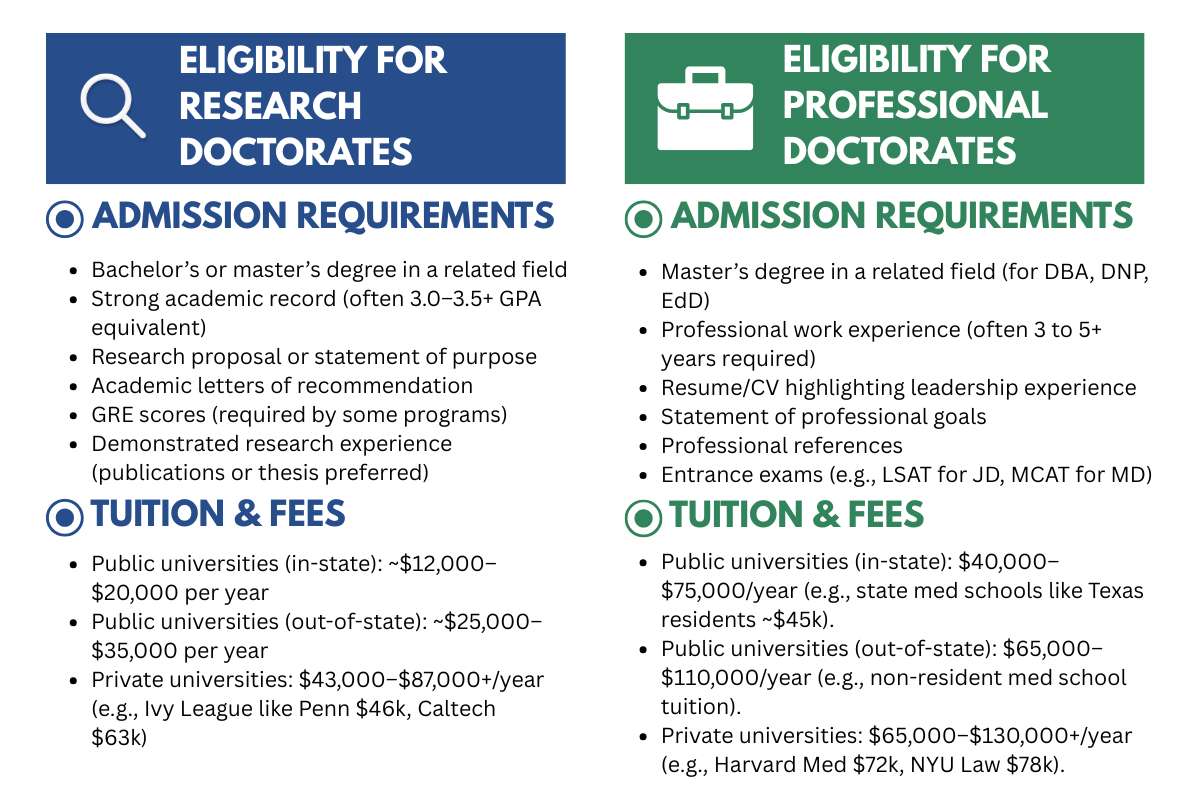
To choose between a research PhD and a professional doctorate is not just about passion. It’s about eligibility, cost, time commitment, and long-term return on investment. So before you commit, analyze the PhD vs Doctorate requirements carefully.
Eligibility For Research Doctorates
➤ Admission Requirements
- Bachelor’s or master’s degree in a related field
- Strong academic record (often 3.0–3.5+ GPA equivalent)
- Research proposal or statement of purpose
- Academic letters of recommendation
- GRE scores (required by some programs)
- Demonstrated research experience (publications or thesis preferred)
➤ Tuition & Fees
- Public universities (in-state): ~$12,000–$20,000 per year
- Public universities (out-of-state): ~$25,000–$35,000 per year
- Private universities: $43,000–$87,000+/year (e.g., Ivy League like Penn $46k, Caltech $63k)
Note: Most PhD students don’t pay tuition themselves. Schools cover it through funding, teaching jobs, or research assistantships, plus a stipend for living costs. Real costs depend on the program and subject.
Eligibility For Professional Doctorates
➤ Admission Requirements
- Master’s degree in a related field (for DBA, DNP, EdD)
- Professional work experience (often 3 to 5+ years required)
- Resume/CV highlighting leadership experience
- Statement of professional goals
- Professional references
- Entrance exams (e.g., LSAT for JD, MCAT for MD)
➤ Tuition & Fees
- Public universities (in-state): $40,000–$75,000/year (e.g., state med schools like Texas residents ~$45k).
- Public universities (out-of-state): $65,000–$110,000/year (e.g., non-resident med school tuition).
- Private universities: $65,000–$130,000+/year (e.g., Harvard Med $72k, NYU Law $78k).
Note: Professional doctorate programs rarely provide full funding like research PhDs do. These costs don’t include living expenses; your actual out-of-pocket amount depends on scholarships and aid.
Also Read: Navigating the Maze: A Comprehensive Guide to Graduate Degree Programs
Top U.S. Universities for Doctorates

Picking the right university for your doctoral journey can shape your research impact, professional network, and future career prospects. Also, institutional reputation plays a major role in the PhD vs Doctorate decision. Below is a curated list of leading U.S. universities that excel in research PhDs and professional doctoral pathways.
Top Universities for Research Doctorates (PhD & Research-Intensive Programs)
These institutions are globally recognised for high research activity, strong doctoral programs, and major contributions to science, technology, humanities, and interdisciplinary research:
- Massachusetts Institute of Technology (MIT): Often ranked #1 globally for postgraduate research excellence across STEM, economics, and technology.
- Harvard University: A gold standard for doctoral research in multiple fields,s including social sciences, law, and biomedical.
- Stanford University: Renowned for innovation and interdisciplinary research, especially in AI, engineering, and business.
- University of California, Berkeley: High research activity across sciences, public policy, and technology.
- Princeton University: Known for strong theoretical research in math, public policy, and physics.
- Yale University: R1 research university with a long legacy of doctoral scholarship.
- University of Chicago: Excellent in economics, social sciences, and theoretical research.
- Johns Hopkins University: World-leading in medical research, public health, and science.
- Carnegie Mellon University: Outstanding in computer science, engineering, and interdisciplinary research.
Top Universities for Professional Doctorates

These universities excel in professional doctorates, including medicine, law, and business leadership.
1. Medical Doctorates (MD)
- Harvard Medical School: Among the most prestigious MD programs globally, top tier for research and clinical training.
- Johns Hopkins University School of Medicine: Leader in medical research and innovation.
- Mount Sinai Icahn School of Medicine: Highly competitive MD program noted for innovation.
- University of Pennsylvania (Perelman School of Medicine): Strong MD research and clinical excellence.
2. Law Doctorates (JD & Advanced Legal Degrees)
- Harvard Law School: Highly ranked and selective JD program.
- Stanford Law School: Top-ranked with excellent federal clerkship outcomes.
- Georgetown University Law Center: Large, prestigious JD program with strong placement.
- Notre Dame Law School: Well-regarded JD program with solid employment stats.
3. Doctor of Business Administration (DBA) & Professional Business Doctorates
- Washington University in St. Louis: Olin Business School (DBA recognition)
- University of Texas at Dallas: Naveen Jindal School of Management (DBA)
- University of Maryland, College Park: Smith School of Business (DBA)
- Other strong institutions with doctoral business tracks include the University of Minnesota, the Ohio State University, and UCLA.
PhD vs Doctorate: How to Nail Your Application and Get Accepted?
Getting into a doctoral program can feel intimidating, but with the right strategy, you can stand out. Understand the expectations behind PhD vs Doctorate applications and improve your acceptance chances.
Also Read: Demystifying the Doctorate: A Guide to Doctoral Programs and Their Impact
➤ Application Tips for Research Doctorates (PhD)

- Define Your Research Focus: Pick a clear topic you’re passionate about and skilled in.
- Choose Your Project Type: Decide between an advertised project or proposing your own research.
- Contact Potential Supervisors: Reach out with a concise, personalized email showing alignment.
- Check Entry Requirements & Funding: Review prerequisites and available funding before applying.
- Prepare a Strong Application Package: Tailor your CV, transcripts, proposal, and references carefully.
- Start Early & Track Deadlines: Begin 6–12 months ahead to meet all deadlines comfortably.
- Tailor Each Application: Customize every application to the specific project and supervisor.
➤ Application Tips for Professional Doctorates
- Highlight Experience: Showcase your relevant professional achievements and expertise.
- Align Your Degree: Ensure your prior qualifications match the program’s field.
- Clarify Your Goals: Explain how the program will help solve real-world challenges.
- Network Strategically: Connect with faculty or alumni to learn expectations and stand out.
- Plan Funding: Search for scholarships, employer support, or payment plans to cover costs.
- ShowLeadership Potential: Show how you’ve led projects or initiatives in your field.
- Prepare a Professional Portfolio: Include work samples, certifications, or applied projects to strengthen your application.
Conclusion
Both a PhD and a doctorate are powerful paths to growth. A doctorate is the highest academic degree, while a PhD is a research-focused type of doctorate. Knowing the differences in focus, complexity, and career impact can help you make an informed choice.
Both paths demand dedication, hard work, and passion. The right decision is the one that aligns with your strengths, interests, and long-term goals. So take what you’ve learned here, reflect on your ambitions, and choose the path that will shape your future the way you want it to.
FAQs
1. Is a PhD higher than a doctorate?
No. A PhD is just one type of doctorate. All doctorates are terminal degrees, but not all are PhDs.
2. Are professional doctorates respected?
Yes. Professional doctorates are highly respected, especially in industry and practice-focused careers.
3. Can only PhD holders use the title “Dr.”?
No. All doctorate holders, including those with professional doctorates, can use the title “Doctor.”
4. Can you get a doctorate without earning a PhD?
Yes. Many professional doctorates, such as DBA, EdD, or DNP, are not PhDs and focus on applied knowledge rather than academic research.
5. Which doctorate has the highest earning potential?
It depends on the field. Doctorates in business, healthcare, and applied professional areas often offer higher earning potential.