
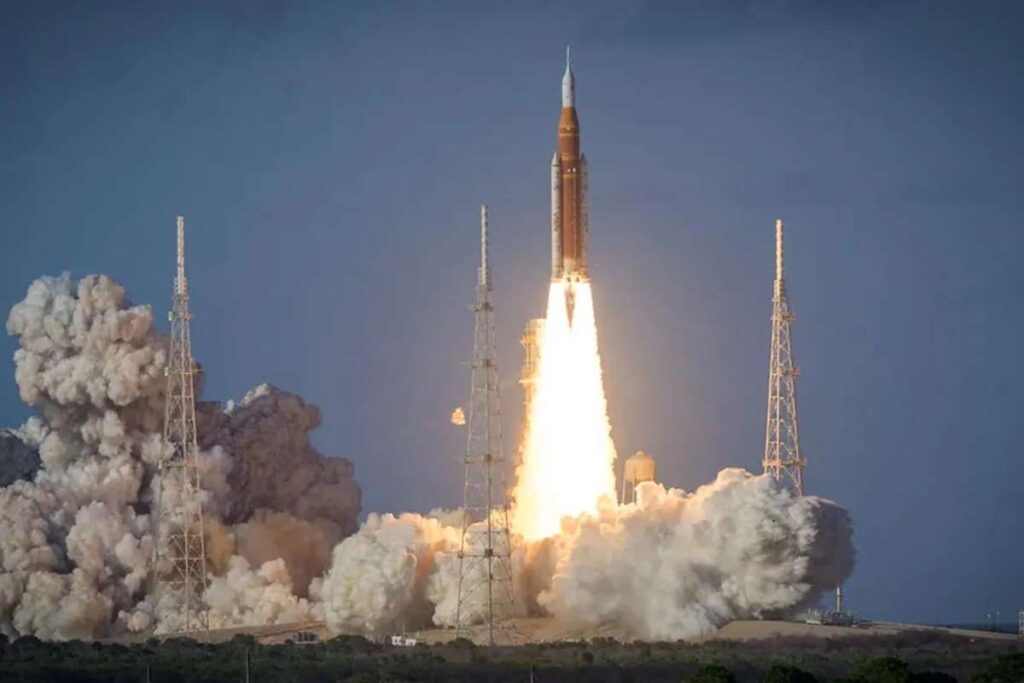
NASA is preparing to launch the Artemis II mission from Kennedy Space Center, marking a major step in human spaceflight that is expected to expand learning opportunities for students and educators in aerospace fields.
Mission Opens New Learning Pathways In Aerospace Studies
The Artemis II mission will send astronauts aboard the Orion spacecraft on a journey around the Moon and back to Earth. The mission is expected to last about ten days and will focus on testing critical systems that support human life in space. This includes evaluating how astronauts live and work inside the spacecraft during extended missions beyond Earth orbit.
For students and teachers, this mission offers an example of how science, technology, engineering, and mathematics come together in space exploration. Concepts such as propulsion, navigation, and life support systems can be studied through a practical lens, helping learners understand how classroom knowledge applies to complex space missions.
Educational institutions are expected to use Artemis II as a case study to explore topics like spacecraft design and mission planning. The Orion capsule will serve as a key reference point, as it is designed to support multiple missions in the coming years. This allows educators to connect theoretical learning with ongoing developments in space exploration.
The mission also demonstrates how advanced computational tools and engineering methods are used to guide spacecraft through complex environments. These systems ensure that astronauts can travel safely while managing variables such as gravity, motion, and distance across space.
Inspiration And Research Drive Future Exploration Goals
Beyond technical learning, the Artemis II Mission is expected to inspire students to pursue careers in aerospace and related fields. Human space missions often create a strong sense of curiosity and ambition, encouraging learners to explore science and engineering disciplines more deeply.
The Moon presents unique research opportunities that can further enhance academic study. Its environment offers conditions that are not available on Earth, making it an ideal location for experiments in physics and astronomy. For example, the absence of atmospheric interference supports advanced observations through radio telescopes, which can deepen understanding of the universe.
The mission also highlights the potential of lunar resources, such as Helium-3, which is being studied for its possible role in future energy solutions. While research in this area is ongoing, it introduces students to the concept of how space exploration can contribute to scientific discovery and innovation. This aspect of the Artemis II Mission connects classroom learning with real-world scientific exploration.
Artemis II serves as a stepping stone for future missions that may extend beyond the Moon to destinations such as Mars. These long-term goals provide a broader context for education, allowing students to see how current missions fit into a larger vision of space exploration.
For teachers, the mission offers a dynamic way to engage students through real-time developments in science and technology. Classroom discussions can incorporate mission updates, engineering challenges, and scientific goals, making learning more interactive and relevant.
As Artemis II prepares for launch, it stands as both a technological milestone and an educational opportunity. The Artemis II Mission connects theoretical knowledge with application, encouraging students to explore the possibilities of space science while building skills that are essential for the future.
By bringing space exploration into the classroom, Artemis II helps shape the next generation of scientists, engineers, and innovators who will continue to expand humanity’s presence beyond Earth.