
Key Points:
- Oral exams in colleges are returning to verify real learning and reduce AI cheating.
- Universities are mixing traditional oral tests with AI tools to assess true understanding.
- Despite some anxiety, oral exams improve confidence, communication, and accountability.
U.S. colleges are increasingly adopting oral exams in colleges in response to widespread generative AI use, requiring students to verbally defend coursework face-to-face or through AI tools to verify learning and preserve critical-thinking skills.
Professors Turn to Face-to-Face Testing
Educators across the United States are shifting assessment methods as generative artificial intelligence reshapes higher education. Professors report assignments returning flawless but suspect, prompting concerns that students rely on AI rather than mastering the material.
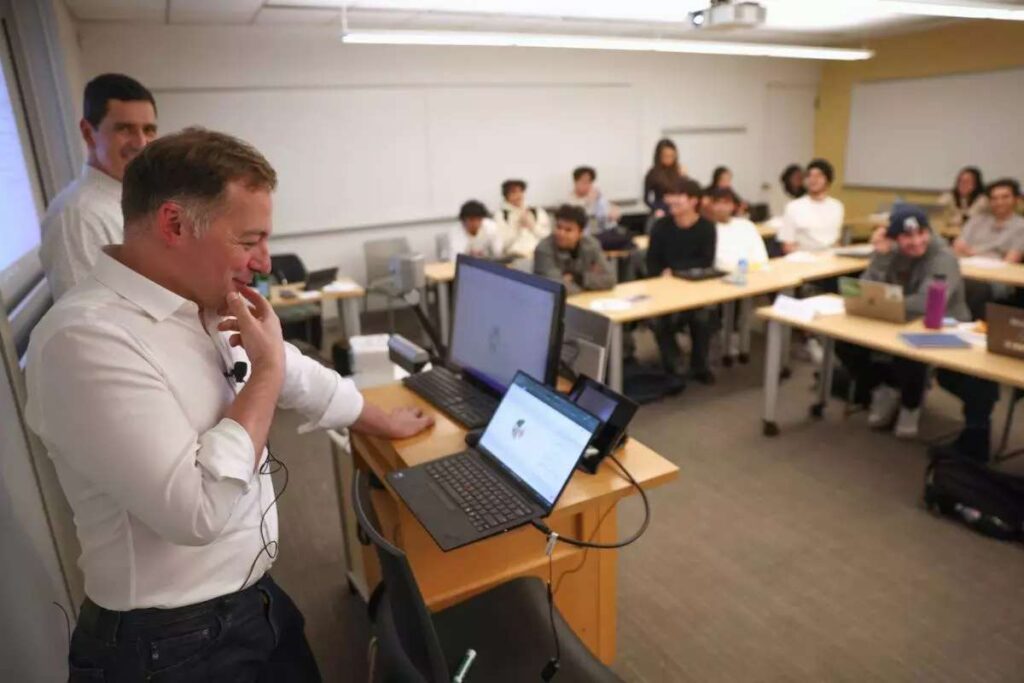
At Cornell University, biomedical engineering professor Chris Schaffer requires students to complete “oral defenses,” speaking directly with instructors without laptops, notes, or technology. This method aligns with the increasing use of oral exams in colleges to confirm understanding rather than written performance.
“You won’t be able to AI your way through an oral exam,” Schaffer said, explaining why he introduced the format last semester.
Faculty nationwide say the change reflects a broader effort to determine what students actually know. Many instructors report students struggling to explain work they submitted in polished written assignments.
At the University of Pennsylvania, associate professor Emily Hammer pairs written papers with oral examinations. She said the goal is not punishment but skill preservation.
“We’re doing this because students are actually losing skills, losing cognitive capacity and creativity,” Hammer said.
University officials there describe a growing shift toward in-person assessments, including oral questioning and supervised testing.
Universities Combine Tradition With New Technology
Oral examinations, common in European universities but rare in modern U.S. undergraduate education, gained renewed attention during the COVID-19 pandemic amid online cheating concerns. Interest surged again following the 2022 launch of widely accessible AI chatbots.
At New York University, faculty increasingly require presentations, office-hour discussions, and spontaneous questioning in class, methods closely tied to oral exams in colleges. Clay Shirky, vice provost for AI and technology in education, said instructors want direct interaction.
“I need to look my students in the eye and ask, ‘Do you know this material?’” Shirky said.
Some institutions are experimenting with AI itself as part of the solution. NYU professor Panos Ipeirotis created an AI-powered oral exam that interviews students using a cloned voice and adaptive questioning.
Students log in remotely while an AI agent asks detailed questions about group projects, probing for understanding and participation. Ipeirotis later reviews and grades responses with AI assistance.
“We wanted to check: Do you know what your team did? Were you a free rider?” Ipeirotis said. “I don’t trust written assignments anymore to be the result of actual thinking.”
Student reactions remain mixed. Business major Andrea Liu said the system felt realistic but awkward, noting pauses and multiple questions created confusion. Still, she acknowledged educators’ concerns about the misuse of AI tools.
“There is no perfect world where AI exists, and kids are not abusing it,” Liu said.
Educators See Benefits Beyond Preventing Cheating
Supporters argue that oral exams in colleges strengthen communication skills and deepen learning across disciplines. Cornell’s Schaffer schedules 20-minute questioning sessions after written problem sets, replacing traditional grading with live evaluation.
With 70 students enrolled, Schaffer and teaching assistants conduct interviews instead of marking written submissions. The method, he said, motivates students to genuinely understand coursework.
Other Cornell instructors have adopted similar approaches, including conversational final exams and brief mock interviews in large engineering classes.
Critics warn oral exams may heighten anxiety for shy students, but educators say preparation and clear expectations help reduce stress. Carolyn Aslan, who leads oral exam training at Cornell, said one-on-one discussions often encourage participation from quieter students.
“Sometimes it’s actually good to get that quiet student one-on-one,” Aslan said. “Sometimes that is the breakthrough.”
Many students report positive outcomes despite initial nervousness. Cornell junior Olivia Piserchia said the experience improved accountability and confidence through oral exams in colleges.
“Having that live check-in holds you accountable,” Piserchia said. “It’s a lot harder to look people in the eyes and say out loud, ‘I don’t know this.’”
As generative AI continues to evolve, educators say oral exams in colleges may become a permanent feature of higher education, blending centuries-old teaching methods with modern technology to ensure authentic learning.