

Hiring is supposed to make your team stronger. But lately, it feels like more chaos than growth.
Resumes pile up, top candidates slip away, and managers struggle to make fair performance decisions. HR collects mountains of data, but no one trusts it. Everyone feels stuck, yet the tools are already there.
At this point, a talent management system becomes critical because the problem isn’t people but the way the process connects or doesn’t. Hiring happens in one place, performance reviews in another, and learning somewhere else. Every decision ends up chasing scattered data instead of relying on clarity.
It connects every step of the employee journey, so decisions are faster, smarter, and fairer. Now, let’s see what that actually means in practice.
What is a Talent Management System?
A workforce management platform gives you one place to track how people enter, grow, and move inside your company. But the real value is not in storing data. It is in how that data gets used.
Without a system, managers rely on recent memory or scattered feedback. With a system, they see goal progress, past reviews, skill development, and peer feedback in one view. Now, you can actually base your decision on facts and not just memory. This is the difference.
According to the Society for Human Resource Management (SHRM), companies that align hiring, performance, and development systems see stronger workforce outcomes because decisions stay consistent across stages.
So, instead of treating hiring, reviews, and growth as separate activities, the system turns them into a single continuous process.
Why Talent Management Systems Matter Today?

Work is changing faster than most company systems can keep up. Managers are responsible for bigger teams, roles evolve quickly, and skills can become outdated in months. Meanwhile, employees want more than a paycheck; they want clear paths to grow. Without a structured system, these gaps quickly start to show.
When there’s no clear process, managers delay feedback. HR struggles to keep track of performance across teams, and leadership debates promotions without solid data. Over time, this adds up. High performers feel overlooked, average performers slip through the cracks, and employees start leaving without anyone understanding why.
A skills management system fixes this. It makes performance visible, feedback consistent, and growth measurable. Instead of reacting after problems appear, companies can act early and keep their best employees engaged.
How a Talent Management System Actually Works Day to Day?
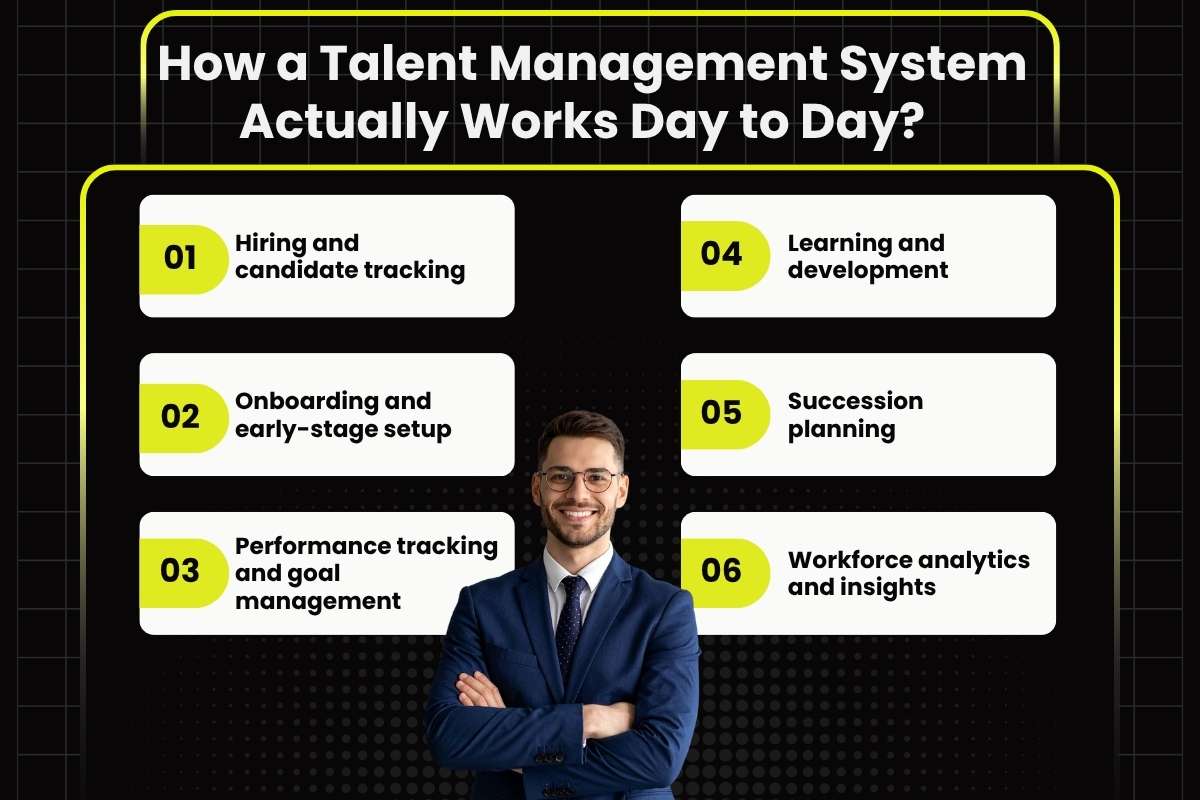
This becomes clearer when you look at how each part works together in your day-to-day processes. The real value shows up when these functions work as one connected flow and not as separate tools. Let’s look at how it works, then:
1. Hiring and candidate tracking:
Recruiters evaluate candidates and record structured feedback. This data stays in the system and becomes the starting point for future performance tracking.
2. Onboarding and early-stage setup:
The system assigns tasks, timelines, and training from day one. Managers don’t need to chase updates because progress stays visible.
3. Performance tracking and goal management:
As employees settle into their roles, goals align with business priorities. Feedback gets recorded regularly, which builds a clear performance history over time.
4. Learning and development:
Skill gaps become visible through performance data. The system connects employees with relevant training, which removes guesswork in development planning.
5. Succession planning:
Instead of depending on opinions, companies use performance data to identify future leaders and plan internal growth.
6. Workforce analytics and insights:
Leaders get a clear view of trends in hiring, performance, and retention, which helps in making better decisions.
Also Read: How an Entrepreneurship Development Program Can Turn Your Business Dreams into Reality?
Benefits of a Talent Management System
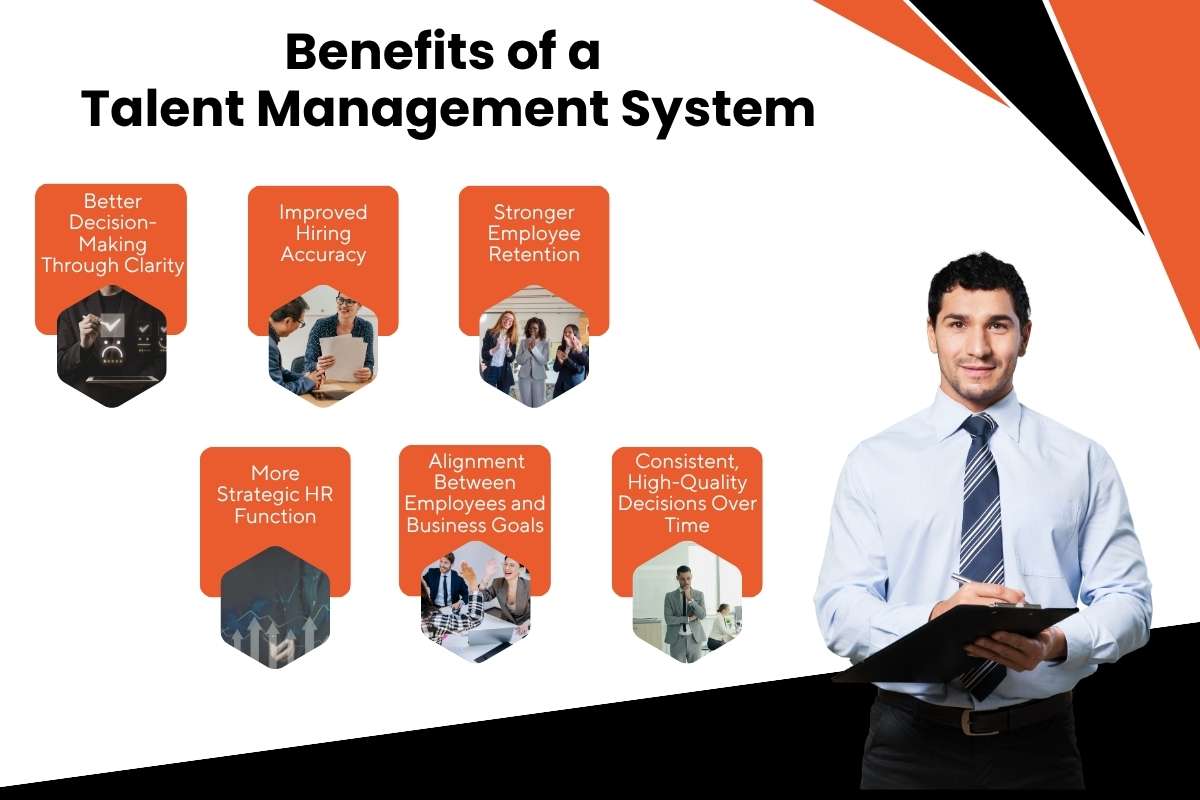
Talent development software does more than improve processes. It changes the way organizations make decisions, help people grow, and achieve real business results.
1. Better Decision-Making Through Clarity
A workforce management platform gives managers a clear, ongoing view of employee performance. Instead of depending on memory or scattered notes, they can see trends in strengths, weaknesses, and growth over time. For example, managers can identify consistently high performers, spot skill gaps early, or notice when someone may need extra support. This transparency reduces bias and ensures promotions, raises, and development opportunities are based on actual performance, not assumptions.
2. Improved Hiring Accuracy
When candidate information is linked to real job performance through a talent management system, hiring decisions become more precise. Organizations can analyze which skills, experiences, or behaviors lead to success in specific roles. For instance, if data shows that candidates with certain problem-solving skills perform better in a technical role, recruiters can prioritize those traits in the future. Over time, this creates a cycle of continuous improvement in hiring, lowering turnover, and improving team productivity.
3. Stronger Employee Retention
Employees are more likely to stay when they understand how to grow within the organization. Clear goals, regular feedback, and visible development plans reduce uncertainty and build trust in management. For example, an employee who sees a clear path to a promotion or new skill development is less likely to leave. Retention improves not just because people are happier, but because they feel supported and see that their effort leads to tangible results.
4. More Strategic HR Function
HR teams spend less time collecting updates and more time solving workforce challenges. With a Talent Management System, they can quickly spot skill gaps, performance bottlenecks, or potential leadership risks. This allows HR to design targeted interventions, like training programs, succession plans, or team restructuring. Instead of coordinating data manually, HR becomes a strategic partner that actively drives business outcomes.
5. Alignment Between Employees and Business Goals
Organizations with structured talent practices achieve higher engagement and productivity. When employee objectives are linked to company goals, everyone works toward the same outcomes. For example, if a sales team’s individual targets are aligned with revenue goals, employees can clearly see how their work contributes to the organization’s success. This connection makes performance evaluations fairer and motivates employees to focus on meaningful results.
6. Consistent, High-Quality Decisions Over Time
The benefits of a Talent Management System come from better decision-making, not just automation. By using consistent, structured data, managers make fairer, evidence-based decisions for hiring, promotions, and development. Over time, this builds a culture of trust and accountability, reduces bias, and ensures that workforce strategies are effective and repeatable.
Challenges of a Talent Management System
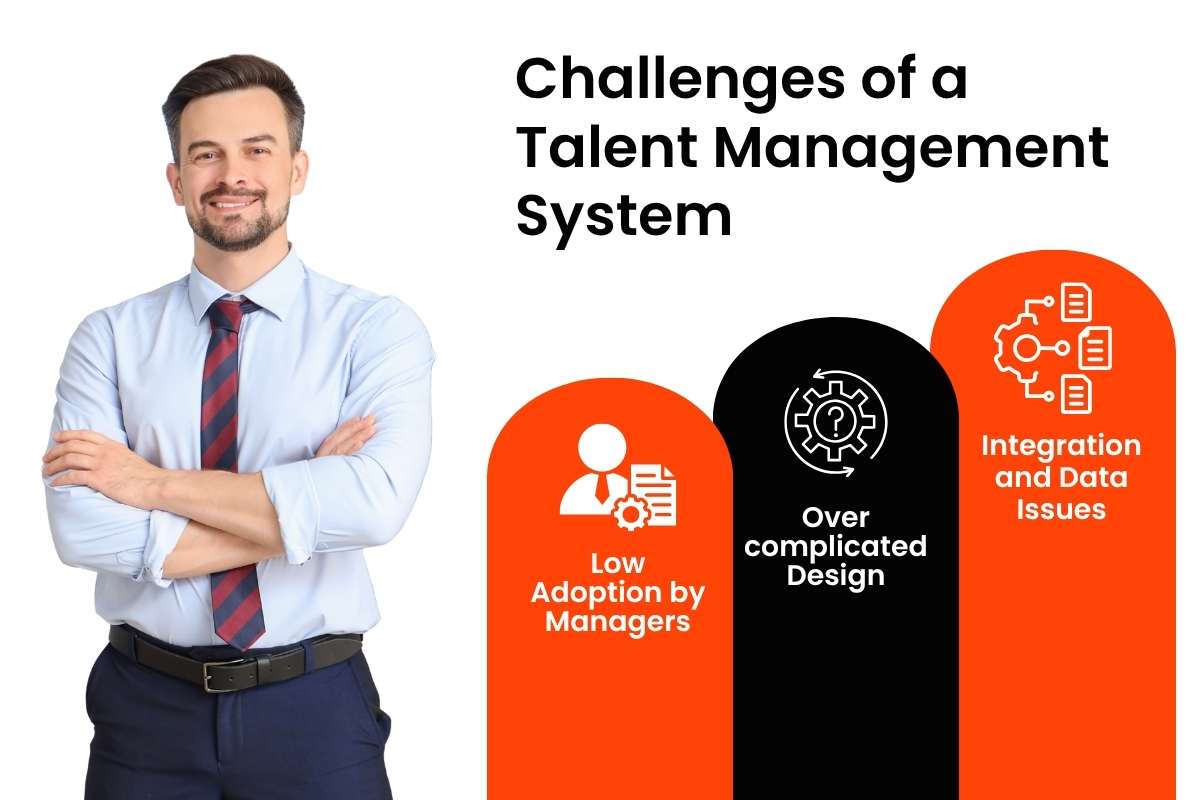
Most systems fail after implementation, not before. Even the most advanced platforms can encounter difficulties after implementation. These are the challenges that often trip up organizations.
1. Low Adoption by Managers
A major challenge is that managers often see the system as extra work. If the interface feels complicated or time-consuming, they may skip entering updates or reviewing employee data. For example, a manager might avoid logging performance feedback, leaving employee records incomplete. When this happens, the system loses credibility, and employees may stop trusting it as well. Adoption struggles can turn even the most advanced system into an unused tool.
2. Overcomplicated Design
Many organizations try to create the “perfect” system from day one, adding multiple workflows, approvals, and reporting layers. While the intention is to cover every scenario, the result is often confusion. For instance, if a system requires five approval steps for a simple goal update, employees and managers may avoid using it. Complexity slows adoption, reduces engagement, and can undermine the benefits of having a centralized system.
3. Integration and Data Issues
A well-designed platform works best when it connects easily with payroll, HRIS, recruiting, and learning tools. Without these integrations, teams may need to enter the same information multiple times. For example, if employee promotions are updated in the system but not reflected in payroll, HR staff must manually reconcile the data, wasting time and increasing the risk of errors. Integration gaps can turn a centralized system into a fragmented process.
Common Talent Management System Software for Different Business Needs
The following table highlights some of the most widely used platforms, their core capabilities, typical pricing models, and the types of organizations they are best suited for, making it easier to compare and find the right fit.
| Software | Core Modules Included | Price (User/month) | Best For |
| 360Learning | Learning Management & Development | $10-$18 | Teams prioritizing collaborative learning |
| Dayforce HCM | Recruiting, Onboarding, Core HR, Payroll | $6-$12 | Global enterprises needing payroll + talent suite |
| HiBob (Bob) | Core HR, Performance, Learning | $16-$25 | SMBs & mid-market with people-first HR needs |
| SAP SuccessFactors | Recruiting, Performance, Learning, Succession | $8+ | Large global organizations |
| Workday HCM | Full Talent Lifecycle + Workforce Planning | $25-$42 | Large enterprises with complex workflows |
| BambooHR | Recruiting, Onboarding, Performance, Reporting | $10-$25 | SMBs & growing teams |
| Eddy | Onboarding, People Management, PTO, Training | $4-$8 | Small to mid-size businesses |
| Culture Amp | Engagement, Feedback, Goal Tracking | $5-$14 | Teams focused on culture & employee experience |
| Rippling | Recruiting, Onboarding, Performance, Payroll | $15-$40 | Companies wanting integrated HR + talent tools |
| Keka HR | HRMS with Talent + Payroll + Engagement | $1.50-$3.50(approx.) | Fast-growing mid-market firms |
| MentorcliQ | Mentoring & Development Programs | $5-$15 | Organizations building mentorship ecosystems |
| Oracle Cloud HCM | Full Talent + Core HR + Workforce Management | $28-$50 | Large enterprises needing deep HCM |
Which Talent Management System Will Truly Benefit Your Team?
Most companies ask the wrong question at this stage. They ask what features the system offers.
The better question is what problem needs to be solved first.
If hiring feels slow and inconsistent, focus on recruitment workflows. If performance reviews lack clarity, focus on goal tracking and feedback systems.
Once the problem is clear, test how easy the system feels for managers. If they struggle during the demo, adoption will fail later. Check how well the system integrates with your existing tools.
Look at the reporting closely. Data should be easy to read and useful in decisions. Complex reports that no one understands add no value.
Support also matters more than expected. A system with strong onboarding and training reduces the risk of failure during the first few months.
Talent Management System vs HRMS vs ATS
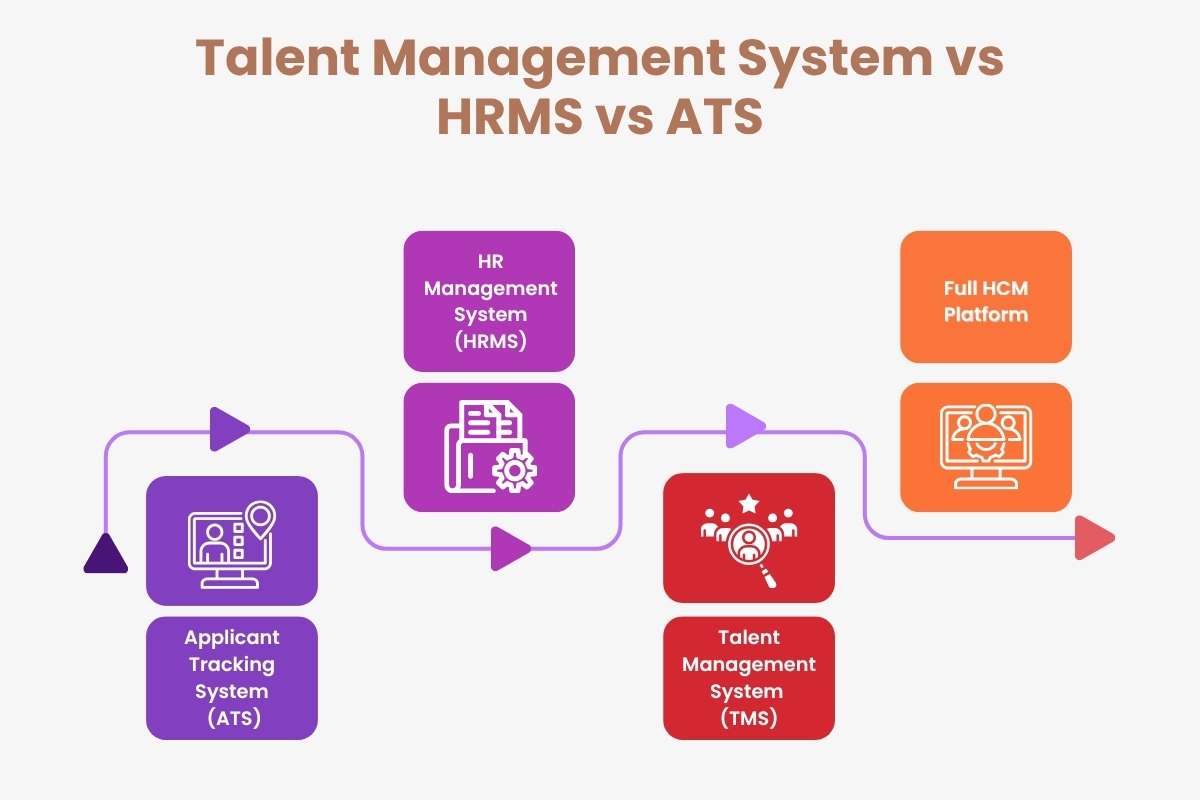
Many organizations choose the wrong HR technology simply because they don’t understand the difference between the tools. The right choice depends on whether your priority is hiring, administrative efficiency, or employee growth. This can save time, reduce costs, and improve adoption.
- Applicant Tracking System (ATS): An ATS focuses on hiring and recruitment. It manages candidates, job postings, and interview workflows, making it ideal for companies looking to scale recruitment efficiently.
- HR Management System (HRMS): An HRMS handles employee data and administrative tasks like payroll, benefits, attendance, and record-keeping. It’s best suited for organizations that want streamlined HR operations and strong compliance.
- Talent Management System (TMS): A TMS emphasizes performance, employee development, and growth. It supports performance reviews, learning programs, and succession planning, helping companies retain and develop talent.
- Full HCM Platform: A full HCM combines ATS, HRMS, and TMS features into one ecosystem. It’s ideal for large enterprises that need a single platform to manage hiring, administrative tasks, and talent development seamlessly.
Also Read: Do Leadership Development Programs Actually Work? The Truth You Need to Know
Future Trends in Workforce and People Management Systems
The next phase of these systems focuses on prediction and not just on tracking.
Modern platforms analyze behavior patterns and flag risks early. For example, they can identify employees who may leave based on engagement signals. Skills are becoming more important than job titles. Companies now track skill development instead of static roles. This allows faster movement within teams.
Internal talent marketplaces are growing. Employees can move across projects within the company instead of looking outside for growth. Continuous feedback is replacing annual reviews. This improves alignment and reduces surprises during evaluations.
Millions of roles are changing, and new ones are emerging. Automation, digitalization, and shifting skills are driving this change. Companies must upskill employees using talent management systems that track and develop skills in real time. Organizations that ignore this risk are falling behind competitors who use data‑driven talent platforms.
Conclusion
Decisions about people are transformed when hiring, performance, and growth are connected into one clear process. This removes guesswork and improves consistency.
The real advantage comes from how the system gets used, not from how many features it offers. Companies that focus on clarity, adoption, and real problems see strong results, while those who chase features often end up with tools that no one trusts. The difference is not in the software itself, but in the approach and in a well-implemented talent management system.
FAQs
Q. Why do most talent management solutions fail after implementation?
They fail because managers do not use them consistently, which leads to poor data and low trust.
Q. When should a company invest in such a system?
When hiring increases, teams grow, and performance tracking becomes difficult to manage manually.
Q. What is the biggest mistake when choosing one?
Focusing on features instead of solving a specific problem leads to poor adoption.
Q. Can this type of system reduce employee attrition?
Yes. It improves visibility into growth and performance, which helps retain employees.
Q. Is it useful for small teams?
It can be useful, but only when processes become complex enough to require structure.