
If you’ve ever stepped onto a lively campus filled with students rushing to lectures, chatting in courtyards, or lining up at cafés, you’ve felt the heart of university life. Now, what if that energy multiplied many times over? The largest universities in the world bring together massive student communities, where learning feels dynamic, diverse, and constantly in motion.
These institutions teach not just thousands, but hundreds of thousands of learners across different programs, campuses, and even countries. Their scale shapes everything: the range of courses, the reach of their research, and the impact they have on society. In this guide, we’ll explore the largest universities by enrollment and see how they manage such huge learning ecosystems while helping students grow, connect, and prepare for global careers.
What Makes a University Large?
Universities can grow to massive scales for many reasons. Understanding these factors helps explain why some institutions become global leaders in higher education.
1. Total Enrollment Size:
A university becomes large when it enrolls huge numbers of full-time, part-time, and distance learners. This metric often decides which institutions join the list of the Largest Universities in the World.
2. Academic Variety:
A wide range of programs helps a university attract more students. When students can choose between science, arts, business, or technical fields, enrollment grows fast.
3. Geographic or Digital Reach:
Many large universities run satellite campuses or strong online platforms. This reach helps them serve students from both cities and rural regions.
4. Public or Government Support:
Funding allows universities to build labs, libraries, and digital learning systems. These improvements make education easier for millions.
The 10 Largest Universities in the World that Shape Modern Education
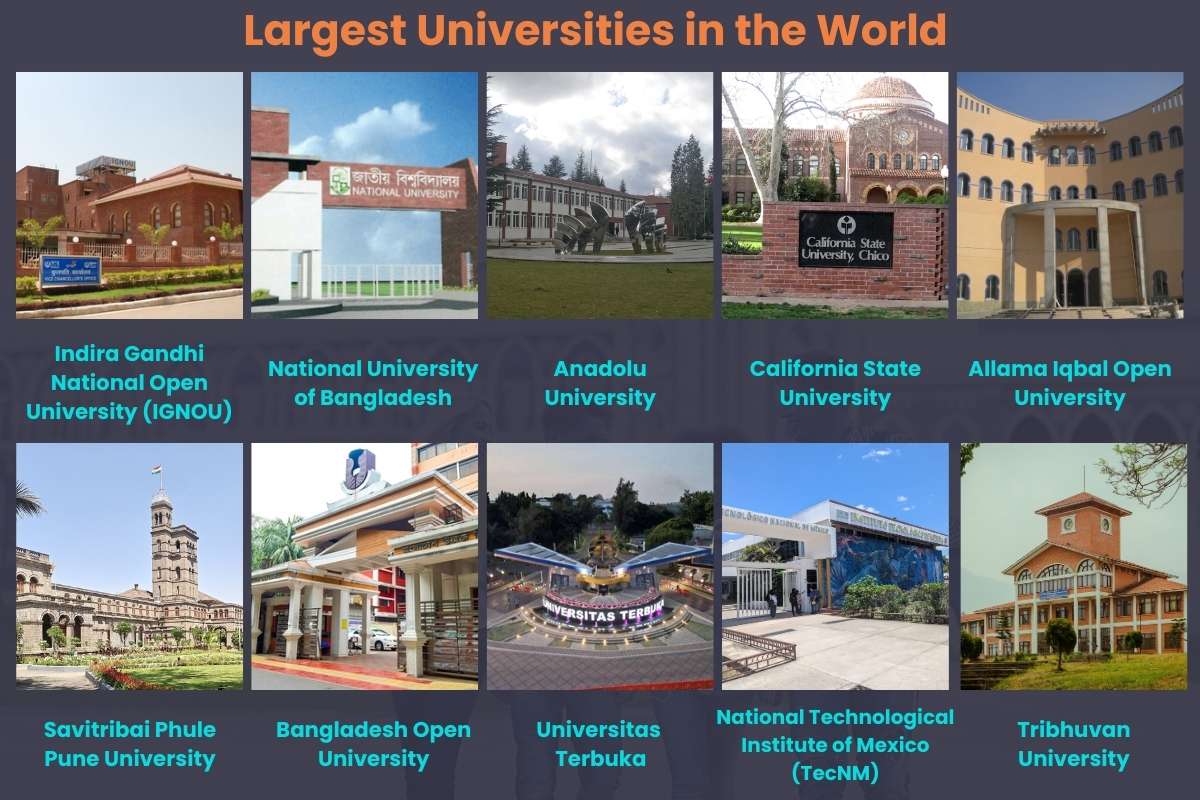
Some universities stand out not just for their history or reputation, but for the sheer number of students they educate. Here are ten of the largest universities in the world, showing how education can reach millions
| Rank | University | Country | Enrollment |
| 1 | Indira Gandhi National Open University (IGNOU) | India | ~7,140,000 |
| 2 | National University of Bangladesh | Bangladesh | ~2,097,182 |
| 3 | Anadolu University | Turkey | ~1,900,000 |
| 4 | California State University | USA | ~1,800,000 |
| 5 | Allama Iqbal Open University | Pakistan | ~1,027,000 |
| 6 | Savitribai Phule Pune University | India | ~665,000 |
| 7 | Bangladesh Open University | Bangladesh | ~650,000 |
| 8 | Universitas Terbuka | Indonesia | ~646,467 |
| 9 | National Technological Institute of Mexico (TecNM) | Mexico | ~620,000 |
| 10 | Tribhuvan University | Nepal | ~604,437 |
1. Indira Gandhi National Open University (IGNOU)

- Country: India
- Enrollment: ~7,140,000 students
IGNOU began in 1985 to bring flexible and affordable learning to the public. Its most popular courses include business, humanities, social sciences, and distance MBA programs. Students choose it because they can learn from any part of India through a wide digital network. This reach helps IGNOU remain one of the Largest Universities in the World. Its study centers also support learners who prefer in-person guidance. Many working adults rely on their schedule freedom to balance jobs and education. The university’s growth shows how distance learning can scale across a large and diverse country.
2. National University of Bangladesh
- Country: Bangladesh
- Enrollment: ~2,097,182 students
This university is popular because it manages many affiliated colleges that serve millions of students. Programs in arts, business, science, and social studies are among its highest enrollments. It was founded in 1992 and grew fast as Bangladesh expanded public higher education. Its broad network keeps it connected to both small towns and big cities. Many students choose it because the admissions process remains accessible for different income groups. Its large teaching network also supports learners who need flexible schedules. The steady rise in enrollment shows how important it is to the country’s education system.
3. Anadolu University,
- Country: Turkey
- Enrollment: ~1,900,000 students
Top courses at Anadolu include economics, media studies, business, and social sciences. The university started its open education model in the 1980s and became a leader in distance learning. Students trust it because its digital systems make learning smooth across Turkey, thereby establishing itself as one of the largest universities in the world. It also invests in new online tools that make lessons easy to follow. Many working adults choose Anadolu because it supports flexible study plans.
4. California State University (CSU) System,

- Country: United States
- Enrollment: ~1,800,000 students
The CSU System began expanding in the late 1800s and now runs many campuses across California. Students choose CSU for its practical teaching style and popular programs in engineering, business, liberal arts, and healthcare. Its long history makes it a trusted system for diverse communities. Its size also places it among the Largest Universities in the World with strong global recognition. Many campuses also partner with local industries to give students real-world experience. The system supports first-generation learners with strong advising and financial aid options. Its wide reach helps students find programs that match their goals and backgrounds.
5. Allama Iqbal Open University
- Country: Pakistan
- Enrollment: ~1,027,000 students
Popular courses at AIOU include Islamic studies, business, education, and Urdu literature. The university started in 1974 and used radio, TV, and printed materials to support distance learners. Students like it because they can study while working or caring for families.
Its flexible model helped it grow into one of Pakistan’s largest education centers. Many of its regional centers also run community workshops that guide new learners. Teachers use simple course structures so students can follow lessons without stress.
Also Read: Top 7 Innovative Classroom Technologies Revolutionizing Education
6. Savitribai Phule Pune University
- Country: India
- Enrollment: ~665,000 students
Savitribai Phule Pune University attracts students with strong programs in science, commerce, engineering, and arts. It began in 1949 and quickly became one of India’s leading universities. Its academic culture mixes old traditions with modern teaching practices.
This balance helps it stay widely respected across the region. The university also supports active research groups that work on real-world problems. Students enjoy a campus that blends green spaces with modern labs. Many learners choose it because it offers steady guidance and clear academic paths.
7. Bangladesh Open University

- Country: Bangladesh
- Enrollment: ~650,000 students
The university was founded in 1992 to bring distance learning to students nationwide. Popular programs include agriculture, business studies, computer science, and education. Students choose it because the flexible schedule supports working adults and rural learners. It is one of the largest universities in the world that follows an open-learning model. It also develops radio and TV lessons that support students with limited internet access. Many of its study centers help learners prepare for exams in a simple and structured way. The university continues to expand its digital tools so students can access lessons with fewer barriers.
8. Universitas Terbuka
- Country: Indonesia
- Enrollment: ~646,467 students
Universitas Terbuka started in 1984 to serve students across Indonesia’s many islands. Many learners choose programs in public administration, education, economics, and science. Its digital systems help students access materials even in remote areas. This mission allows it to grow steadily into a major open university. It focuses on simple course design so learners can follow lessons without advanced technology. Many working adults rely on its flexible system to balance study and daily responsibilities.
9. National Technological Institute of Mexico (TecNM)
- Country: Mexico
- Enrollment: ~620,000 students
TecNM is one of the largest universities in the world that focuses on technology. It is known for strong programs in engineering, applied sciences, and technology. It started in the mid-20th century as a group of technical institutes and later formed a connected network. Students like its hands-on approach to learning and regional campuses. Many of them work closely with local industries, giving students real project experience. The network also supports research in automation, manufacturing, and renewable energy.
10. Tribhuvan University

- Country: Nepal
- Enrollment: ~604,437 students
Tribhuvan University began in 1959 and became Nepal’s first national university. Students study popular subjects like management, humanities, science, and law. Its long history and wide network of affiliated colleges help it serve both urban and rural areas. This reach keeps it one of Nepal’s main academic pillars. Many students appreciate its affordable fee structure, which opens doors for families across the country. Its research centers also support studies related to Nepal’s environment and culture. The university’s influence continues to shape higher education across the region.
Advantages of Learning at the Largest Universities in the World
Learning at a massive university brings opportunities that few smaller institutions can offer. From a vast range of courses, they can give students experience that can shape their future.
1. Wide Access to Many Programs
Large universities offer a huge range of degrees in science, arts, business, and technology. Students can switch paths easily because they have so many choices. This freedom helps learners follow careers they enjoy and opens many job possibilities.
2. Helpful Support Systems
These universities build strong digital libraries, online learning portals, and career centers. Students can access help without long waits, which keeps learning smooth. Clubs, labs, and workshops also create a richer academic life.
3. Diverse Student Communities
Students from many regions and cultures study together at large universities. This mix creates open conversations and shared learning experiences. Working with different viewpoints builds confidence and teamwork skills.
4. Affordable and Flexible Learning
Many of the Largest Universities in the World offer low tuition fees and flexible schedules. Distance-learning systems help students study from home. These options support working adults, young students, and learners from rural areas.
5. Strong Infrastructure and Resources
Large universities often use steady funding to grow research labs, modern classrooms, and digital tools. Students study with updated materials and well-trained teachers. This stability creates a reliable learning environment.
The Future of Enrollment in Universities and Higher Education
Global enrollment is expected to continue rising, especially in regions that expand digital and distance-learning systems. UNESCO reports that there are around 264 million students enrolled in universities around the world. Many of the largest Universities in the world will guide this growth through online innovation and wider access. Students will see more flexible learning paths and new technology-based programs. Governments will also strengthen digital infrastructure to support this demand.
Also Read: The Evolution and Impact of Open Educational Resources
Conclusion:
When you look closely at the largest universities in the world, you see more than big campuses and massive enrollment numbers. You see global learning hubs that bring together students from many backgrounds and give them access to huge academic networks. These institutions help you understand how large-scale education works and why so many learners choose these universities for stability, flexibility, and opportunity.
Whether you want diverse programs, strong alumni connections, or a wide academic reach, these universities show how size can open new doors for growth.
FAQ
1. Are the largest universities always the best?
Not always. A large university offers variety and scale, but the “best” choice depends on your goals, preferred learning style, and desired academic environment.
2. Do large universities provide good job opportunities?
Yes. Their wide networks, industry partnerships, and alumni communities give students access to many career pathways.
3. Which countries have the largest universities in the world?
Countries like India, the United States, Bangladesh, and China often appear on the list because they have large populations and strong distance-learning systems.