

Staring at a blank resume is intimidating when you are still juggling classes and exams. You want to gain experience, but it’s hard to tell which path actually leads to a career. That’s why apprenticeship vs internship means choosing between a quick industry snapshot and a deep dive into a craft.
One option offers a short-term trial of office life, while the other pays you to master a trade. Your choice in the apprenticeship vs internship debate depends on how you prefer to learn. So, which one should you choose?
Let’s find out.
Apprenticeship vs Internship: What are They?
Apprenticeships and internships both provide hands-on work experience, but they differ in duration, structure, and career outcomes. Apprenticeships focus on skilled trades with long-term training, while internships offer shorter exposure, often tied to academic programs. These distinctions help professionals choose based on goals in fields such as business or trades.
Internship: An internship acts like a professional sampler pack for students who want to explore an industry without a long-term commitment. You typically join a company for a few months, often during summer break, to shadow experts and assist with daily tasks. It is a fantastic way to build your network and see if a specific career path feels right for you.
Apprenticeship: An apprenticeship, on the other hand, offers a more direct route into a career by combining paid work with structured, hands-on training. Instead of just observing, you spend years learning a specific trade under the guidance of a master professional. You earn a salary that increases as your skills grow, eventually leading to a recognized qualification.
Apprenticeship vs Internship: Key Differences You Must Know About
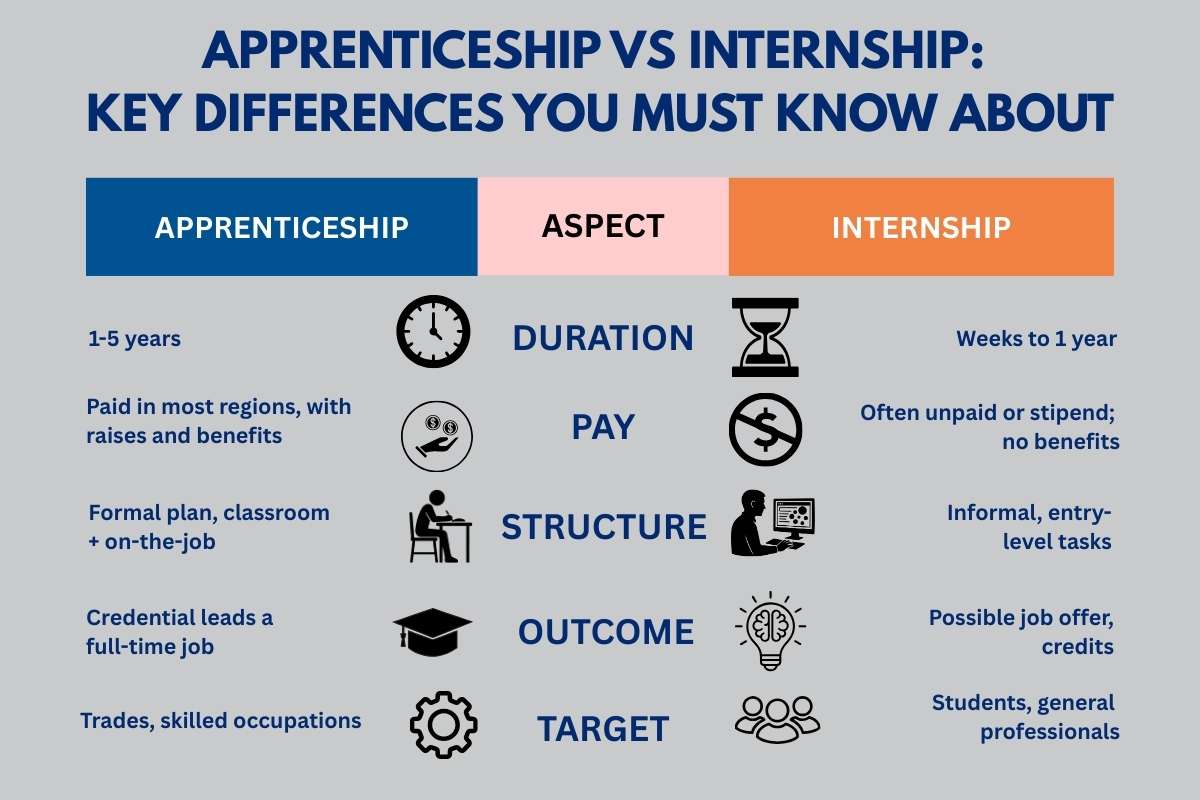
Apprenticeships last 1-5 years with structured on-the-job and classroom training leading to credentials. Internships typically span weeks to 12 months, emphasizing general exposure without guarantee of certification.
Apprentices receive dedicated mentorship from one or two experts, building independence in specific skills. Interns may assist teams broadly, with mentorship varying by employer.
Here’s a simple explanation of the two:
| Apprenticeship | Aspect | Internship |
|---|---|---|
| 1-5 years | Duration | Weeks to 1 year |
| Paid in most regions, with raises and benefits | Pay | Often unpaid or stipend; no benefits |
| Formal plan, classroom + on-the-job | Structure | Informal, entry-level tasks |
| Credential leads a full-time job | Outcome | Possible job offer, credits |
| A credential leads to a full-time job | Target | Students, general professionals |
Benefits of Apprenticeship and Internship
Both paths offer a unique way to bridge the gap between your studies and a full-time career. While they might look similar on paper, the specific perks of an apprenticeship vs internship depend on whether you want a quick test drive of a job or a deep dive into a craft.
Here is a breakdown of all the benefits to help you decide which route fits your current goals:
Benefits of an Internship
- Low Commitment: Most last only a few months, letting you sample an industry without a long-term contract.
- Career Clarity: You can test drive different roles to see what you actually enjoy before graduating.
- Resume Boost: Having a recognizable company name on your CV helps you stand out to future employers.
- Academic Credit: Many universities allow you to swap classroom time for internship hours.
- Networking: You meet mentors and peers who can provide references and job leads later on.
Benefits of an Apprenticeship
- Earn While You Learn: You receive a steady paycheck from day one, often with guaranteed raises as you improve.
- Debt-Free Education: Employers often cover the cost of your formal training or technical certifications.
- Job Security: Most apprentices turn into full-time roles with the same company.
- Career Success: ERIC’s comparative study found cooperative apprenticeship graduates 5.7 times more likely to be in directly-related jobs
- National Credentials: You earn a recognized qualification that proves your skills to any employer in that field.
Also Read: Hard Skills vs Soft Skills: which matters more for Career Growth?
Apprenticeship vs Internship: The Issues

No comparison is perfect without balancing the ups with downs. Now that we know the benefits of both of them, let’s look at their flaws.
When we look at the downsides of the apprenticeship and internship debates, it comes down to the question: What are you willing to trade?
Here are 10 common drawbacks to keep in mind:
The 5 Drawbacks of an Internship That We Rarely Talk About
- Uncertain Pay: A report states that 60.4% paid internships average, while 39.6% remain unpaid or stipend-only.
- Menial Tasks: You might spend more time fetching coffee or filing papers than actually learning the core business.
- Short Duration: Just as you start to understand the job, the internship often ends, leaving you with limited deep knowledge.
- No Guarantee of a Job: Most internships are temporary snapshots and don’t always lead to a permanent role.
- Lack of Benefits: Unlike full employees, interns rarely get health insurance, paid time off, or retirement contributions.
5 Drawbacks of an Apprenticeship That Every Student Must Know
- Heavy Workload: Juggling full-time work with required evening or weekend classes can lead to serious burnout.
- Long-Term Lock-in: When you commit to a field for several years, it becomes difficult to leave if you realize early on that you hate it.
- Lower Initial Salary: While you receive payment, your starting wage is usually lower than that of a fully qualified professional.
- Missed Campus Life: Since you are working full-time, you might miss out on the traditional university social experience.
- Narrow Specialization: You become an expert in one specific trade, which makes it trickier to switch to a completely different industry later.
Apprenticeship vs Internship: When to Choose and Why?

Choosing between these two paths depends entirely on your personality and how soon you want to commit to a specific career. When you look at both of them, you are really choosing between exploring the horizon or building a foundation.
Choose an Internship If:
- You are undecided: You want to test out different company cultures or industries before committing to a major.
- You need flexibility: You want a role that fits into a three-month summer break so you can return to school in the fall.
- You want a big-name brand: You aim to get a famous company on your resume to help you apply for competitive jobs later.
- You are early in your studies: You have a few years of school left and just want to see what a professional office feels like.
- You prioritize networking: Your main goal is to meet as many people as possible in a short amount of time.
Choose an Apprenticeship If:
- You know your craft: You have a specific trade or technical skill in mind and want to start mastering it right now.
- You need to earn money: You want a guaranteed, rising salary while you learn, rather than hoping for a paid internship.
- You want job security: You prefer a clear, multi-year path that statistically leads directly to a permanent position (remember that 5.7x higher success rate).
- You learn by doing: You find sitting in a classroom frustrating and prefer to gain knowledge through hands-on, daily repetition.
- You want to avoid debt: You want your training and certifications paid for by an employer instead of taking out student loans.
When to Make the Move
- Internship Timing: Best during your sophomore or junior year of college, or the summer before your final year of high school.
- Apprenticeship Timing: Best when you are ready to enter the workforce full-time, often right after high school or if you are looking to pivot careers entirely.
Here’s a clearer table for you to understand what your situation is and what you should pick:
| Your Situation | Pick Internship | Pick Apprenticeship |
| Undecided major | Test multiple roles | |
| Need income now | Paid from day 1 | |
| Trade-focused | Credentials + job | |
| School priority | Summer flexible |
Apprenticeship vs Internship: The Top Sites to Help You
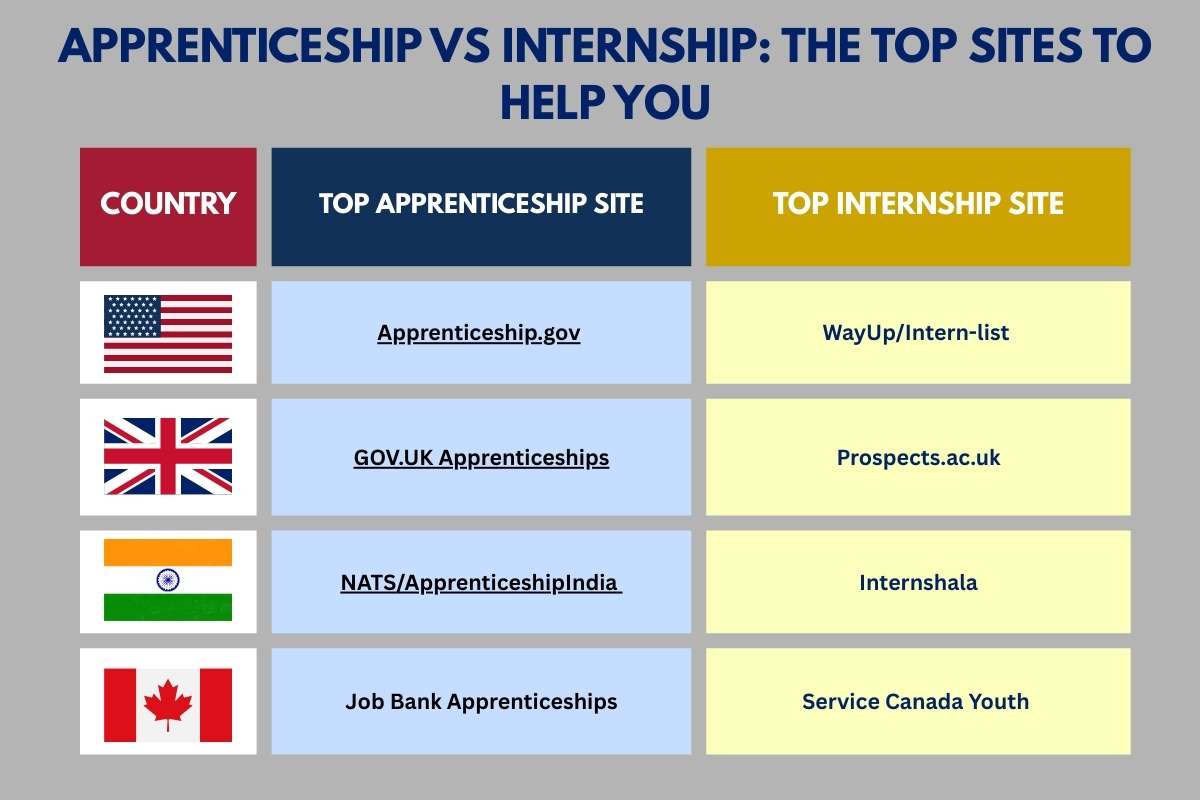
Here are some sites that can help you land an apprenticeship and an internship.
| Country | Top Apprenticeship Site | Top Internship Site |
|---|---|---|
| US | Apprenticeship.gov | WayUp/Intern-list |
| UK | GOV.UK Apprenticeships | Prospects.ac.uk |
| India | NATS/ApprenticeshipIndia | Internshala |
| Canada | Job Bank Apprenticeships | Service Canada Youth |
Conclusion:
Your first career step doesn’t have to feel like a permanent life sentence. Regardless of what you choose, you are simply gathering tools to build your future. Your decision in the apprenticeship vs internship debate depends on your own pace and how you prefer to learn.
Ultimately, your career is a marathon, and every experience adds a new layer to your story. Weighing the apprenticeship vs internship is about more than just a paycheck; it is about finding your place. Trust your gut and choose the path that makes you feel confident.
Also Read: Looking for Research Opportunities? These are the 10 Top Public Research Universities that Deliver
FAQs
1. Is an apprenticeship better than an internship?
It depends on your goals. An apprenticeship is better for long-term job security and mastering a specific trade while earning a salary. An internship is superior if you want to explore different industries quickly without committing to one career path immediately.
2. Do apprenticeships and internships pay the same?
Generally, no. Apprenticeships almost always provide a guaranteed, increasing wage as you learn. Internships vary widely; many are unpaid or offer a one-time stipend. If a steady paycheck is your priority, the apprenticeship vs internship choice usually favors the apprenticeship.
3. Which one looks better on a resume?
Both are valuable, but they tell different stories. An internship shows you have broad exposure to professional environments. An apprenticeship proves you have deep, specialized expertise. Your choice in the apprenticeship vs internship battle depends on the specific job you want later.