

Take a deep breath. You do not have to figure out your whole life today. But choosing a college major is still a big step. It can shape the kind of work you do, the money you earn, and the lifestyle you build. That is why this decision feels heavy for many students.
The world around us is changing fast. New jobs are rising. Old jobs are fading. Some careers that were strong ten years ago are shrinking now. At the same time, new fields in tech, health, and energy are growing every year. Because of this shift, many students search for useful degrees before they decide.
But what makes a degree useful?
Is it high pay?
Is it job security?
Is it global demand?
Or is it future growth?
The truth is, it is often a mix of all these things. A useful degree should open doors. It should give you skills that employers need. It should also give you room to grow as the job market changes.
In this guide, we break down the most useful degrees for 2026 based on real data, hiring trends, and global needs. We look at salary, job growth, and long-term value. If you want a degree that gives you strong career options and a steady income, this list will help you think clearly and choose with confidence.
How We Chose the Most Useful Degrees?
Most blogs simply list popular majors. We did more.
There are many articles about useful degrees. Some focus only on salary. Others only talk about trends. But a high salary alone does not make a degree useful. Popularity alone does not either.
We selected useful degrees using clear and practical factors. We looked at:
- Strong job demand in 2026
- High median salary
- Global career options
- Future growth potential
- Skills that transfer across industries
We reviewed official job growth data from the Bureau of Labor Statistics to see which careers are expanding in 2026. Then we looked at long-term growth. Some jobs pay well today but may shrink in the future. We avoided those.
We also looked at skills. Useful degrees teach skills you can use in many roles. For example, problem-solving, data analysis, leadership, and technical skills can move across industries. That gives you safety if the market changes.
Finally, we considered global value. A degree that works in many countries gives you more freedom.
This means these degrees are not just popular today. They are built for long-term value and real career strength.
15 Degrees That Offer Strong Pay and Job Demand in 2026
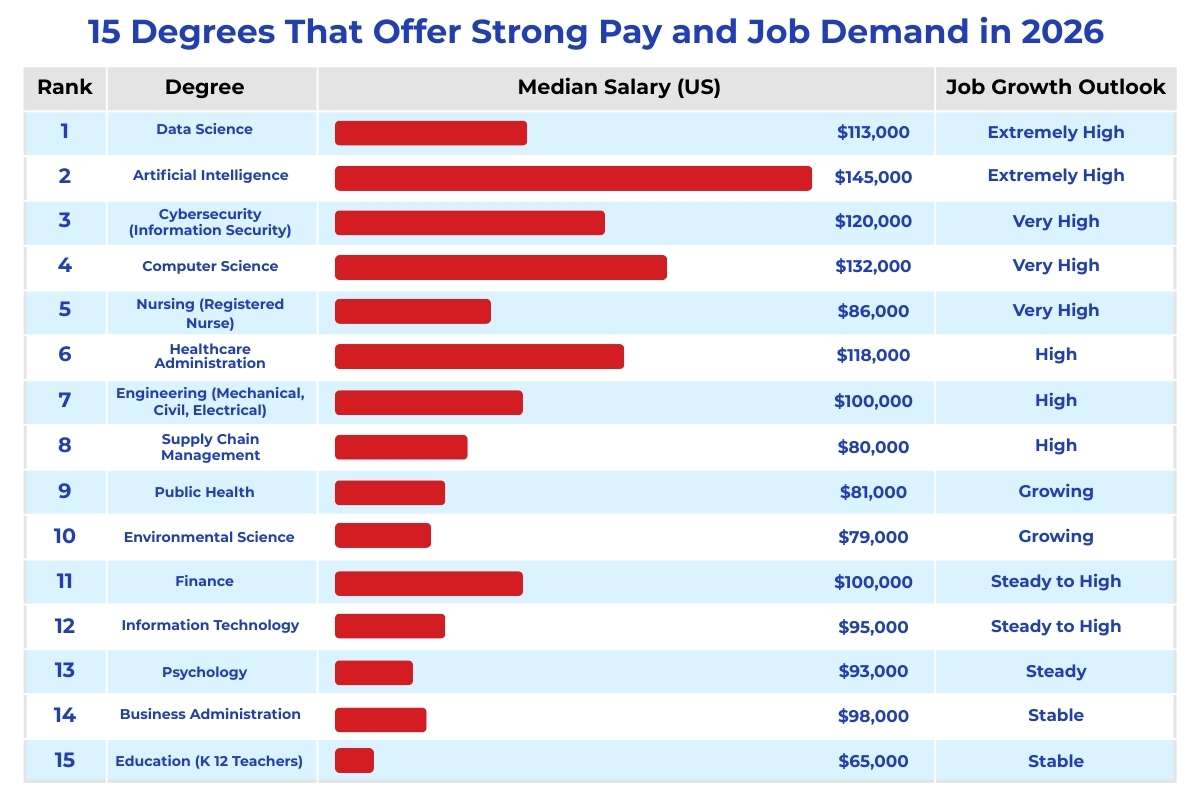
This list is ranked by projected job growth, with the fastest-growing careers placed at the top. We used official labor data to compare growth rates and median salaries.
We also looked at long-term demand, global relevance, and how flexible the skills are across industries. Each degree was chosen based on real hiring trends, not just popularity.
| Rank | Degree | Median Salary (US) | Job Growth Outlook | Main Industries |
| 1 | Data Science | $113,000 | Extremely High | Tech, Finance |
| 2 | Artificial Intelligence | $145,000 | Extremely High | Tech, AI Research |
| 3 | Cybersecurity (Information Security) | $120,000 | Very High | IT, Defense |
| 4 | Computer Science | $132,000 | Very High | Tech, Software |
| 5 | Nursing (Registered Nurse) | $86,000 | Very High | Healthcare |
| 6 | Healthcare Administration | $118,000 | High | Hospitals, Health Systems |
| 7 | Engineering (Mechanical, Civil, Electrical) | $100,000 | High | Manufacturing, Energy |
| 8 | Supply Chain Management | $80,000 | High | Logistics, Global Trade |
| 9 | Public Health | $81,000 | Growing | Government, Healthcare |
| 10 | Environmental Science | $79,000 | Growing | Sustainability, Energy |
| 11 | Finance | $100,000 | Steady to High | Banking, Investment |
| 12 | Information Technology | $95,000 | Steady to High | IT Services |
| 13 | Psychology | $93,000 | Steady | Healthcare, Corporate |
| 14 | Business Administration | $98,000 | Stable | Corporate, Startups |
| 15 | Education (K 12 Teachers) | $65,000 | Stable | Schools |
1. Data Science

Median Salary: ~$113,000
Data helps companies make better choices. Businesses collect large amounts of data every day from apps, websites, and devices. In this degree, students study statistics, coding, databases, and machine learning. Many universities offer it as a bachelor’s or master’s program, and some schools also offer strong online options. It is important because almost every industry now depends on data to plan, sell, and grow.
Jobs You Can Get:
- Data Scientist
- Data Analyst
- Machine Learning Engineer
- Business Intelligence Analyst
2. Artificial Intelligence

Median Salary: ~$145,000
Artificial intelligence is growing fast across many industries. Students in this field learn programming, algorithms, robotics, and deep learning. It is often offered as a specialization within computer science or as a separate master’s degree. AI is important because it powers chat tools, medical imaging systems, fraud detection, and smart automation.
Jobs You Can Get:
- AI Engineer
- Machine Learning Engineer
- AI Researcher
- AI Product Manager
3. Cybersecurity

Median Salary: ~$120,000
Online threats are rising each year. This degree teaches network security, ethical hacking, digital forensics, and risk management. Many colleges offer it as a bachelor’s degree, and there are also strong certification paths. It matters because banks, hospitals, and governments must protect sensitive data every day.
Jobs You Can Get:
- Information Security Analyst
- Security Engineer
- Ethical Hacker
- IT Security Consultant
4. Computer Science

Median Salary: ~$132,000
Software runs almost everything today. Students study programming, operating systems, data structures, and cloud computing. This degree is widely offered at universities across the world and also online. It is important because businesses rely on software for daily operations and digital services.
Jobs You Can Get:
- Software Developer
- Systems Engineer
- Cloud Engineer
- Application Developer
5. Nursing

Median Salary: ~$86,000
Healthcare needs are rising as people live longer. Nursing programs include classroom learning and clinical training in hospitals. Students study anatomy, patient care, and medical ethics. This degree is offered at universities and specialized nursing schools. It is important because nurses are the backbone of patient care.
Jobs You Can Get:
- Registered Nurse
- ICU Nurse
- Nurse Practitioner
- Public Health Nurse
You may also like: Think Twice Before Choosing Most Useless Degrees.
6. Healthcare Administration

Median Salary: ~$118,000
Hospitals and clinics need skilled managers. This degree combines healthcare systems, finance, and leadership training. It is often offered as a bachelor’s or MBA-style master’s program. It is important because large health systems require strong planning, budgeting, and staff coordination.
Jobs You Can Get:
- Medical and Health Services Manager
- Hospital Administrator
- Clinic Director
- Health Program Manager
7. Engineering (Mechanical, Civil, Electrical)

Median Salary: ~$100,000
Engineers design and improve machines, roads, bridges, and power systems. Students take math, physics, design, and technical lab courses. Engineering programs are common at major universities and technical institutes. This degree is important because infrastructure and manufacturing depend on skilled engineers.
Jobs You Can Get:
- Mechanical Engineer
- Civil Engineer
- Electrical Engineer
- Project Engineer
8. Supply Chain Management

Median Salary: ~$80,000
Products must move smoothly from the factory to the customer. Students study logistics, operations, global trade, and inventory systems. Many business schools now grant this as a specialized degree. It is important because companies must avoid delays and manage costs in global markets.
Jobs You Can Get:
- Logistics Manager
- Supply Chain Analyst
- Procurement Manager
- Operations Manager
9. Public Health

Median Salary: ~$81,000
Public health focuses on protecting entire communities. Students learn about disease control, health policy, statistics, and prevention programs. Many universities provide this as a bachelor’s or master’s degree. It is important because strong public health systems reduce disease spread and improve the quality of life.
Jobs You Can Get:
- Epidemiologist
- Public Health Analyst
- Community Health Manager
- Health Policy Advisor
10. Environmental Science

Median Salary: ~$79,000
Climate and energy issues are growing concerns. This degree covers ecology, climate science, environmental law, and sustainability practices. It is offered by science departments at many universities. It is important because governments and companies are working toward cleaner energy and reduced pollution.
Jobs You Can Get:
- Environmental Scientist
- Sustainability Specialist
- Environmental Consultant
- Climate Policy Analyst
11. Finance

Median Salary: ~$100,000
Finance focuses on money management and investment planning. Students study accounting, economics, risk analysis, and financial markets. Business schools widely offer this degree. It is important because companies and individuals need smart financial planning to grow and stay stable.
Jobs You Can Get:
- Financial Analyst
- Investment Analyst
- Risk Manager
- Portfolio Manager
12. Information Technology

Median Salary: ~$95,000
IT keeps computer systems running. Students learn about networks, databases, cybersecurity basics, and system support. Many colleges offer this degree, and it is also available online. It is important because every business depends on reliable technology systems.
Jobs You Can Get:
- IT Manager
- Systems Administrator
- Network Engineer
- IT Support Specialist
13. Psychology

Median Salary: ~$93,000 (varies by role)
Psychology studies how people think and behave. Students learn research methods, counseling basics, and human development. It is offered widely at universities and often leads to advanced study for clinical roles. It is important because mental health and workplace behavior affect every part of society.
Jobs You Can Get:
- Clinical Psychologist
- HR Specialist
- Behavioral Analyst
- School Counselor
14. Business Administration

Median Salary: ~$98,000
Business administration teaches leadership, strategy, marketing, and operations. It is one of the most widely offered degrees everywhere. Many schools also offer online MBA programs for advanced study. It is important because strong management helps companies grow and adapt.
Jobs You Can Get:
- Operations Manager
- Marketing Manager
- HR Manager
- Business Consultant
15. Education

Median Salary: ~$65,000
Education prepares teachers and school leaders. Students study teaching methods, subject content, and child development. Programs include classroom training and supervised teaching practice. It is important because schools shape future generations and support community growth.
Jobs You Can Get:
- Teacher
- Academic Counselor
- School Administrator
- Instructional Coordinator
Smart Extra Degrees for Career Advancement
Not all useful degrees require a traditional four-year campus path. Many strong careers now deliver flexible ways to study. You can learn online, part-time, or through short-term programs. This makes education more accessible and often more affordable.
Below is a simple comparison of flexible study options in high-demand fields.
| Program Type | Field | Typical Duration | What You Earn | Common Career Paths |
| Online Bachelor’s Degree | Data Analytics | 3 to 4 years | Bachelor’s Degree | Data Analyst, Business Analyst |
| Professional Certification | Cybersecurity | 3 to 12 months | Industry Certificate | Security Analyst, IT Security Specialist |
| Online MBA | Business Administration | 1 to 2 years | Master of Business Administration | Manager, Consultant, Operations Lead |
| Bootcamp | UX or UI Design | 3 to 6 months | Certificate of Completion | UX Designer, Product Designer |
| Online Degree or Certification | Digital Marketing | 6 months to 3 years | Degree or Certificate | Digital Marketer, SEO Specialist, Marketing Analyst |
These flexible paths can support some of the most useful degrees without requiring a full-time campus schedule. They work well for working adults, career changers, or students who want a faster route into growing fields.
While traditional degrees still hold strong value, flexible programs are becoming a smart option in 2026.
You may also like: Are You Choosing the Wrong Degree? Undergraduate vs Graduate Degrees Explained
How to Choose the Most Useful Degree for You?
A degree is only useful if it fits you. What works well for someone else may not work for you. A useful degree is not just about money or trends. It should match your strengths, your interests, and your goals.
Before you decide, take a moment to think clearly.
Ask yourself:
- Do I enjoy this field?
- Is the job demand strong?
- Does it offer good salary growth?
- Can I adapt this skill in the future?
If you do not enjoy the subject, it will be hard to stay motivated. If the field has weak demand, jobs may be harder to find. If salary growth is limited, your long-term earning power may stay flat. And if the skills are too narrow, you may struggle if the market changes.
The most useful degrees usually combine three things. They match your interests. They provide consistent cash flow, and they create real opportunities for growth. When those three align, you are more likely to build a stable and rewarding career.
Conclusion
The job market keeps changing. New tools appear. New skills become important. Some roles grow fast, while others slow down. But certain fields continue to expand year after year.
Healthcare, technology, data, business, and sustainability remain strong across many countries.
In this guide, we looked at job growth, median salary, and long-term demand. We compared fast-growing careers with stable ones. We also explored flexible programs that can add extra value to your education. Each section focused on practical outcomes, not trends alone. The goal was to highlight degrees that offer real opportunities in 2026.
These degrees are not just popular for a short time. They solve real problems in the world. They provide a regular yield over time. They are needed across many regions. And they prepare graduates for change instead of locking them into one narrow path.
At the same time, usefulness depends on the person. A degree only works well if it matches your interests and strengths. High pay means little if you dislike the daily work. Strong growth matters, but so does long-term fit.
Choosing carefully today can shape your next twenty years. The most useful degrees listed in this guide present solid demand, steady earning potential, and room to grow in a changing world.
FAQs
1. Are STEM degrees the most useful?
STEM degrees often rank highly because they connect to fast-growing fields like technology, engineering, and data.
2. Do useful degrees always pay the most?
Not always. Some useful degrees focus more on job stability and long-term demand rather than the highest salaries.
3. Can online degrees still be useful?
Yes. Accredited online degrees can provide the same skills and career opportunities as traditional programs.
4. What should students consider before choosing a degree?
Students should look at job demand, salary potential, career growth, and whether the field matches their interests