
Key Takeaways
- Indonesia’s court ordered the Indonesia free meals program to be funded separately from the education budget by 2028.
- Judges said the nutrition program deserves its own dedicated state budget allocation.
- The ruling adds pressure on President Prabowo’s flagship free meals program.
Indonesia’s Constitutional Court ruled Thursday that the government must stop using education funds to finance its free meals program by 2028, saying the initiative requires a separate budget despite its role in improving student nutrition.
Court Orders Separate Funding for Free Meals
Indonesia’s top constitutional court ruled that the Indonesia free meals program can no longer be financed through the national education budget beginning in 2028. The judges also recommended that the separation be implemented as early as 2027, ahead of the presentation of the country’s 2027 state budget next month.
The decision follows petitions filed by students and educators challenging the 2026 state budget law. They argued that classifying the free meals initiative as an educational provision diverted money intended for schools and operational education spending.
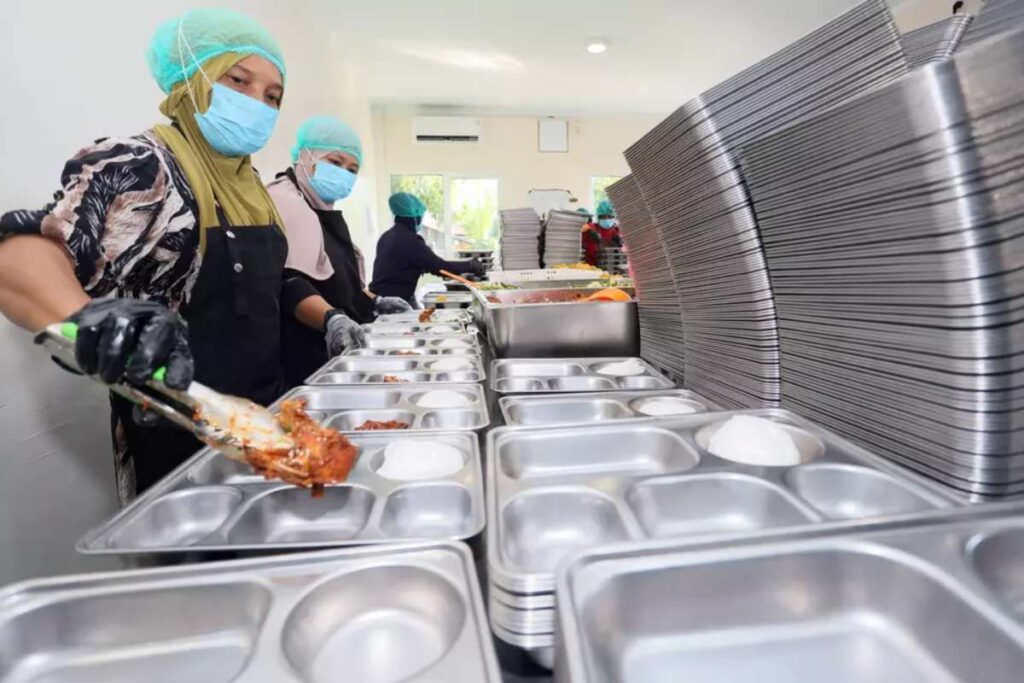
The government launched the Indonesia free meals program in 2025 to provide nutritious meals to 83 million schoolchildren and expectant mothers. The initiative aims to reduce undernutrition and stunting across Indonesia, an archipelago with a population of about 280 million people.
Chief Justice Suhartoyo said the meals program should have its own allocation within the state budget instead of relying on education funding.
Judges Cite Budget Balance as Key Concern
Indonesia’s Finance Ministry allocated 769 trillion rupiah for education in the 2026 budget, including 223 trillion rupiah to support the Indonesia free meals program.
Government officials argued during court proceedings that nutrition is an essential part of the education process and justified including the program within education spending.
However, educators testified that the funding arrangement had negative consequences for schools. History teacher Iman Zanatul Haeri told the court that the program coincided with teacher contract terminations and salary reductions.
“The free meals program is a real solution” to address stunting, the judges said, adding that it deserves its own dedicated funding.
Judge M. Guntur Hamzah said, “Adding nutritious meals as one of the education provisions … creates imbalances in the proportionality of the education budget.”
Indonesia’s Finance Ministry declined to comment after the court’s ruling on the Indonesia free meals program.
Program Faces Mounting Political and Public Pressure
The court’s decision adds to a series of setbacks for President Prabowo Subianto’s flagship campaign promise.
The agency overseeing the free meals program has undergone two leadership changes in recent weeks. Authorities also arrested the agency’s chief last month over corruption allegations linked to the program.
The government has already reduced the Indonesia free meals program budget for the 2026 budget twice and has indicated that additional spending cuts remain possible as officials seek to manage rising fiscal pressures.
The large scale of the initiative and the logistical challenge of distributing meals across thousands of islands have fueled concerns that the program could increase Indonesia’s fiscal deficit.
Public support for the Indonesia free meals program has also weakened. According to an independent survey conducted in July, 33.8% of respondents said they were satisfied with the free meals program, down about 30 percentage points from November last year.
The Constitutional Court’s ruling is expected to shape future budget planning while allowing the government to continue the nutrition initiative under a separate funding structure.
Visit Future Education Magazine to read more.