

Studying for several hours can feel hard, even when you have enough time. After a while, your mind may wander, your phone starts to look tempting, and the same page seems harder to understand.
The goal is not to sit at a desk for 10 hours without moving. Good study sessions include focus, short breaks, active learning, and enough rest. Learning how to study for long hours is really about building the stamina to stay focused while using your time well.
With the right plan, you can study longer without feeling like every minute is a struggle. This article offers 10 practical ways to study better and fast learning techniques. Let’s get started.
What is the Real Meaning of ‘How to Study for Long Hours’?
Studying for long hours does not mean forcing yourself to work without breaks. It means spending several planned hours on useful learning while maintaining focus and energy. In fact, 90 minutes should be the focus limit. This is because your brain runs on 90-minute cycles called ultradian rhythms.
A four-hour study period could look like this:
| Time | Activity |
| 9:00–9:50 | Read and understand a topic |
| 9:50–10:00 | Short break |
| 10:00–10:50 | Practice questions |
| 10:50–11:10 | Longer break |
| 11:10–12:00 | Review notes and recall key ideas |
| 12:00–12:10 | Short break |
| 12:10–1:00 | Solve problems or take a practice test |
This approach is more useful than staring at a book for four hours and remembering very little. The quality of your study time matters as much as the number of hours.
How to Study for Long Hours Without Burning Out?

Studying for long hours starts with making long sessions easier to manage. Instead of thinking about the full day, break your work into smaller blocks.
1. Set a Clear Study Goal
Do not start with a vague plan such as “study biology.”
Choose a result you can finish and check. For example:
- Read pages 40–55 and write five key points.
- Solve 20 algebra questions.
- Learn 30 new terms.
- Review one chapter and complete a quiz.
Clear goals make it easier to know what to do next.
2. Use Focused Study Blocks
Try studying for 45–60 minutes, then take a 5–15 minute break. During the study block, focus on one task only.
As your focus improves, you may be able to work for longer blocks. If you are wondering how to study for long hours without losing focus, start by extending your study blocks gradually instead of trying to work for several hours at once.
3. Remove Easy Distractions
A study plan will fail if your phone keeps pulling your attention away.
Before you begin:
- Put your phone in another room or use focus mode.
- Close social media tabs.
- Keep only the study materials you need nearby.
- Tell people around you when you need quiet time.
Even small distractions can make it harder to return to deep focus.
Also Read: Feeling Overwhelmed by Academic Deadlines? Stay Organized With These 10 Study Planning Apps
4. Study at Your Best Time of Day
Some people focus better in the morning. Others work better in the afternoon or evening.
Track your energy for a few days. Notice when you feel most alert and place your hardest subjects in that time. Use lower-energy periods for simple tasks such as reviewing flashcards, organizing notes, or checking mistakes.
5. Plan Breaks Before You Need Them
Breaks are part of a long study session, not a sign that you are being lazy.
During a break, get up, stretch, drink water, or walk for a few minutes. Try not to turn a 10-minute break into 45 minutes of scrolling. A timer can help you return to your work on time.
6. Keep Your Study Space Ready
Your desk should make studying easy to start. Keep your books, charger, water, pens, and other needed tools nearby. Remove clutter that does not help with the task.
The answer to how to study for long hours is often a simple setup that cuts down on small choices that waste your time.
7. Use Small Rewards
Give yourself something simple to look forward to after finishing a study block. Rewards can make long study periods feel less difficult.
For example, after two focused blocks, you could:
- Have a snack.
- Listen to a few songs.
- Take a short walk.
- Chat with a friend.
8. Protect Your Sleep
Knowing how to study for long hours also means knowing when to stop and rest. Your brain needs rest to support memory, attention, and problem-solving. A better plan is to sleep enough and use your waking hours well.
Supporting Research: A meta-analysis of 39 studies found that sleeping for 3–6.5 hours negatively affected memory formation compared with getting 7–11 hours of sleep.
9. Change Subjects When Focus Drops
Studying one hard subject for six hours can become mentally tiring. Try switching between subjects. For example, study math first, then history, followed by language practice.
A change in task can help you reset your attention while keeping your study day productive.
10. Track Your Progress
At the end of the day, write down what you completed.
Do not focus only on hours. Track useful results too, such as chapters reviewed, questions solved, or topics mastered. This helps you see whether your study method is working.
Also Read: 9 Best AI Tools for Students to Study Smarter, Not Harder
How Can You Build the Habit of Studying for Long Hours?

Learning how to study for long hours is easier when you treat it as a habit rather than a one-day challenge.
Start with a study period you can handle without major stress. For example, begin with two focused hours a day. After several days, add another 20–30 minutes if your focus remains strong.
Keep the same study start time when possible. A routine teaches your brain when it is time to work. The key is consistency. Studying for three hours each day is more useful than studying for eight hours once a week and then losing the habit.
“You should probably go slower than you think. Do things you can sustain.” – James Clear, author of Atomic Habits
Which Study Techniques Help You Learn More in Less Time?
Long study hours are only useful when the work helps you remember and understand the material. These techniques can make your sessions more effective.
Active Recall:
Close your book and try to explain what you just learned. Write down the main ideas from memory, then check what you missed. This forces your brain to retrieve information instead of simply looking at it.
Spaced Repetition:
Review information several times over days or weeks instead of trying to learn everything in one sitting. For example, review new terms today, again in two days, and then again the following week.
Practice Testing:
Use quizzes, past papers, and practice questions to test your knowledge. Practice tests can also show which topics still need work. Research by psychologists Henry Roediger and Jeffrey Karpicke found that practice testing improved long-term retention more than repeated studying, especially when students were tested 2 days and a week later.
The Feynman Technique:
Explain a difficult idea in simple words, as though you were teaching it to a younger student. When you get stuck or use unclear language, you have found a gap in your understanding.
The Blurting Method:
Read a section, close your notes, and write everything you remember. Then compare your answer with the original material. This works well for subjects that require facts, steps, or key concepts.
Here’s a quick comparison of these techniques:
| Technique | Best for | How to use it |
| Active recall | Facts and concepts | Answer from memory |
| Spaced repetition | Long-term memory | Review at set intervals |
| Practice testing | Exams | Solve questions without notes |
| Feynman technique | Hard concepts | Explain in simple words |
| Blurting | Recall-heavy subjects | Write what you remember |
Using these methods can help you get more from each hour, making how to study for long hours less about sitting longer and more about learning better.
Why Is It So Difficult to Study for Long Hours?
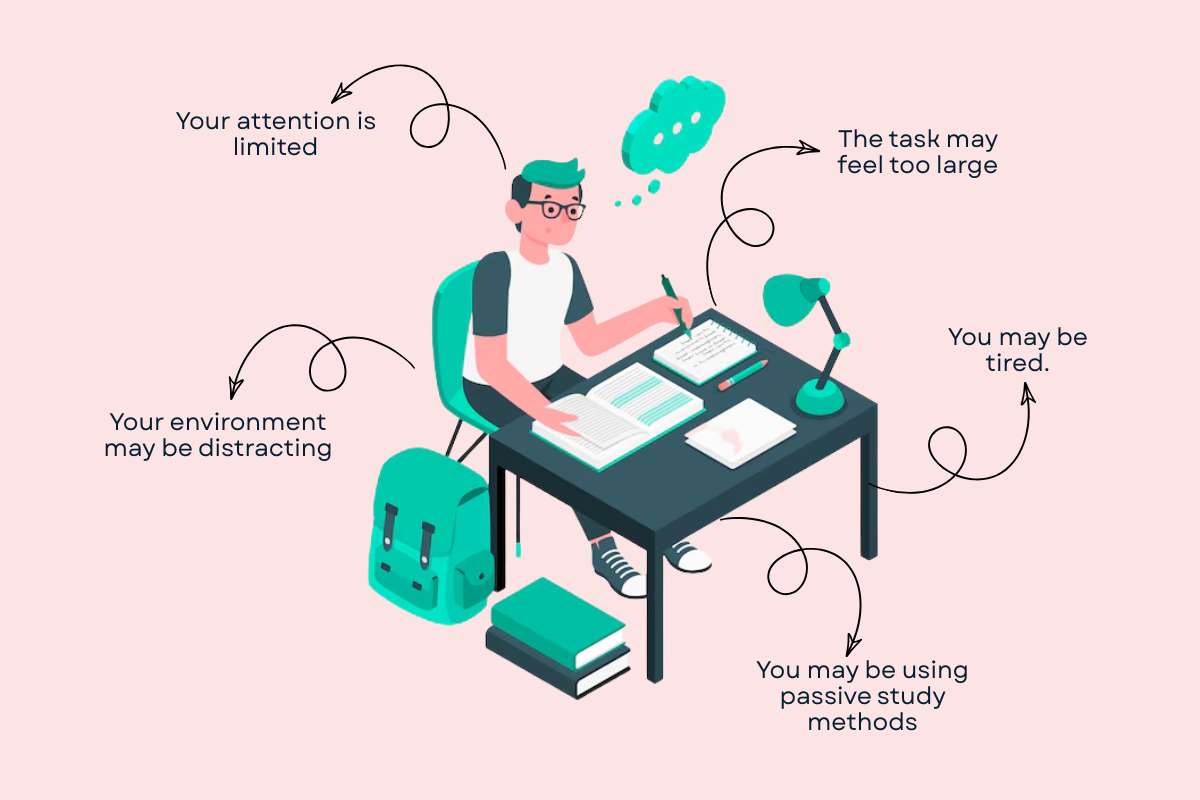
There are several reasons long study sessions can feel difficult.
- Your attention is limited. Even when you want to focus, your mind can drift, especially during boring or complex tasks.
- The task may feel too large. Looking at an entire textbook or exam syllabus can create stress. Breaking the work into small goals makes it easier to start.
- You may be tired. Lack of sleep, poor meals, too little movement, or long screen use can affect your energy.
- You may be using passive study methods. Reading the same notes again and again can feel productive without giving your brain enough work to do.
- Your environment may be distracting. Noise, notifications, social media, and constant interruptions can quickly break your focus.
Expert Insight: Gloria Mark, a researcher of attention and digital distraction, has found that people frequently switch between tasks during work. Interruptions can make it harder to regain focus. This helps explain why studying continuously for long periods can feel difficult, even when you are motivated.
The solution is not always to force yourself harder. Sometimes the better choice is to improve the task, study space, break plan, or sleep routine.
The Key Takeaway
The best approach for how to study for long hours is to focus on steady, useful work rather than a high hour count.
Set clear goals before each session. Work in focused blocks. Take planned breaks. Use active recall and practice questions instead of only rereading. Protect your sleep and slowly build your study stamina.
Long study sessions should support learning, not leave you too tired to continue the next day. Once you create a routine that fits your energy and workload, studying for several hours becomes much more manageable.
FAQs
1. How can I focus 100% on studying?
Eliminate all digital distractions and work in short, single-task sessions with clear, specific goals.
2. What is the 7-8-9 rule for studying?
It recommends 7 hours of study, 8 hours of sleep, and 9 hours for personal well-being daily to prevent burnout.
3. How to avoid being lazy while studying?
Use the 5-minute rule to build immediate momentum and keep your workspace clean and prepped.
4. How to study for long hours without getting tired?
Pace yourself with timed study blocks, take active breaks, and switch subjects when your focus drops.
5. How many hours are perfect for studying?
For most students, 4 to 6 hours of deep, well-spaced study per day is optimal.