
Key Points:
- AI training for teachers helps educators use AI for lessons and grading.
- Training emphasizes responsible AI use and classroom safety.
- AI boosts student engagement and personalized learning.
On a sweltering Saturday in late September, dozens of teachers in San Antonio spent their day learning how to bring artificial intelligence (AI) into their classrooms through AI training for teachers programs. The workshop, hosted by the American Federation of Teachers (AFT) and funded by major technology companies, marks a growing effort to help educators integrate AI tools into everyday teaching.
Training Teachers for the AI Era
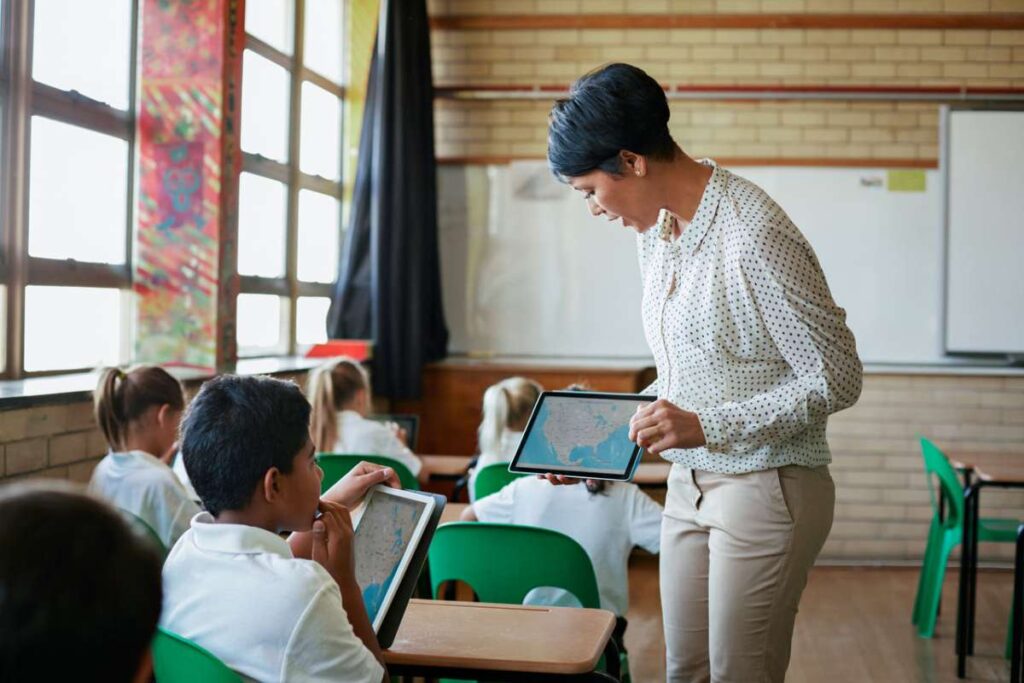
At the event, teachers explored how AI could simplify lesson planning, grade assignments, and create engaging learning materials. Participants used tools such as ChatGPT, Microsoft CoPilot, Google Gemini, and AI platforms built for schools like Khanmingo and Colorín Colorado.
For many, the results were eye-opening. One teacher used AI to instantly generate illustrated flashcards for bilingual lessons, while another created custom storybooks featuring students’ names as characters.
“It can save you so much time,” said Gabriela Aguirre, a first-grade dual-language teacher. “If you can find ways to engage kids with new technology, you’ve just got to do that.”
Unions and Tech Companies Partner for AI Education
To prepare educators nationwide, Microsoft, OpenAI, and Anthropic have pledged millions of dollars to the AFT for AI training for teachers programs. Under the five-year agreement announced in July, Microsoft will provide $12.5 million, OpenAI will contribute $8 million plus $2 million in technical support, and Anthropic will add $500,000.
The funding will support an AI training hub in New York City, with plans to open more centers across the country. The AFT aims to train 400,000 teachers within five years through a mix of virtual and in-person sessions.
AFT President Randi Weingarten said the union sought to ensure that educators—not private funders—design the training content. “We wanted an approach that allows any company’s tools to be demonstrated, but the focus remains on teaching and safety through proper AI training for teachers,” she said.
The National Education Association (NEA), the country’s largest teachers union, has launched a similar initiative with Microsoft. The company has awarded $325,000 to support NEA’s online AI “microcredential” courses, which aim to train 10,000 teachers this school year.
AI Literacy Expands Across Schools
Both unions stress that their goal is to build AI literacy while maintaining classroom privacy and data security. The training programs include lessons on responsible AI use, student data protection, and digital ethics.
Educators say the workshops help them prepare for a future where AI will be as common in classrooms as laptops or projectors. “Teachers need to understand how to use these tools effectively and safely,” said Daaiyah Bilal, NEA’s senior director of education policy.
Opportunities and Caution in AI Integration
Technology leaders emphasize that AI can help educators save time and personalize learning. Microsoft CEO Brad Smith said AI should be viewed as an assistant, not a replacement. “We should always be mindful of how we use these tools,” he said.
At the San Antonio session, teachers practiced generating lesson plans, simplifying complex texts, and translating passages into multiple languages for English language learners. Celeste Simone, a middle school teacher, said AI has already changed how she teaches.
“I can give my students access to things that never existed before,” Simone said. “Once you see how helpful it is, you don’t want to go back.”
The Future of AI in Education
As AI becomes part of modern education, experts say AI training for teachers is key to ensuring technology enhances learning rather than replacing traditional instruction. Schools nationwide are expected to expand AI-based tools in the coming years, from personalized tutoring platforms to automated grading systems.
For now, educators like Aguirre and Simone see AI as a way to make learning more interactive and inclusive. “It helps us reach students in ways we couldn’t before,” Simone said. “That’s what makes it exciting.”