
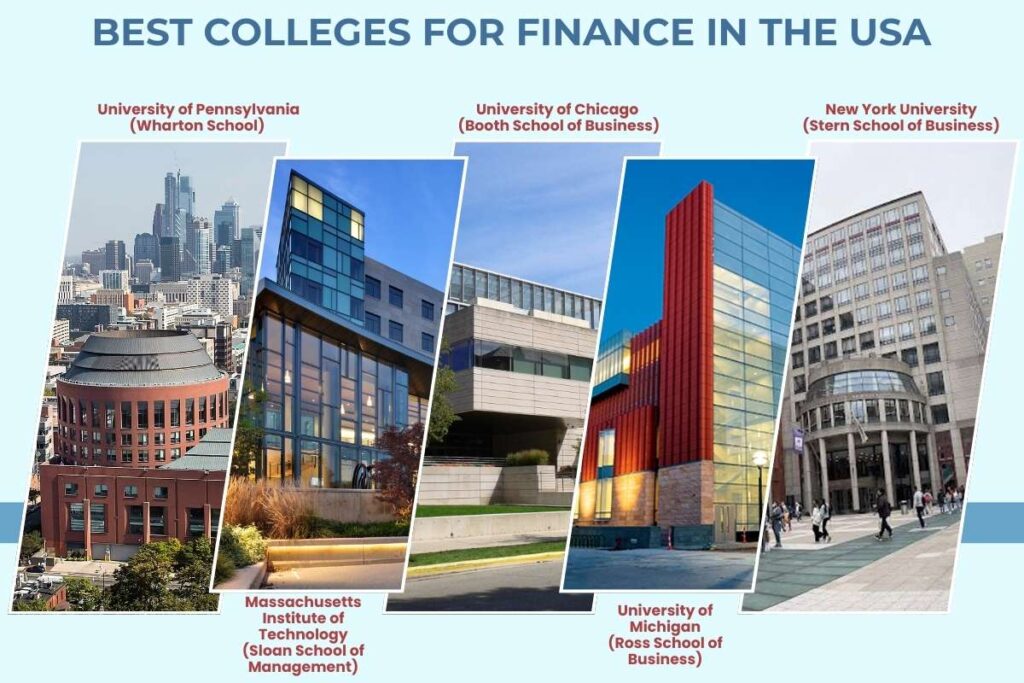
Did you know graduates from the best colleges for finance often start with salaries above $70,000 per year? According to the U.S. Bureau of Labor Statistics, business and financial occupations earn a median annual wage of $ 80,920 or higher as of May 2024.
This is higher than the national average.
That number climbs fast for graduates from elite programs who enter investment banking, private equity, or fintech.
If you want a strong ROI, powerful alumni networks, and access to Wall Street, choosing among the top colleges can change your career trajectory.
This guide breaks down the top 15 Best Colleges for Finance in the US, key specializations, and what you can expect after graduation.
Why Choosing the Right Finance College Matters?
Finance is intensely competitive. Firms like Goldman Sachs, JPMorgan, and Morgan Stanley do not recruit equally from every campus. They consistently hire from specific schools.
When students attend one of the best colleges for finance, they gain more than classroom knowledge. They gain proximity to opportunity. They gain structured access to employers. They step into an ecosystem designed to connect them with top firms.
Here is what that looks like in practice:
- Students at the best colleges for finance see recruiters on campus, mentorship, and strong internship pipelines.
- Alumni working in investment banking and consulting respond to outreach and offer referrals.
- Established internship pipelines place students in New York, Chicago, and San Francisco.
- Starting salaries rise because leading firms compete for graduates from target schools.
According to the National Association of Colleges and Employers, finance majors rank among the highest-paid business graduates in the U.S. This shows both strong employer demand and structured recruiting systems.
A college brand becomes an early signal in the hiring process. Faculty members often bring industry experience and professional networks. Classmates grow into future bankers, founders, and investment professionals. Over time, those connections compound and create long-term advantages.
Students from top finance programs often secure internships as early as their sophomore year. Early exposure builds confidence and sharpens technical skills. On campuses without a strong recruiting presence, even talented students must work harder to access the same opportunities.
In this industry, access plays a defining role in long-term success. That’s why choosing the top school strengthens positioning from day one.
How We Selected the Best Colleges for Finance?
A strong reputation alone is not enough when finding the top finance college. We reviewed business rankings from U.S. News & World Report to measure academic strength.
As well as:
- Salary data and job outlook reports from the U.S. Bureau of Labor Statistics show earning potential and market demand.
- Official university career reports to compare real starting salaries and placement rates.
- Acceptance rates on admissions pages are used to measure selectivity.
- Internship pipelines, alumni networks in investment banking, and corporate finance.
Our focus is on finding programs that deliver strong academics and strong career outcomes. The list below is arranged from highest to lowest average starting salary. It is to help students prioritize career outcomes when choosing the top finance college.
Top 15 Best Colleges for Finance in the USA to Launch Your High-Paying Career
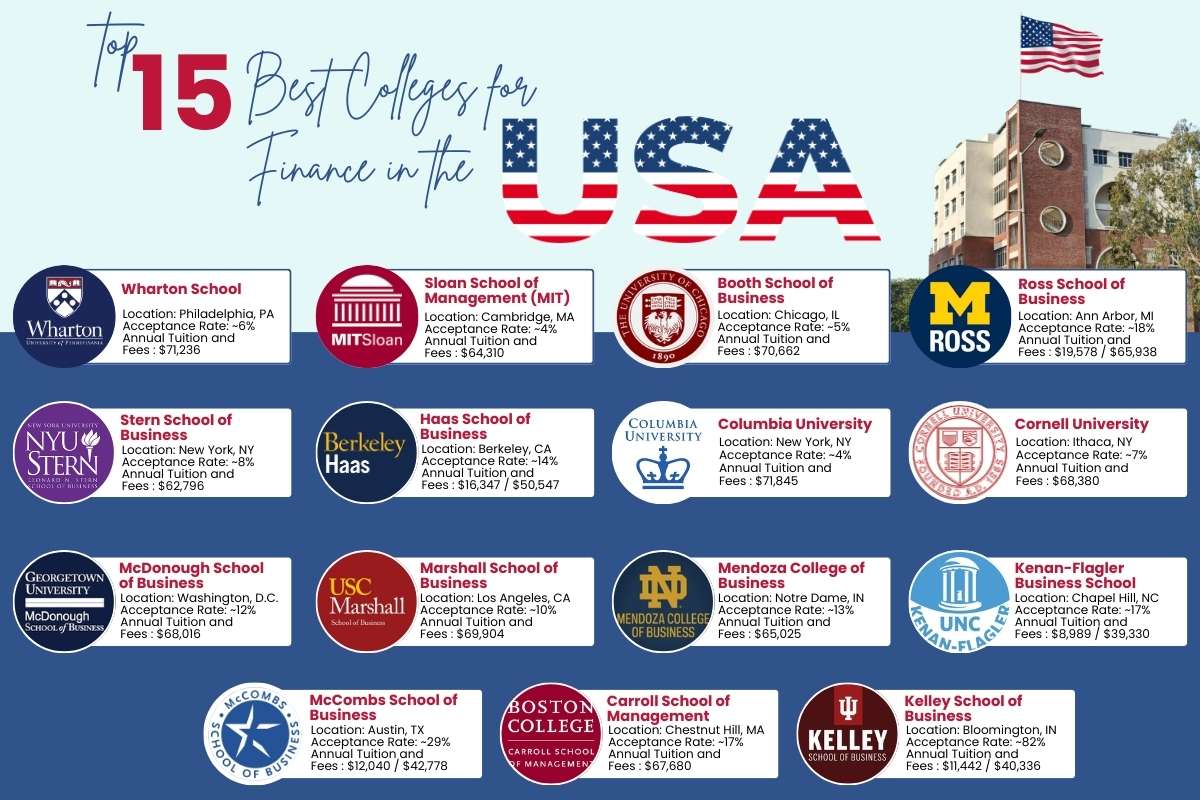
If you’re aiming for a finance career, choosing the right college can make a huge difference. Here are some of the best finance colleges in the USA that consistently produce successful graduates and open doors to top financial firms
| Sr.No. | College Name | Location | Acceptance Rate | Annual Tuition and Fees |
| 1 | Wharton School | Philadelphia, PA | ~6% | $71,236 |
| 2 | Sloan School of Management (MIT) | Cambridge, MA | ~4% | $64,310 |
| 3 | Booth School of Business | Chicago, IL | ~5% | $70,662 |
| 4 | Ross School of Business | Ann Arbor, MI | ~18% | $19,578 / $65,938 |
| 5 | Stern School of Business | New York, NY | ~8% | $62,796 |
| 6 | Haas School of Business | Berkeley, CA | ~14% | $16,347 / $50,547 |
| 7 | Columbia University | New York, NY | ~4% | $71,845 |
| 8 | Cornell University | Ithaca, NY | ~7% | $68,380 |
| 9 | McDonough School of Business | Washington, D.C. | ~12% | $68,016 |
| 10 | Marshall School of Business | Los Angeles, CA | ~10% | $69,904 |
| 11 | Mendoza College of Business | Notre Dame, IN | ~13% | $65,025 |
| 12 | Kenan-Flagler Business School | Chapel Hill, NC | ~17% | $8,989 / $39,330 |
| 13 | McCombs School of Business | Austin, TX | ~29% | $12,040 / $42,778 |
| 14 | Carroll School of Management | Chestnut Hill, MA | ~17% | $67,680 |
| 15 | Kelley School of Business | Bloomington, IN | ~82% | $11,442 / $40,336 |
Now let’s learn about each college in detail. We’ll look at the courses offered, alumni networks, and career opportunities. This will help you make the right choice.
1. University of Pennsylvania (Wharton School)

- Location: Philadelphia, PA
- Finance Programs Offered: B.S. in Economics
- Acceptance Rate: ~6%
- Annual Tuition and Fees: $71,236
- Average Salary After Graduation: ~$95,000
Wharton offers a B.S. in Economics with a Finance concentration. Admission is extremely competitive. Students have access to on‑campus recruiting from top investment banks, private equity firms, and consulting companies. The program includes finance labs, case competitions, and structured internships. Alumni networks help students secure internships and full‑time jobs in major financial hubs. Many families choose Wharton because of its strong academics, real‑world training, and high‑profile career opportunities in finance.
2. Massachusetts Institute of Technology (Sloan School of Management)

- Location: Cambridge, MA
- Finance Programs Offered: Undergraduate finance courses
- Acceptance Rate: ~4%
- Annual Tuition Fees: $64,310
- Average Salary After Graduation: ~$92,000
MIT Sloan sits among the best colleges for finance with a strong quantitative curriculum. Students prepare for careers in investment banking, trading, fintech, and financial analytics. Undergraduate finance courses follow a data‑driven curriculum. The Boston location provides access to finance and tech companies. Alumni networks help graduates secure jobs in leading financial and technology firms.
You may also like: Not Sure Which Degree Adds Real Value? Choose from the Best Masters in Finance Programs
3. University of Chicago (Booth School of Business)

- Location: Chicago, IL
- Finance Programs Offered: Undergraduate Economics pathway
- Acceptance Rate: ~5%
- Annual Tuition Fees: $70,662
- Average Salary After Graduation: ~$90,000+
Chicago does not offer a standalone finance undergraduate major. Instead, it provides a finance‑intensive pathway through the Economics department. Students take advanced courses such as financial economics, econometrics, and asset pricing. Many also enroll in the Polsky Center for Entrepreneurship and Innovation. The center connects students with financial startups and quantitative firms. Booth students regularly secure internships on trading desks, in hedge funds, and in consulting finance groups.
4. University of Michigan (Ross School of Business)

- Location: Ann Arbor, MI
- Finance Programs Offered: BBA (Finance)
- Acceptance Rate: ~18%
- Annual Tuition Fees: $19,578 in-state / $65,938 out-of-state
- Average Salary After Graduation: ~$85,000
Ross offers a BBA in Finance with structured experiential learning. Students can join the Student Investment Fund to manage real capital and learn valuation, portfolio management, and risk assessment. Ross hosts corporate treks to New York, Chicago, and other financial hubs for interviews and networking. Many rank Ross high in the list of best colleges for finance for its hands-on approach and early internship access.
5. New York University (Stern School of Business)

- Location: New York, NY
- Finance Programs Offered: BS in Business
- Acceptance Rate: ~8%
- Annual Tuition Fees: $62,796
- Average Salary After Graduation: ~$85,000
Stern’s undergraduate finance program offers concentrations in Finance & Quantitative Finance. Students complete internships in sectors like mergers & acquisitions, trading, risk management, and fintech. Stern organizes Stern Signature Projects, where students solve real problems for corporate partners. An internship fair in the fall attracts Wall Street recruiters from Goldman Sachs, Morgan Stanley, and JPMorgan. Stern career outcome reports show over 70% of finance majors secure full‑time jobs before graduation.
6. University of California, Berkeley (Haas School of Business)

- Location: Berkeley, CA
- Finance Programs Offered: BS in Business (Finance)
- Acceptance Rate: ~14%
- Annual Tuition Fees: $16,347 in-state / $50,547 out-of-state
- Average Salary After Graduation: ~$85,000
Haas offers the BS in Business Administration with a Finance emphasis. Core courses cover corporate finance, venture capital, and data analytics for finance. Students access internships through the Haas Career Management Group (HCMG) and partnerships with Silicon Valley employers. Haas is widely regarded as a top school for finance with strong West Coast connections. It also has several student finance clubs, including the Haas Investment Club and Berkeley FinTech Club. These clubs host speaker series and networking events.
7. Columbia University

- Location: New York, NY
- Finance Programs Offered: Financial Economics
- Acceptance Rate: ~4%
- Annual Tuition Fees: $71,845
- Average Salary After Graduation: ~$85,000+
Columbia offers a Financial Economics major through its Economics department. Students complete rigorous courses in corporate finance, financial markets, and investment analysis. Columbia’s location gives students access to on‑site recruiting from Wall Street firms. They often participate in Wall Street Prep bootcamps and analytics workshops. Columbia’s Career Design Center publishes outcome data showing high placement into investment banking, private equity, and consulting roles for finance‑oriented students.
8. Cornell University

- Location: Ithaca, NY
- Finance Programs Offered: Applied Economics & Management (Finance focus)
- Acceptance Rate: ~7%
- Annual Tuition Fees: $68,380
- Average Salary After Graduation: ~$80,000
Cornell’s Applied Economics & Management (AEM) major lets students focus on finance. Courses include portfolio management, corporate finance, and derivatives. Students participate in the Cornell Investment Club, managing parts of the endowment and competing in national finance challenges. Cornell is often highlighted as a leading undergraduate option for finance majors. Typical internships include summer analyst positions at major banks and in consulting.
9. Georgetown University (McDonough School of Business)

- Location: Washington, D.C.
- Finance Programs Offered: Finance Major (BBA)
- Acceptance Rate: ~12%
- Annual Tuition Fees: $68,016
- Average Salary After Graduation: ~$82,000
McDonough’s BBA Finance program offers courses in international finance, investment analysis, and financial modeling. Located in D.C., students access internships with federal agencies, global financial firms, and policy institutions. The McDonough Career Center organizes finance job fairs and alumni panels. Many students find roles in corporate finance, international banking, and consulting. Georgetown is often included in lists of top schools for finance majors.
You may also like: Don’t Let Deadline Crush You. Use These 20 Time Management Tips to Stay Focused and Productive
10. University of Southern California (Marshall School of Business)

- Location: Los Angeles, CA
- Finance Programs Offered: BS Business (Finance)
- Acceptance Rate: ~10%
- Annual Tuition Fees: $69,904
- Average Salary After Graduation: ~$79,000
Marshall is widely recognized as one of the best colleges for finance on the West Coast, especially in corporate and investment finance. The Pacific Southwest Finance Forum and career treks connect students with employers in Los Angeles and beyond. USC publishes detailed placement outcomes. These show internships at major financial firms and entry‑level jobs in banking, corporate finance, and asset management.
11. University of Notre Dame (Mendoza College of Business)

- Location: Notre Dame, IN
- Finance Programs Offered: BBA Finance
- Acceptance Rate: ~13%
- Annual Tuition Fees: $65,025
- Average Salary After Graduation: ~$78,000
Mendoza’s BBA in Finance includes core courses in financial management, investments, and financial institutions. The program ranks well among the top programs for finance majors in the Midwest. Students can participate in the Investment Banking Program. This program prepares them for banking internships with structured training. Career Services publishes outcome data showing strong placement in financial roles. The program also includes partnership programs with firms in Chicago, New York, and Atlanta.
12. University of North Carolina at Chapel Hill (Kenan-Flagler Business School)

- Location: Chapel Hill, NC
- Finance Programs Offered: BSBA Finance
- Acceptance Rate: ~17%
- Annual Tuition Fees: $8,989 in-state / $39,330 out-of-state
- Average Salary After Graduation: ~$76,000
Kenan‑Flagler’s BSBA in Finance includes financial analysis, portfolio management, and international finance courses. The Career & Leadership team publishes salary and placement outcomes showing steady placement in finance roles. Students secure internships with banks, asset management firms, and corporate finance teams. Many families see Kenan‑Flagler as a strong regional choice for aspiring finance professionals.
13. University of Texas at Austin (McCombs School of Business)

- Location: Austin, TX
- Finance Programs Offered: BBA Finance
- Acceptance Rate: ~29%
- Annual Tuition Fees: $12,040 in-state / $42,778 out-of-state
- Average Salary After Graduation: ~$75,000
McCombs’ BBA in Finance covers corporate finance, investment principles, and energy finance. Austin’s growing tech and energy sectors provide internships and employer connections. McCombs Finance majors report placement in major corporate and financial companies. The school is often highlighted as a top public option for finance majors in the U.S.
14. Boston College (Carroll School of Management)

- Location: Chestnut Hill, MA
- Finance Programs Offered: Finance Major
- Acceptance Rate: ~17%
- Annual Tuition Fees: $67,680
- Average Salary After Graduation: ~$72,000
Carroll offers a Finance major that includes courses in investment analysis, corporate finance, and financial institutions. The Carroll Career Center publishes internship and placement data showing roles in Boston, New York, and other financial centers. Students participate in the Eagles Investment Group and other finance clubs. Boston College is often ranked among the top private schools for finance majors on the East Coast.
15. Indiana University Bloomington (Kelley School of Business)

- Location: Bloomington, IN
- Finance Programs Offered: BS Finance, Investment Banking Workshop
- Acceptance Rate: ~82%
- Annual Tuition Fees: $11,442 in-state / $40,336 out-of-state
- Average Salary After Graduation: ~$70,000
Kelley’s BS in Finance includes courses in financial management, investment analysis, and valuation. The Investment Banking Workshop provides structured training before internships. Career Services data shows placements in banking and corporate finance roles. Kelley reports an average starting salary of $70,000. Alumni networks extend across industries and regions, making Kelley a solid option for finance‑oriented undergraduates.
Specializations Offered in Top Finance Colleges
The best colleges for finance in the USA give students clear paths to different careers in the financial world. Understanding these specializations helps parents and students pick programs that match their goals.
- Investment Banking: Investment banking focuses on raising capital, mergers and acquisitions, and corporate finance deals. Students learn financial modeling, M&A analysis, and valuation techniques. Schools like Wharton and NYU Stern send many graduates into top investment banks. Students gain access to internships, mentorships, and direct recruiting from firms like Goldman Sachs, JPMorgan, and Morgan Stanley.
- Corporate Finance: This specialization prepares students to manage company finances and support strategic business decisions. Ross School of Business and Berkeley Haas focus on corporate finance roles. Courses cover capital budgeting, financial statement analysis, and corporate strategy. Students often secure internships in Fortune 500 finance departments.
- Financial Planning and Wealth Management: This covers personal finance, investment advice, and portfolio management for clients. Georgetown McDonough and Boston College Carroll School offer these programs. Alumni networks help graduates land roles in wealth management firms and financial advisory services.
- Quantitative Finance: MIT Sloan and Columbia University provide strong quantitative finance programs. Students focus on statistical modeling, risk analysis, derivatives, and algorithmic trading. MIT Sloan’s Master of Finance program and undergraduate electives support careers in trading and financial analytics.
- Fintech and Blockchain: MIT Sloan and Berkeley Haas integrate fintech, blockchain, and digital finance. Students work on projects involving blockchain applications, cryptocurrency, and fintech startups. These schools also maintain partnerships with tech firms and venture capital networks.
- Risk Management: Cornell AEM and Booth allow students to specialize in risk management. Coursework includes credit risk, market risk, derivatives, and enterprise risk frameworks. Alumni often move into risk management, regulatory compliance, and hedge fund roles.
- Private Equity: Schools like Wharton, Columbia, and NYU Stern offer private equity and alternative investment tracks. Students gain exposure through internships, case studies, and student investment funds. These programs feed into top private equity firms and venture capital roles.
- Asset Management: Students from the best colleges for finance gain early access to asset management roles. They participate in student-run investment funds. They also gain certification opportunities and build connections to top asset management firms.
- The top undergraduate finance programs in the USA combine specialized coursework, hands-on projects, and strong alumni networks. Different schools focus on different strengths. Parents and students should consider program specializations, alumni placement, and internship pipelines when selecting the best colleges for finance.
Career Outlook for Finance Graduates
Finance graduates have a bright road ahead. Jobs in this field aren’t going anywhere, but they’re growing steadily. Students from the best colleges for finance enter roles with strong starting salaries and clear career paths.
The U.S. Bureau of Labor Statistics projects 6% growth for financial analysts from 2024 to 2034. That’s faster than average for all jobs. About 29,900 openings will come each year. Many will replace workers who retire or switch fields.
Common job titles are:
- Financial Analyst
- Investment Banking Analyst
- Portfolio Manager
- Corporate Finance Associate
- Risk Analyst
These jobs pay really well right after graduation. Median starting salary for analysts is around $101,910 in 2024. Many top students hit six figures quickly. The skills you learn in finance work almost anywhere, including banks, tech companies, and startups. Even as AI and global changes reshape industries, employers always need people who analyze numbers and spot risks.
A finance degree doesn’t just help you land your first job, but it also opens doors for your whole career.
Conclusion:
The best colleges for finance provide more than a degree. They give access to top employers, strong alumni networks, and hands-on experience. Students aiming for Wall Street benefit from schools in New York like Wharton or NYU Stern. Those interested in fintech or tech-driven finance find MIT Sloan or Berkeley Haas a great fit. Public schools such as Michigan Ross or UNC Kenan-Flagler combine strong career outcomes with good value. Choose a school based on your career goals, specialization, and the opportunities it offers.
FAQs
Q: What are the best colleges for finance in the US?
The University of Pennsylvania (Wharton) consistently ranks first for undergraduate finance according to U.S. News.
Q. Are finance degrees worth it?
Yes. According to BLS data, finance and business majors earn above-average salaries compared to many other fields.
Q. Do I need to attend an Ivy League school for finance?
No. Schools like Michigan, UT Austin, and UNC offer strong placement at lower tuition costs.
Q. Which state is best for finance jobs?
New York leads due to its concentration on Wall Street, followed by Illinois and California.