

Back in the days, schools and colleges focused on how good your memory was. Our education system was focused on memorizing facts, rather than learning them. It goes without saying that the method wasn’t good for long-term learning. Most students focused on memorizing a certain concept. And the school system rarely tried to help them understand it.
But that has changed now. In inquiry-based learning, children’s curiosity and questions are central instead of concepts. The point is no longer to remember the concept by heart. But to understand what it means.
So, what is inquiry-based learning, and how does it work? We shall take a look at all your questions regarding the method. Also, we will learn how it can help you in the long run.
What is Inquiry-Based Learning?
Inquiry-based learning, also known as IBL, is a student-centered method. It has a learner actively ask questions, check out real-world problems. It forces them to find answers through either guided or independent research.
It completely flips the script of the traditional learning process. Traditionally, a teacher will give you a piece of information, “the answer,” up front. But in this method, the teacher will present scenarios, questions, or problems. And the student must try to solve them and navigate through them.
Main Principles of Inquiry-based Learning
There are three main principles behind this learning method. Here’s a breakdown of these principles:
Principle 1: Curiosity-driven
Learning must relate to the student’s question and interest. It should be led by curiosity and interest over rigid formats.
Principle 2: Exploration and Reflection
In this learning method, the learner goes through a series of processes. They have to engage, navigate, research, create, discuss, and reflect.
Principle 3: Skill Development
The goal of this method is to develop various skills in students. Through this method. Students develop reasoning, research, teamwork, self-assessment, and communication skills.
Now that we know what inquiry-based learning is and what its main principles are, let’s move on to its key features.
Key Features of Inquiry-based Learning
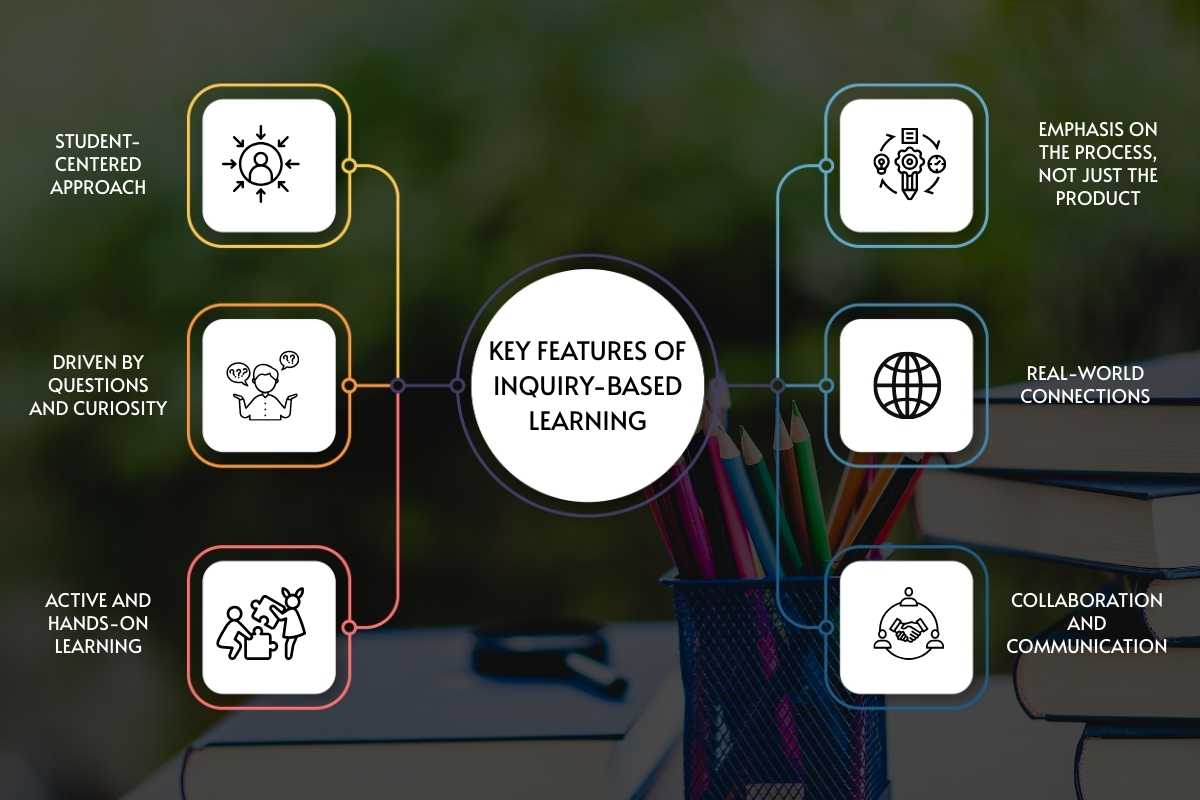
The key feature of this learning method is that students take control of learning. They do this by actively engaging with learning content.
Let’s explain the key features in a more comprehensive manner, shall we?
1. Student-Centered Approach
Inquiry-based learning puts the student at the heart of the learning experience. The teacher goes from being the conveyor of information to a coordinator. This allows independent thinking and a sense of responsibility for their education.
2. Driven by Questions and Curiosity
The learning session starts with a curious and compelling question or scenario. The starting points often come from the students themselves. This sparks their natural curiosity and makes the learning relevant for them.
3. Active and Hands-On Learning
Traditionally, students would passively receive information through lectures or textbooks. But through IBL, students are actively involved in the process. This includes conducting experiments, carrying out research, and analyzing data. It also has them collaborating with peers to find solutions.
4. Emphasis on the Process, Not Just the Product
In this method, the journey is far more important than the destination itself. The goal of this method is not to find the “right answer.” Instead, it focuses on developing critical thinking, problem-solving, and research skills.
5. Real-World Connections
Any good education shows the relevance of information to the real world. In this method, the teacher brings complex real-world problems to the students. This helps them understand why they are learning the topic and how it is relevant to the world they live in.
6. Collaboration and Communication
Students frequently work in groups to explore questions and solve problems. This collaboration encourages them to share ideas, debate, and learn from one another. This helps in building essential teamwork and communication skills in students.
Types of Inquiry-based Learning: What They Are and How They Differ?
There are four types of inquiry-based learning methods. Here’s what they are:
- Structured Inquiry: Students are given a question and a clearly defined method. But must draw their own conclusions based on the evidence collected.
- Controlled Inquiry: Learners receive a question, method, and known result to verify findings. This reinforces existing knowledge and practicing research techniques.
- Guided Inquiry: The teacher only provides the students with the main question. Students design their own procedures for investigation and interpretation.
- Open Inquiry: Students independently identify their own questions. Then they create their investigative methods and determine how to analyze results.
Now that’s the type of IBL that you must know about. We should talk about how you can implement this learning method for your students. So, let’s get straight into it!
Also Read: Unlocking Potential: The Power of Inquiry-Based Learning in Education
How to Implement Inquiry-based Learning?
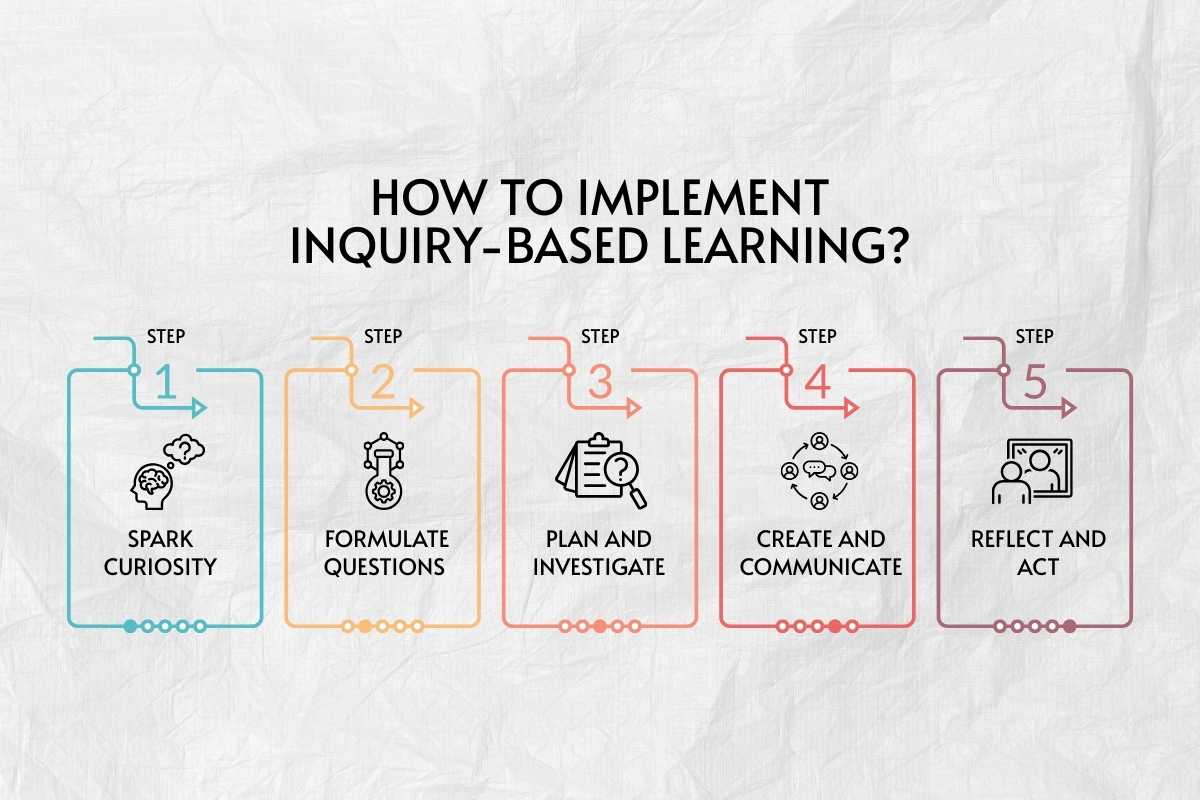
Here are simple ways you can implement IBL in your classrooms:
- Firstly, use a central question, problem, or scenario for your lessons. Guide students through the exploration process.
- Include activities like case studies, group projects, scientific experiments, or field research. All of these activities are designed to promote research skills and independent thinking.
- The teacher acts as a facilitator of information. The role of the teacher is to support students through the inquiry process. To help them structure their own investigations.
Let’s go a step further and learn a step-by-step process of implementing IBL in your classrooms.
Step 1: Spark Curiosity
The first step is to hook in your students with a compelling question, problem, or argument. It should be complex in a way that it is impossible for them to find a solution in a single search. This “provocation” can be a puzzling image, a real-world scenario, or a hands-on activity.
The goal is to create a sense of “need-to-know” among the students. Do not give all the information up front. It is important to keep the mystery lingering for the students to solve the problem.
Step 2: Formulate Questions
Once the curiosity has piqued, help students create their own questions. You help them move from simple questions (what, when, where) to complex questions (Why and how). Encourage the students to brainstorm, collaborate, and refine their inquiries. These questions will act as the foundation for their investigations.
Step 3: Plan and Investigate
Now that curiosity is at its height, all the questions are formed. It is time to turn students into investigators and researchers. This phase includes them experimenting, researching primary sources, interviewing topic-experts, and analyzing solutions.
The teacher’s role is to act as a coach. They provide resources, teach research skills, and offer guidance when students get stuck. This phase is less about having a correct path and more about the student’s process of discovery.
Step 4: Create and Communicate
After gathering information, students must make sense of their findings. They combine their discoveries. And then draw conclusions for a logical argument that answers their initial questions. They then communicate their learning to an audience.
This can take many forms, from a formal presentation or a debate to a documentary, a prototype, or a blog post. This validates their hard work and reinforces the idea that learning has a purpose.
Step 5: Reflect and Act
The final step involves students reflecting on their entire inquiry process. They think about what they learned and what they would do differently next time. This metacognitive reflection helps them internalize the skills they’ve developed. For many inquiries, a final step is taking action.
Students might use their new knowledge to write a letter to a local official or create a solution to a problem. This closes the loop and shows them how their learning can create real-world impact.
Case Study: Long-lasting Impact of Inquiry-based Learning

Inquiry-based learning places students at the center of their own education. It has them acting as chief investigators of a given topic. The case study shows the use of this method. It was used to address the resistance of students to social justice issues.
The study involved 50 students and was guided by constructivist and critical theories. The students were tasked with a five-step inquiry process:
- Step 1: Identification of a problem. It was often based on their own resistance to a specific topic like sexism, racism, or homophobia. For example, a student who was against homophobia was told to investigate it on campus.
- Step 2: Proposal writing. The student would write how they investigated the problem. And what actions they would take based on their findings.
- Steps 3 & 4: Data collection and analysis. Students engaged in real-world research. This often led to cognitive dissonance when their findings contradicted their initial beliefs. For instance, students who didn’t believe in gender inequality found evidence of it.
- Step 5: Implementation of a solution. This propelled students from knowledge production to activism.
Key Takeaway:
The findings showed that the inquiry-based method helped reduce student resistance. It also increased their willingness to engage in activism. About 47 out of 50 students were able to re-examine their previous knowledge. The process allowed students to “own” the knowledge they produced. Eventually, this leads to more vibrant and in-depth class discussions.
The study concludes that while the method is not a cure-all. Inquiry-based learning is an effective vehicle for students. Allowing them to confront their beliefs and reduce resistance to difficult topics.
What Are The Benefits of Inquiry-based Learning?
Here’s a list of benefits from IBL that you must know about.
| Benefit | Description |
|---|---|
| Enhances Student Engagement | Students learn to ask questions and explore topics that interest them. This keeps them motivated and curious. |
| Develops Critical Thinking & Problem-Solving | Encourages analyzing evidence, evaluating sources, and constructing explanations rather than memorizing facts. |
| Improves Knowledge Retention | Learning through investigation leads to deeper understanding and better memory of concepts. |
| Fosters Creativity and Innovation | Open-ended inquiries allow exploration of multiple solutions, promoting divergent thinking and original ideas. |
| Builds Research and Inquiry Skills | Teaches students to gather, evaluate, and synthesize information, nurturing curiosity and lifelong learning. |
| Encourages Collaboration and Communication | Teamwork and sharing findings enhance the ability to explain reasoning and defend conclusions. |
| Promotes Self-Directed Learning | Students plan, investigate, and reflect independently. This prepares them for higher education and real-world problem-solving. |
| Supports Differentiated Learning | Allows learners to explore topics at their own pace and interest level. This accommodates diverse learning styles. |
Conclusion:
Inquiry-based learning moves further than the traditional classroom. It transforms students from passive recipients of information into active investigators of knowledge. When curiosity is the base of learning, students develop skills for the 21st century.
But beyond that, you also empower them to become agents of change in their communities. So, instead of memorizing, let’s start asking questions and finding the answers ourselves.
FAQs
1. Why is the IBL method considered beneficial?
Inquiry-Based Learning boosts:
Engagement: Students who pose their own questions are more invested in learning.
Retention & Mastery: Discovering and working through concepts deepens understanding.
Critical Thinking: Learners evaluate evidence, assess sources, and synthesize knowledge.
Understanding Student Thought: Teachers gain insight into students’ processes and misconceptions.
2. What are some challenges with Inquiry-based learning, and how do we solve them?
There are a few challenges that IBL faces, such as:
Challenge: Students may feel uncertain about their success without fixed benchmarks.
Solution: Use co-constructed success criteria, frequent check-ins, and reflective guidance.
Challenge: Initial enthusiasm may wane.
Solution: Begin with topics students are passionate about. Then maintain the flow by adjusting difficulty suitably.
Challenge: Developing teamwork, self-management, and planning takes time.
Solution: Teach collaboration skills explicitly, offer structure, and model organizational strategies.
3. Is IBL just about asking questions?
No, questioning is foundational. Inquiry also involves designing investigations, analyzing data, constructing explanations, and sharing findings. Students must also prioritize which questions to explore deeply.
Also Read: 7 Innovative Approaches to Cultivate Critical Thinking in Elementary Education