
Key Points:
- 350,000 NYC free Chromebooks for students.
- $327M investment in devices and the internet.
- Focus on equity and responsible use.
New York City’s public schools are set to provide 350,000 new NYC free Chromebooks to students in the 2025–2026 school year, helping ensure that learning continues both inside and outside the classroom. The devices, equipped with LTE or 5G connectivity, are designed to support students without reliable internet access at home, allowing them to stay connected for schoolwork, remote opportunities, and college or job applications.
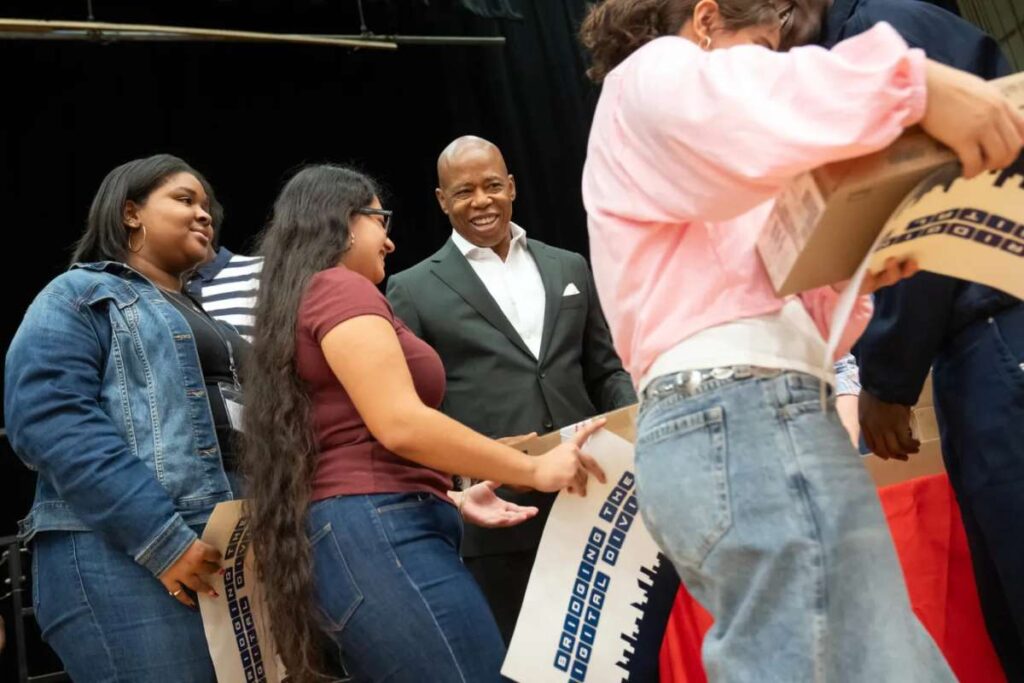
The rollout was announced by Mayor Eric Adams, New York City Public Schools Chancellor Melissa Aviles-Ramos, Chief Technology Officer Matthew Fraser, and partners including T-Mobile and Dell Technologies. The distribution will focus on schools where students either lack devices or have ones that are more than five years old. Priority will also be given to students in temporary housing, schools serving high-poverty communities, and those who have formally requested additional devices.
“We’re going to focus on the locations where the needs are the greatest so that students are able to continue their learning, take advantage of remote opportunities, and apply for jobs and colleges,” Adams said during the announcement at DeWitt Clinton High School in the Bronx.
The city plans to invest $129 million in purchasing the NYC free Chromebooks and cover $198 million in operating expenses over the next four years, which includes broadband connectivity. However, officials have not yet clarified what will happen to the internet services once the four-year period concludes.
This initiative builds on earlier efforts to provide digital resources to students. The last centrally funded distribution occurred in 2023, though schools have individually purchased devices since then to meet local needs. In total, about 1,594 schools across the city are expected to benefit from this program.
Supporting Remote Learning and Equity
The introduction of internet-enabled devices comes as schools continue to adapt to the digital demands of modern education. With students increasingly relying on online resources for learning, having access to both hardware and connectivity is critical. The program aims to reduce educational disparities by ensuring that students from underserved communities can participate fully in remote or hybrid learning environments.
Chancellor Aviles-Ramos emphasized the district’s commitment to ensuring students have the necessary tools to succeed. “We want to make sure every student has access to the technology they need, regardless of their background or living situation,” she said.
The distribution plan will be phased in over the next several months, with schools receiving devices based on their specific needs. Students will use these NYC free Chromebooks throughout the day for coursework, assignments, and communication related to their education.
Addressing Challenges
The rollout comes as schools implement a statewide ban on cell phones during school hours, raising concerns that students might try to bypass the rules by using school-issued devices to stay connected. In response, Mayor Adams acknowledged students’ creativity in finding ways to stay connected but affirmed that schools would encourage responsible use while matching that creativity with practical solutions.
“This is all about creativity. We have to match their creativity to make sure the rules are followed,” Adams remarked.
Looking Ahead
As educational institutions increasingly integrate technology into their teaching models, initiatives like this NYC free Chromebooks distribution are seen as vital steps toward bridging the digital divide. By providing both the devices and the connectivity required for learning, New York City’s schools aim to support students in staying engaged and prepared for academic and career opportunities.
For teachers and students, the new Chromebooks represent not only a technological upgrade but also an opportunity to explore new learning tools, access resources beyond the classroom, and ensure that every student can participate fully in today’s educational landscape.