
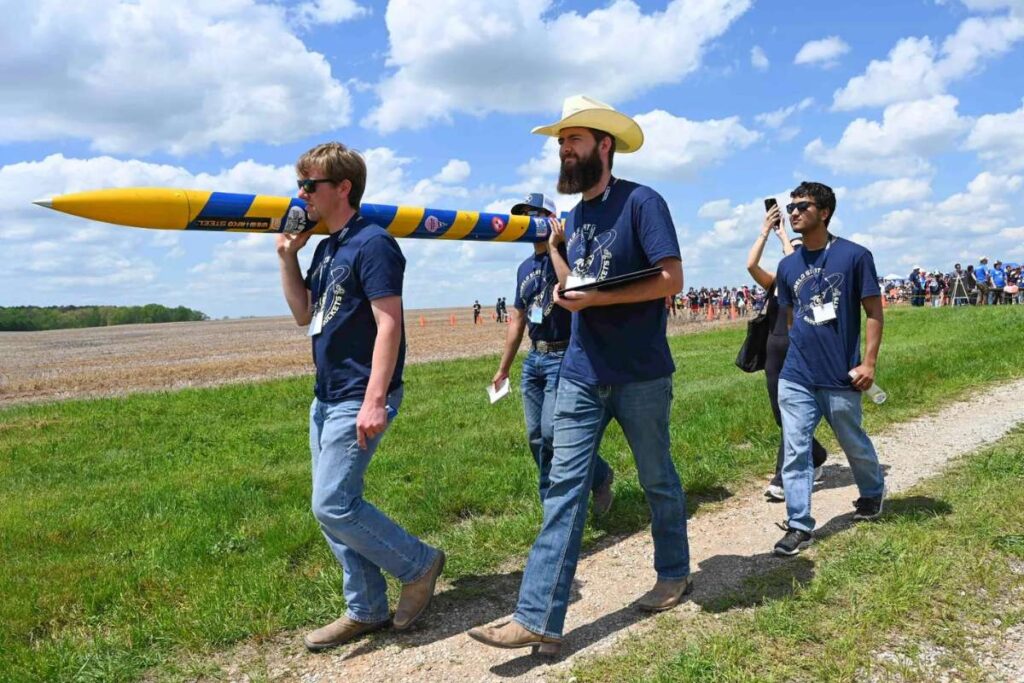
NASA has officially opened applications for the Student Launch 2026 challenge, inviting middle school, high school, and college teams to design, build, and launch high-powered rockets carrying scientific or engineering payloads. The competition, now in its 26th year, will culminate with final launches on April 25, 2026, at Bragg Farms in Toney, Alabama, near NASA’s Marshall Space Flight Center.
A Nine-Month STEM Challenge
Proposals are due by Sept. 22, 2025, and selected teams will go through a rigorous process, including documentation milestones and technical reviews throughout the academic year. Each team must not only demonstrate engineering precision in their rocket design but also carry out a payload mission that mirrors real-world space challenges.
Kevin McGhaw, director of NASA’s Office of STEM Engagement Southeast Region, emphasized the program’s role in preparing students for the future. “These bright students rise to a nine-month challenge for Student Launch that tests their skills in engineering, design, and teamwork. They are the future scientists, engineers, and innovators who will lead us into the future of space exploration.”
Artemis-Inspired Payload Challenge
Each year, the university-level payload challenge reflects NASA’s current exploration goals. For 2026, the theme draws inspiration from the Artemis missions, which aim to advance lunar exploration and prepare for human missions to Mars. College and university teams are tasked with creating a habitat that can safely house four “STEMnauts” — non-living objects representing astronauts — during extended missions.
The habitat must also include equipment capable of collecting and testing soil samples to support agricultural research operations, simulating the conditions astronauts may face on other worlds. This practical application links the competition directly to the challenges of long-duration space exploration.
Growth of the Student Launch Program
The Student Launch 2026 challenge has expanded dramatically since its beginnings in 2000, when just two universities — Alabama A&M University and the University of Alabama in Huntsville — took part. In 2025, nearly 1,000 students across 71 teams launched rockets reaching altitudes between 4,000 and 6,000 feet, with many teams successfully completing their payload missions.
This growth highlights the increasing enthusiasm for hands-on STEM education. Many former participants have gone on to careers at NASA or in the aerospace and technology industries, showing the long-term impact of the program.
Real-World Experience for Students
NASA Marshall’s Office of STEM Engagement hosts the competition, with support from industry partners including Northrop Grumman, National Space Club Huntsville, American Institute of Aeronautics and Astronautics, National Association of Rocketry, Relativity Space, and Bastion Technologies.
By involving students in real engineering challenges — from rocket design and construction to flight testing and mission operations — Student Launch bridges the gap between classroom learning and professional aerospace careers. Participants develop teamwork, problem-solving, and project management skills that are directly applicable to future opportunities in science and engineering.
A Launchpad for Future Careers
More than just a competition, NASA’s Student Launch 2026 serves as an educational platform that encourages young people to pursue careers in STEM. The hands-on nature of the challenge allows students to see how their classroom knowledge applies in real-world problem-solving.
As the 2026 season gets underway, NASA hopes to inspire the next generation of explorers. With its Artemis-inspired theme and growing participation nationwide, Student Launch continues to be a cornerstone in preparing students for future contributions to space science and technology.
NASA has officially opened applications for the Student Launch 2026 challenge, inviting middle school, high school, and college teams to design, build, and launch high-powered rockets carrying scientific or engineering payloads.
Visit Future Education Magazine for the most recent information.