

“The goal of education is not to increase knowledge but create possibilities for a child to invent and discover, to create men who are capable of doing new things” – Jean Piaget.
Jean Piaget was a Swiss Psychologist known for his work on child development. He believed that children make their own observations about the world. They actively participate in the learning process and have the ability to draw their own conclusions. He eventually put forth his findings by establishing his stages of cognitive development. But what exactly is cognitive development? Why is it important?
What is Cognitive Development? : Piaget’s Theory

Jean Piaget was born in Switzerland in 1896. He published his first paper when he was just 10 years old. Piaget’s interest in intellectual development started when he was working as an assistant for Alfred Binet and Theodore Simon, as they were developing their famous IQ test. It further expanded into cognitive development through his observations of his nephew and niece. He believed that children are like “little scientists” capable of forming theories about the world by their own experiences.
Cognitive development cultivates how children think, learn, and explore the world around them. It focuses on developing knowledge and problem-solving skills in children. The way a child thinks constantly changes as he grows. From birth to age 5, a child develops a lot of neural pathways. Cognitive development at this time of a child’s life is essential. It acts as a stage for future success.
Piaget studied children from infants to teenagers. He observed them and conducted interviews with them. Through his findings, he documented the components of a child’s development and established four stages of cognitive development. What are they?
The 4 Stages of Cognitive Development
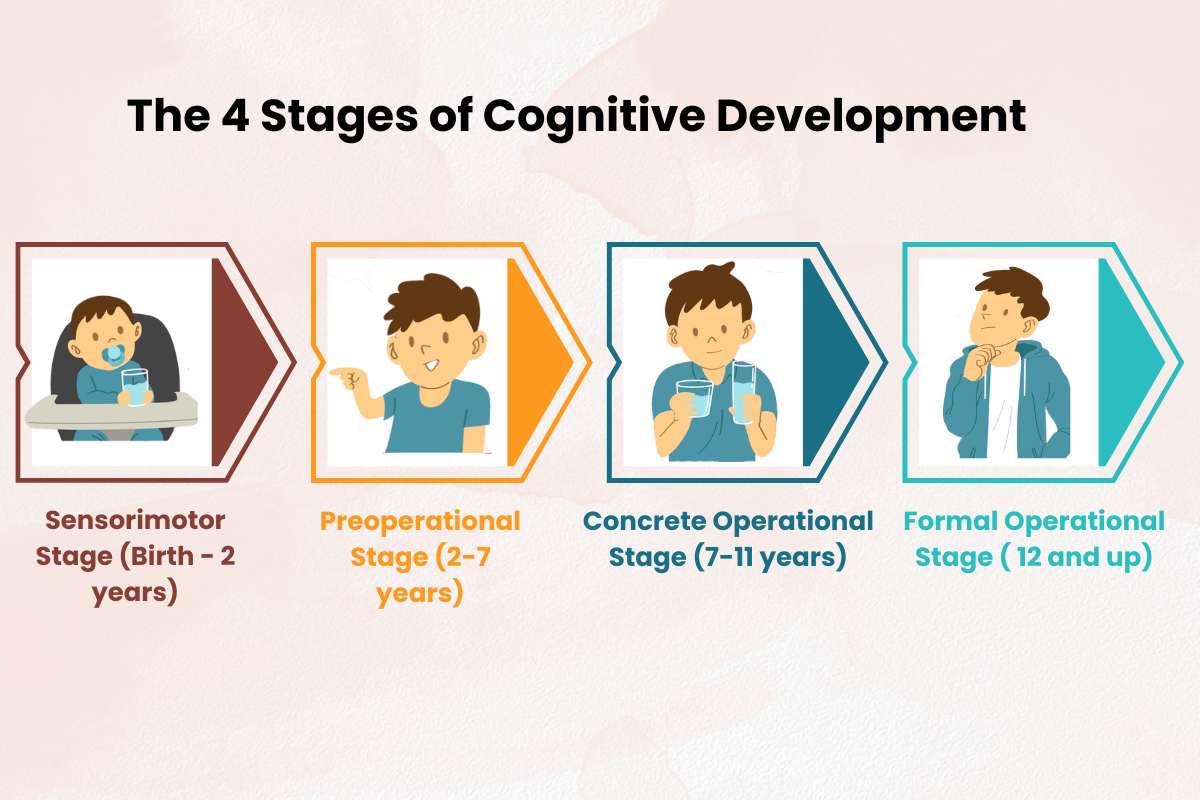
1. Sensorimotor Stage (Birth – 2 years)
This is the earliest stage of cognitive development. This time is very eventful, and a lot can happen in the first two years of a child’s life. During this stage, infants and toddlers acquire knowledge by experiencing the world around them. They do this through their senses and basic reflexes. This can present itself in the form of a kid wanting to put everything in their mouth.
One key development that occurs is object permanence. Object permanence is the ability to know that a thing or object exists even though a child cannot sense it. For example, a baby might know that their parent is nearby even though they can’t see or hear them.
Children in this stage learn to crawl and walk. They can also pick up parts of language by interacting with the people around them. They begin to develop a basic sense of individualism. They realise that they are separate human beings from other people and that their actions can affect things around them.
2. Preoperational Stage (2-7 years)
In this stage, children often exhibit self-focused behaviour. They have difficulty understanding the viewpoint of other people. One characteristic of the preoperational stage is learning through role play or pretend play. By using their imagination, children engage in metacognition. Metacognition is the ability to be aware of one’s thought process.
The main development that occurs in the preoperational stage is the discovery of concrete language. This is built upon the foundation of language that occurs in the sensorimotor stage. Children learn to use words and associate them with certain ideas and objects.
3. Concrete Operational Stage (7-11 years)

As kids enter the concrete operational stage, logic begins to take shape in their minds. However, their thoughts can be very one-dimensional. They can struggle with hypothetical concepts and abstract ideas.
Children also start to become less egocentric. They can comprehend what others might think and feel. There are two major traits that start showing in this stage, decentring and reversibility. Decentring is the ability to consider a problem from different perspectives. Reversibility is the ability to remember and retell a series of events in the order that they occurred.
4. Formal Operational Stage ( 12 and up)
The final stage in Piaget’s theory involves the ability to understand abstract ideas and use deductive reasoning. Children, especially those who are adolescents, can use logical thinking to solve complex problems.
Children have a better grasp of understanding hypothetical situations and abstract thinking. They begin to form their ideas on topics like philosophy, morality, and ethical and political issues. The ability to plan for the future also starts to develop during the final stage of cognitive development.
Every child goes through these four stages of cognitive development. But Piaget further explains that these stages aren’t mutually exclusive. According to him, a child in the Formal Operational Stage is not necessarily smarter than a child in the concrete operational stage.
The early stages of cognitive development are fundamental to how a child progresses through life. It is important that a child develops these qualities. So, how can we nurture cognitive development in children?
How To Improve Cognitive Development in Children?

1. Puzzle Solving:
Solving puzzles can enhance strategic thinking and build problem-solving skills.
2. Listening to Music:
Listening to music can promote word identification. It can also develop coordination through dancing. According to a study published in the National Library of Medicine music enhances auditory processing and phonological awareness.
3. Interactive Reading:
Interactive reading can allow kids to ask open-ended questions.
4. Counting Games:
Develops mathematical thinking and improves numerical skills.
5. Play Pretend:
Play pretend improves imagination and helps in the early development of social skills
6. Playing Outside:
Playing outdoors can stimulate multiple senses at the same time, improving overall cognition
7. Storytelling:
Narrating and listening to stories can develop basic vocabulary and comprehension. According to a study published in the International Journal of Language and Literary Studies, children exposed to frequent storytelling developed denser and diverse vocabularies.
8. Ask Questions:
Ask a lot of questions. This encourages children to think for themselves and enhance their communication skills.
Conclusion:
Cognitive development is the foundation from which children build and develop essential life skills. These skills can help them succeed in school and develop healthy relationships. Piaget’s theory enforces the idea that children are not just vessels waiting to be filled with knowledge, but that they are constantly building their understanding of the world. His four stages of cognitive development are a massive breakthrough in fostering, developing, and nurturing children. As Albert Einstein put it, “It is so simple, only a genius could have thought of it.”
FAQ
1. How to encourage cognitive development during teenage years?
A. Help your child in setting goals and thinking about the future. Support him in evaluating poor decisions made in the past.
2. Are there any barriers that can hinder a child’s cognitive development?
A. Yes, there are lots of things that can stunt cognitive development. Lack of sleep, a bad diet, poor communication, and abuse can severely hinder cognitive growth. A study done in 2023 concluded that ADHD and autism can harm cognitive growth.
3. What is the main difference between Piaget’s theory and Vygotsky’s theory?
A. Piaget focused on the individual development of a child, while Vygotsky focused on a child’s development regarding his/her culture and social interactions.
Also Read :- Unlocking Potential: The Importance of Quality Primary Schooling