
What if software could spot a student’s confusion before a teacher even notices? Instead of giving the same textbook to everyone, adaptive learning platforms shift digital lessons automatically to match how each person learns.
This tool replaces old multiple-choice quizzes with responsive teaching that changes right away. It treats education as an active path, adjusting within seconds to clear up confusion the moment it happens.
These systems stand out by offering quick mistake tracking, automatic review paths, and easy connections to your current school software. For example, if a student struggles with a fraction problem in a math lesson, the platform spots the error and opens a short video to help them master the concept before moving forward.
Which Adaptive Learning Platforms Are Right for Your Needs?
An adaptive learning platform is educational software that uses data and algorithms to act as a personal tutor. By tracking progress and spotting what a student does not yet know, the software makes sure each learner stays challenged, but never bored or overwhelmed.
Not all learning software is built the same way. To help you find the right fit, we analyzed the top adaptive learning platforms available today. We studied their unique features, who they are intended for, and how they support different learning styles. Based on this, we have categorized them into the three distinct groups below so you can identify the tool that best meets your specific needs.
Top Adaptive Learning Platforms for Students
1. CogBooks
CogBooks is a digital textbook and courseware maker that builds custom tracks for higher education classes. The platform gives students exact help at the moment they get stuck on a topic. It replaces standard, one-size-fits-all lessons with pages that change based on how a student answers questions.
- Pros: Gives help at the exact moment a student struggles, reduces extra work for teachers, and raises course pass rates.
- Cons: It does not work as a full school management system and hides its pricing from the public.
2. McGraw-Hill ALEKS
ALEKS is a math and science web program that has served over 50 million students globally. Developed by cognitive scientists, it uses a smart testing engine to figure out what a student truly knows about a subject. Once it builds a knowledge map, it guides the student directly to the next task they are ready to learn.
- Pros: Stops students from guessing answers, scores student skills accurately from day one, and rewards effort with visual goal maps.
- Cons: Mostly limited to math and science classes.
3. DreamBox
DreamBox provides web-based math and reading programs for students from kindergarten through high school. It uses learning software to build foundational math and literacy skills through independent study. The system automatically shifts lessons to match a child’s reading and problem-solving pace.
- Pros: Fun and highly engaging for younger children, keeps a gentle pace to build student confidence, and works well for studying alone.
- Cons: Students cannot pick specific lessons to practice on their own, and uploading school lists takes too long.
Top Adaptive Learning Platforms for Educators
4. Smart Sparrow
Smart Sparrow is a learning design company that helps teachers build interactive digital course materials. Founded by researchers studying intelligent tutoring tools, it focuses on replacing basic multiple-choice quizzes with rich virtual lab experiences. The system gives educators the tools to control and customize how their digital lessons adapt.
- Pros: Gives teachers total freedom to build custom lessons, tracks how students move through digital labs, and lets teachers write custom feedback rules.
- Cons: Requires significant time for teachers to build lessons from scratch, and is no longer sold as an independent standalone tool.
5. Redmenta
Redmenta is an online worksheet builder designed to manage active classroom projects and tests. The platform lets teachers turn traditional textbook pages into interactive lesson blocks. It focuses on using simple layout tools to help teachers build quick homework tasks and track student reasoning.
- Pros: Saves hours of desk work by making worksheets instantly, features a clean layout, and protects student data privacy.
- Cons: Full data charts require a paid plan, require a constant internet connection to load, and take time for teachers to learn every tool.
6. iSpring Suite
iSpring creates online tools for employee growth and school development. Its flagship toolkit turns basic PowerPoint presentations into interactive web courses and quizzes with no special technical training required. The company focuses on building accessible design software backed by round-the-clock live human support.
- Pros: Very easy to use if you already know PowerPoint, speeds up lesson creation, and makes speaking practice simple.
- Cons: Design choices are limited by PowerPoint templates, and tests favor simple right-or-wrong questions.
Also Read: What is Project-Based Learning?
Top Adaptive Learning Platforms for Educational Institutions
7. Realizeit
Realizeit is a large-scale enterprise training engine that organizes learning across global companies and major universities. It uses a self-learning machine engine to drop content-heavy methods and replace them with knowledge-based tracking. The platform targets workforce safety and campus readiness by measuring what every person understands about their role.
- Pros: Helps colleges change entire degree tracks at once, cuts student failure rates, and saves training dollars by reusing school files.
- Cons: Demands massive structural changes across the school, and lacks instant human support lines.
8. CENTURY Tech
CENTURY Tech is an AI education technology company developed by an experienced team of teachers, neuroscientists, and programmers. It blends artificial intelligence with brain research to remove learning roadblocks for schools and colleges worldwide. The system continuously alters learning tracks while feeding rich data insights to school leaders to guide their choice of study plans.
- Pros: Cuts down weekly teacher grading workloads, alerts principals about struggling students early, and raises test scores across large school groups.
- Cons: Focuses almost entirely on math, science, and English, and requires a total shift in how a school assigns homework tasks.
9. Area9 Lyceum
Area9 Lyceum focuses on building future-ready workforces by tracking true knowledge mastery instead of just school attendance hours. Its software mirrors the experience of a private human tutor. The system guides large corporate teams and advanced schools toward complete proficiency by tracking student confidence.
- Pros: Cuts training time in half by skipping known topics, highlights hidden skill gaps, and manages tutoring paths for thousands of users at once.
- Cons: Licensing fees are too expensive for small schools and require detailed content mapping before the system can launch.
Why Adaptive Learning Platforms Get Better Results?
Implementing adaptive technology changes how students learn, how teachers instruct, and how schools operate. The data-driven nature of these platforms provides distinct, measurable advantages across all three tiers.
- Matches each student’s pace: Let learners skip what they already know and spend extra time on tough topics so they never feel bored or overwhelmed.
- Fixes mistakes right away: Catches misunderstandings the moment they happen and gives immediate practice to fix the error.
- Boosts memory retention: Shows difficult concepts again at regular intervals to help students store information for the long term.
- Cuts down on teacher paperwork: Scores quizzes and tracks progress automatically, giving teachers more time each week to focus on teaching.
- Flags struggles early: Warns teachers when a student needs help and groups classmates who share the same skill gaps for quick reviews.
- Offers clear class insights: Shows exactly which lessons confused the class, so teachers can adjust their lectures and buy the right tools.
- Raises graduation rates: Helps more students finish their courses on time and speeds up training to lower total school costs.
How Do Adaptive Learning Platforms Work?
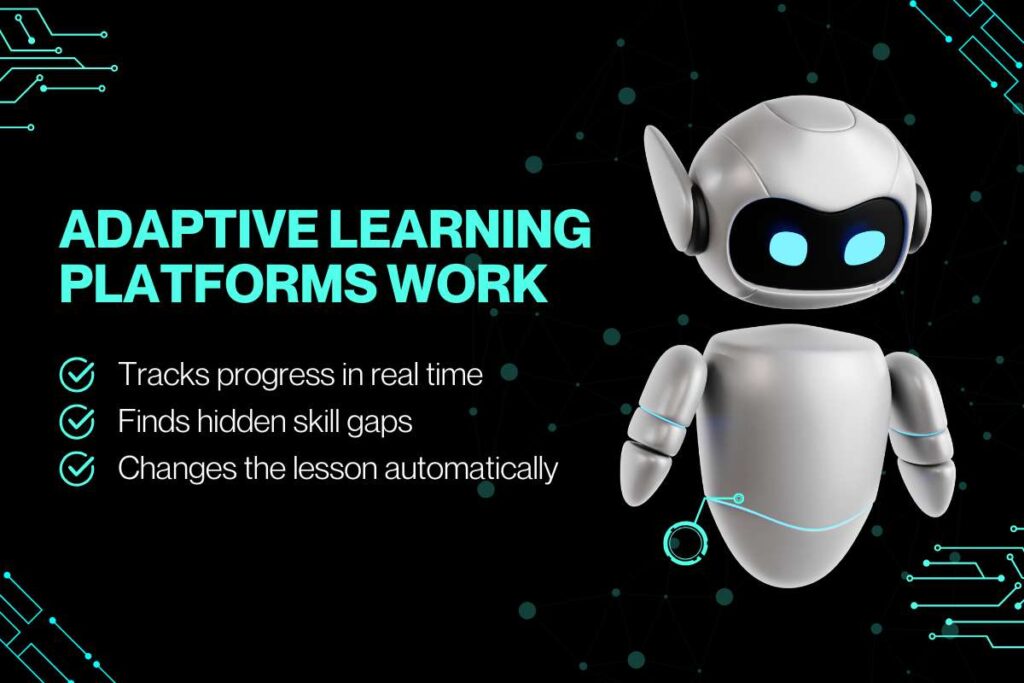
These platforms constantly update based on how a student performs. Instead of showing the same static lesson to everyone, the system changes instantly to match the learner’s needs. This turns regular reading into an active, personalized learning path.
1) Tracks progress in real time:
The software constantly watches how a student answers questions and how long they spend on each problem.
2) Finds hidden skill gaps:
It analyzes this data right away to spot exactly where a student is confused or stuck.
3) Changes the lesson automatically:
The system instantly gives the student a short review or a new type of video to help them learn the topic before they move on.
What is the Difference Between Adaptive Learning and Personalized Learning?
People often mix up these two ideas, but they are different.
Personalized learning is a broad educational goal. It means tailoring education to a student’s interests and pace. Teachers can personalize lessons without any technology at all by using group work or custom projects.
Adaptive learning is the specific technology that makes personalization automatic. It uses computer code and artificial intelligence to change the curriculum on the fly.
| Feature | Personalized Learning | Adaptive Learning |
| Who Drives It? | The teacher, student, or system | The AI software engine |
| Tools Used | Choice boards, projects, tech | Algorithms and data data pipelines |
| Speed of Change | Weekly or daily planning | Real-time, second-by-second changes |
What is the Role of Artificial Intelligence in Adaptive Learning Platforms?
Artificial intelligence is the brain of modern learning software. Older programs used basic rules, like an ‘if-then’ choice tree. If you got a question wrong, the computer sent you to page five.
Today, AI uses machine learning to predict what a student needs next. It looks at data from thousands of other learners to find the best path.
AI also helps platforms read written text and listen to voices. New tools use large language models to talk with students. The software can listen to a student explain their answer and spot mistakes in their logic.
Conclusion:
Choosing the right tools can completely transform how your school or company handles education. By focusing on real-time needs, adaptive learning platforms make mastering new skills faster and easier for everyone. Investing in this technology ensures no learner gets left behind.
Frequently Asked Questions
Q1: Can adaptive learning platforms replace human teachers?
A: No, these platforms do not replace teachers. They serve as assistants who handle grading and basic drills, which frees up educators to provide human support.
Q2: Do these tools work for all school subjects?
A: They work best in structured subjects like math, science, and grammar. They are harder to use for creative tasks like art or essay writing.
Q3: How much faster can students learn with adaptive software?
A: Studies show that adaptive paths can cut training timelines by 20% to 35% because students skip topics they already know.