
Key Takeaways
- Pichai avoided mentioning AI during Stanford’s 2026 commencement address.
- About 200 students walked out protesting Google’s ties to Israel.
- Pichai focused on personal experiences, accessibility, and technology’s social impact.
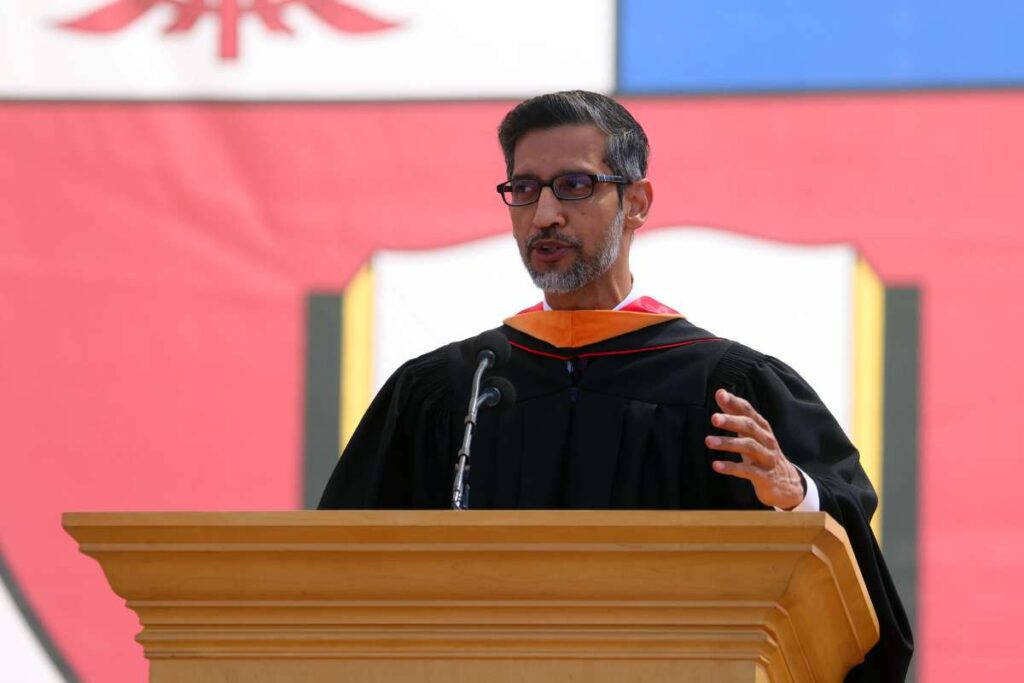
Google and Alphabet CEO Sundar Pichai delivered Stanford University’s commencement address on Sunday without mentioning artificial intelligence, while about 200 students walked out to protest Google’s ties to the Israeli government and Project Nimbus.
Students Protest During Commencement Speech
A group of graduating students and attendees staged a walkout as Sundar Pichai, a Stanford alumnus, took the stage at Stanford University’s commencement ceremony in Palo Alto on Sunday.
Protesters waved Palestinian flags, carried banners, and blew whistles before leaving the ceremony. Demonstrators criticized Google’s relationship with the Israeli government, including Project Nimbus, a $1.2 billion cloud-computing contract signed in 2021.
The protest followed similar demonstrations at Stanford commencements over the past three years, tied to Israel’s war in Gaza and university actions against pro-Palestinian demonstrations on campus.
Some students who left the ceremony attended a separate “People’s Commencement” event. For the second consecutive year, organizers hosted an alternative ceremony featuring pro-Palestinian speakers.
This year’s keynote speaker was activist Mahmoud Khalil, who was detained by U.S. Immigration and Customs Enforcement for more than 100 days last year amid efforts to deport him over his involvement in pro-Palestinian activism at Columbia University in 2024.
Sundar Pichai Focuses on Personal Journey
Despite leading one of the world’s most influential technology companies, Pichai avoided discussing artificial intelligence, a topic that has become increasingly controversial at college graduation ceremonies.
Instead, he centered his remarks on personal experiences, including his move from India to California, his decision to leave a doctoral program to pursue a master’s degree, and the challenges he faced early in his career at Google.
After the demonstrations subsided, much of the audience responded positively to his speech. Graduates greeted several of his stories with laughter and applause.
Pichai also spoke about the role technology can play in expanding opportunity and improving lives.
“Seeing computing change people’s lives as it had changed mine was the most exciting thing in the world to me,” Pichai said.
AI Becomes a Sensitive Topic at Graduations
Sundar Pichai’s decision to avoid artificial intelligence stood out as technology leaders increasingly face skepticism from graduates when discussing the rapidly evolving field.
Last month, former Google CEO Eric Schmidt received boos during a commencement address at the University of Arizona after emphasizing AI’s growing influence.
Schmidt told graduates that “AI is going to touch everything,” even for those who do not work in science-related fields.
Ahead of Stanford’s ceremony, interviewers on The New York Times’ “Hard Fork” podcast asked Pichai about how he planned to address graduates amid concerns over audience reactions to discussions about AI.
Rather than focusing on the technology directly, Sundar Pichai highlighted broader themes of accessibility and opportunity. He shared examples of women in rural India using smartphones to learn new skills and improve their economic prospects.
The approach appeared to help shift attention away from debates surrounding artificial intelligence and toward personal growth, education, and the social impact of technology.
Visit Future Education Magazine For The Most Recent Information.