

Employee development strategies are structured ways to help employees build skills and grow into bigger roles. They include methods like mentoring, coaching, and job rotation. This article breaks down eight proven approaches, the tools that support them, and how to measure results. Use it to build a plan that keeps your best people learning, growing, and staying with your company.
Imagine a software company spending a year training an employee to lead their biggest product line, only to watch her resign after promotion. She’d already accepted an offer elsewhere. The reason wasn’t pay; it was about growth.
This is a common scenario in many companies. They pour money into training but rarely check whether it matches what employees actually need to grow, and skills go stale fast in the process. This is where strong employee development strategies come in. They’re the daily habits and conversations that help people build real skills and see a future at your company. Below, we cover eight approaches that work, the tools that support them, and how to measure success.
What are the Most Effective Employee Development Strategies?
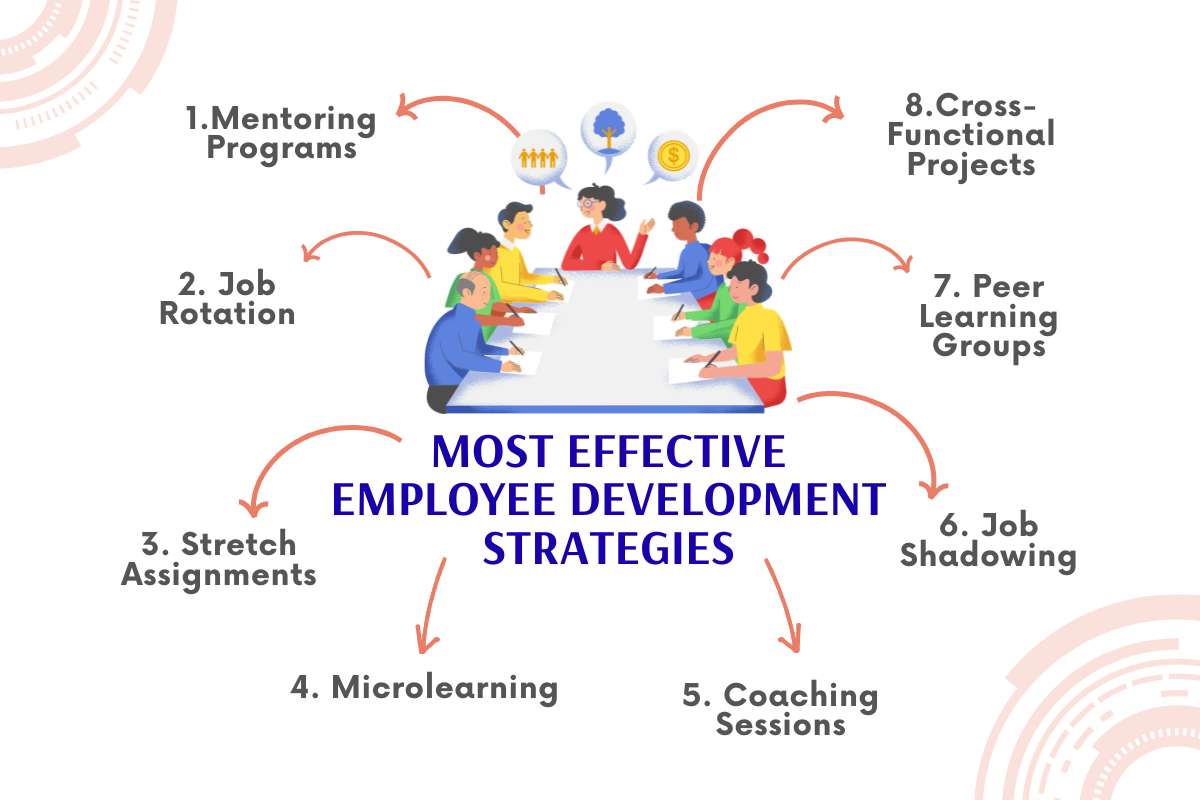
Employee development is the ongoing process of helping staff build skills, knowledge, and confidence so they can grow into new roles or handle bigger responsibilities. Without a clear employee development plan, this growth becomes random. One employee gets a great mentor by luck. Another gets nothing. Solid strategies of employee development remove that luck factor and make growth available to everyone. As a fact, 94% of employees say they’re more likely to stay with a company that invests in their career development.
Below are eight employee development strategies that deliver results across industries.
| Strategy | Best For | Time Investment |
| Mentoring programs | New hires, mid-career growth | Ongoing, low weekly hours |
| Job rotation | Cross-functional skill building | 3–6 months per rotation |
| Stretch assignments | High performers ready for more | Project-based |
| Microlearning | Busy teams, quick refreshers | 10–15 minutes daily |
| Coaching sessions | Leadership development | Bi-weekly or monthly |
| Job shadowing | Onboarding, career exploration | 1–2 weeks |
| Peer learning groups | Shared problem-solving | Weekly, 30–60 minutes |
| Cross-functional projects | Building business-wide awareness | Project-based |
1. Mentoring Programs
Pairing a junior employee with a senior one sounds simple, but most mentoring programs fail because they lack structure. A good pairing needs clear goals, a set meeting schedule, and check-ins from HR to confirm the relationship is actually helping. Without that structure, employee mentorship programs become chat sessions and not growth tools.
2. Job Rotation
Letting employees spend time in a different department teaches them how the business really works. A marketing employee who spends a month in customer support will write better campaigns because they’ve heard real complaints firsthand. This kind of hands-on exposure builds instincts that no classroom training can replicate.
3. Stretch Assignments
Give a capable employee a project slightly beyond their current skill level, with support available if they get stuck. As Meghan Freeman of Quantum Workplace puts it, growth should be “part of the work, not something separate.” This builds confidence fast, shows leadership who’s ready for more responsibility, and tests promotion readiness before it’s official.
4. Microlearning
Not every company has time for week-long workshops. Short, focused lessons, delivered through an app or a quick video, let employees learn without stepping away from their desks for long stretches. This approach works especially well for teams in retail, healthcare, or manufacturing, where long training blocks aren’t realistic.
5. Coaching Sessions
Coaching differs from mentoring in one key way: it’s tied to a specific goal, like managing conflict better. A trained coach asks pointed questions to help employees find their own solutions. This method works well for employees stepping into leadership roles for the first time. Manager quality accounts for 70% of the variance in team engagement, so this is important.
6. Job Shadowing
New hires or employees curious about another department can learn a lot just by watching someone else work for a day or two. It’s low-cost, easy to schedule, and part of many employee development strategies. This is because it gives a realistic preview of a role before someone commits to pursuing it. Many companies use shadowing as a bridge before a full job rotation.
7. Peer Learning Groups
Small groups of employees who meet regularly to discuss challenges and share solutions can be surprisingly effective. These sessions work well for teams facing similar problems, like new managers or sales staff learning a new product line. The informal setting often gets people to open up more than a formal training session would.
8. Cross-Functional Projects
Assigning employees to short-term projects outside their usual team exposes them to new ways of thinking and builds relationships across departments. Industry analyst Josh Bersin puts it simply: “As change accelerates with AI, you need to skill people in a dynamic, continuous way.” As skills are changing fast, cross-functional projects are much needed.
Together, these strategies cover almost every learning style and budget level, from low-cost shadowing to structured coaching programs.
Which Tools Support Employee Development Strategies?

Technology can make development easier to track and scale. Common tools include:
| Tool Type | What It Does |
| Learning management systems (LMS) | Hosts courses and tracks completion |
| Skills mapping software | Shows gaps across teams |
| Performance review platforms | Links growth goals to reviews |
| Feedback apps | Collects real-time input from peers |
For smaller companies, even a shared spreadsheet and regular one-on-one meetings can work just as well if the follow-through is consistent. The employee development tools matter far less than the habit of actually using them. Many strong strategies run on nothing fancier than a calendar reminder and a manager who shows up.
How Do You Measure the Success of Employee Development Strategies?

If you can’t measure it, you can’t improve it, and most companies are struggling. Association for Talent Development (ATD) reports that 87% of organizations struggle to measure the direct impact of training on employee performance or business results.
A few practical metrics to track are:
1. Internal promotion rate:
Are more roles being filled by existing staff? A rise can show that development is helping employees prepare for bigger responsibilities.
2. Retention among trained employees:
Do people who go through development programs stay longer? Compare retention between employees who participate and those who do not.
3. Skill assessment scores:
Are employees testing higher after training compared to before? Use a pre-training assessment as a baseline to measure actual improvement.
4. Manager feedback:
Do supervisors notice real changes in performance? Manager observations can help show whether employees are applying new skills at work.
Chartered Institute of Personnel and Development (CIPD) recommends looking beyond training completion and evaluating whether learning improves performance and transfers to the workplace. This means companies should also track relevant business outcomes, such as productivity, quality, customer satisfaction, sales performance, or time to proficiency.
Track these numbers every six months rather than waiting for an annual review. Comparing results against the baseline can show whether the strategy is working, where employees need more support, and which employee development strategies are worth continuing.
Conclusion
The employee who left after her promotion didn’t need a bigger salary or a fancier title. She needed someone to ask what she wanted before deciding for her. That’s the piece most companies don’t consider.
Pick one among the given employee development strategies that fits where your team struggles most. It may be a mentoring pair for a new hire or a stretch assignment for someone eyeing their next role, and give it a full quarter before judging results. Track it against the promotion rate, retention numbers, or skill scores that actually connect to it. The companies that get this right are just paying attention to what their people are asking for before those people stop asking and start applying elsewhere.
FAQs
1. How often should employee development plans be reviewed?
Most experts recommend reviewing plans every quarter to keep goals relevant and catch problems early.
2. Why do employee development strategies matter for retention?
Employees who see a clear path to grow their skills are far less likely to leave, since a lack of growth opportunities is one of the top reasons people quit.
3. What is the difference between employee development and employee training?
Training focuses on specific skills for a current job, while development looks at long-term growth and future roles.
4. How much should a company budget for employee development?
Many organizations spend between 1% and 3% of payroll on development, though the right amount depends on industry and company size.
5. Can small businesses use employee development strategies without a big budget?
Yes, low-cost methods like mentoring, job shadowing, and regular feedback sessions can be just as effective as expensive formal programs.