
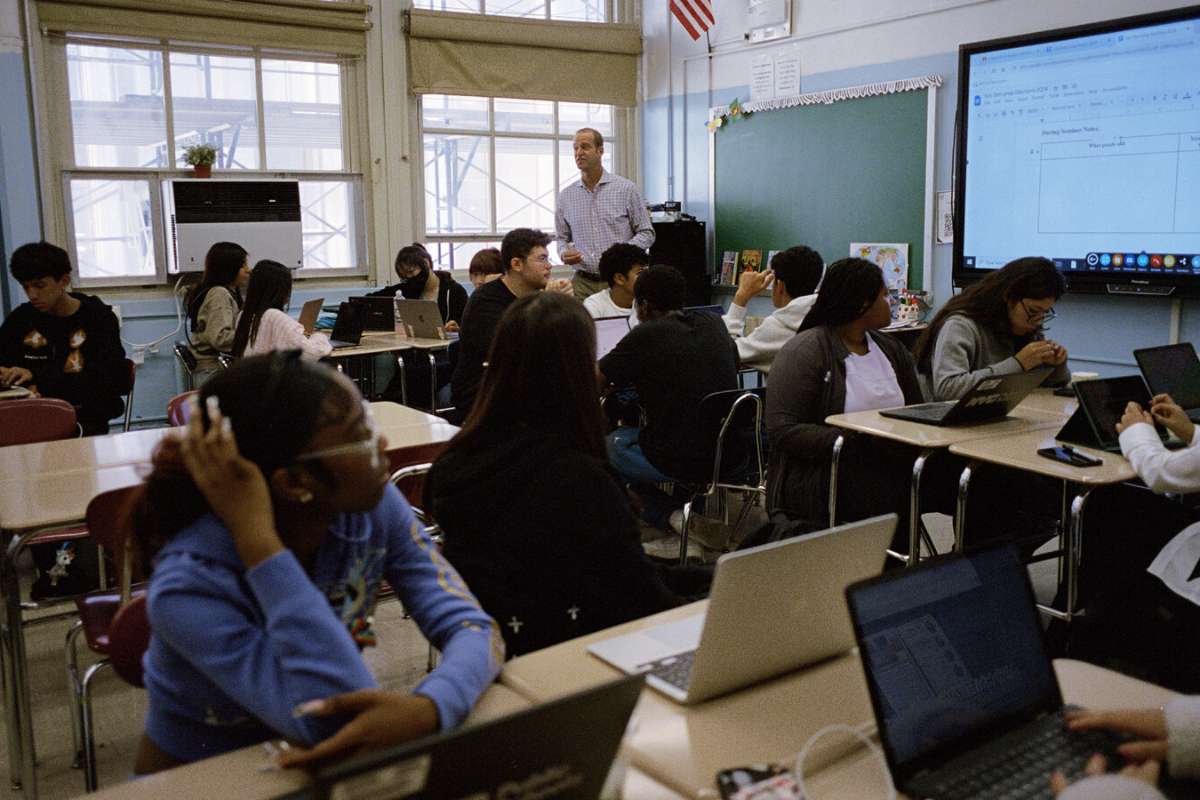
Key Takeaways
- NYCPS restricts generative AI for students below high school.
- LAUSD temporarily blocks generative AI on district-issued student devices.
- Districts nationwide are setting AI rules based on age and instructional value.
This month, AI restrictions in schools intensified as New York City and Los Angeles tightened student access to generative AI, prompting education leaders nationwide to weigh age, instructional value, evidence and student independence.
NYC and la tighten AI restrictions in schools
New York City Public Schools, the nation’s largest school district, announced a one-year moratorium as part of its AI restrictions in schools, limiting student-facing generative AI for all grades below high school. The decision marked a pullback as school systems continue testing how artificial intelligence should fit into classrooms.
Los Angeles Unified School District, the nation’s second-largest district, later announced that it had temporarily blocked generative AI on district-issued student devices while officials develop longer-term rules.
Rebecca Winthrop, director of the Center for Universal Education at the Brookings Institution, said the moves reflect a changing approach to AI in education. “We’re sort of entering a third wave,” she said. “Like, wait, before we start, let’s be really thoughtful about it. Let’s slow down to get it right.”
Winthrop said schools initially restricted access after ChatGPT became widely available in November 2022. Districts then moved into a period of experimentation before becoming more deliberate about when, how and by whom AI should be used.
Not all education leaders support New York City’s approach. Florida Education Commissioner Henry Mack called the moratorium “terrible,” arguing that students need exposure to technologies that can affect their education and future work.
States favor guardrails over blanket bans
Florida has instead established statewide rules that set boundaries while allowing districts and teachers to decide how AI should be used in instruction. These AI restrictions in schools focus on guardrails, parental involvement and age-appropriate classroom use rather than blanket bans. The rules adopted Sept. 16 include parental opt-in requirements, non-AI alternatives and requirements for transparency, privacy and data security, according to Maya Israel, a University of Florida professor and co-director of the state’s K-12 AI Education Task Force.
Israel said broad access to general-purpose AI is different from using narrowly designed tools for specific instructional tasks.
“I don’t believe that young learners ought to be engaging with these broad AI tools either,” Israel said. “I think that developmentally they need to learn how to think for themselves.”
She said schools could evaluate specialized tools based on factors including developmental appropriateness, teaching value and supporting evidence.
Districts draw lines around classroom use
Nevada’s Clark County School District has limited generative AI mainly to secondary grades and does not use it in elementary classrooms. Jesse Welsh, the district’s deputy superintendent of teaching and learning, said students need to build their own thinking skills before relying heavily on AI.
“We need students to develop those critical thinking skills,” Welsh said. “There’s definitely a worry if you start too early that it just becomes a crutch.”
In rural Iowa, the Winterset Community School District has also avoided both unrestricted access and a districtwide ban. ChatGPT, Claude and about 20 AI companion-chatbot sites are blocked on school devices, while Gemini remains available through the district’s Google for Education environment.
Winterset also uses controlled AI tools for specific assignments. Assistant Principal Chad Sussex said teachers can monitor student interactions and limit access when needed.
Across the districts, the debate increasingly centers on whether AI supports learning or replaces the mental work students are expected to do. Winthrop said schools need more evidence before making broad classroom use routine, especially for younger students.
“There’s a big difference between using AI to learn in school and schools teaching about AI,” she said.