

Employee mentorship programs pair experienced staff with newer employees to build skills and boost retention. This article covers how to set one up, manage it day-to-day, and match pairs using practical rules. You’ll also find best practices for running these programs and benefits. Read on to build a program that keeps employees engaged and growing.
Studies show at least 38% of new hires leave within their first year, and one major reason is a lack of guidance early on. In fact, 87% of businesses find that assigning a mentor during onboarding is very effective. That’s why more companies are turning to employee mentorship programs to keep talent, build skills, and create a culture where people actually want to stay.
This article breaks down everything you need to know. We’ll cover what these programs are, how to build one step by step, how to manage it once it’s live, and the best practices that separate strong programs from forgettable ones. By the end, you’ll have a clear plan you can act on this quarter.
What are Employee Mentorship Programs? What are Their Types?
They are structured systems that pair experienced staff with less experienced colleagues to support learning, career growth, and skill development. Unlike casual advice from a coworker, these programs have clear goals, a set timeline, and some form of tracking.
There isn’t just one model. Different companies need different setups, and picking the wrong one is a common reason programs fail.
Common types of employee mentorship programs:
| Type | Best For | How It Works |
| One-on-one mentoring | New hires, career changers | A senior employee guides one junior employee over months |
| Group mentoring | Large teams, limited mentors | One mentor supports 3-6 mentees at once |
| Peer mentoring | Skill-sharing between equals | Employees at similar levels swap knowledge |
| Reverse mentoring | Digital skills, fresh perspectives | Junior staff mentor senior leaders, often on tech or trends |
| Flash mentoring | Quick, specific questions | A single short session focused on one problem |
| Project-based mentoring | Skill building tied to real work | Pairing lasts only for the length of a project |
Most companies use a mix. A new hire might get a one-on-one mentor, while mid-career employees join a peer group. The type you choose should match your goal.
How to Build Successful Employee Mentorship Programs (Step by Step)?
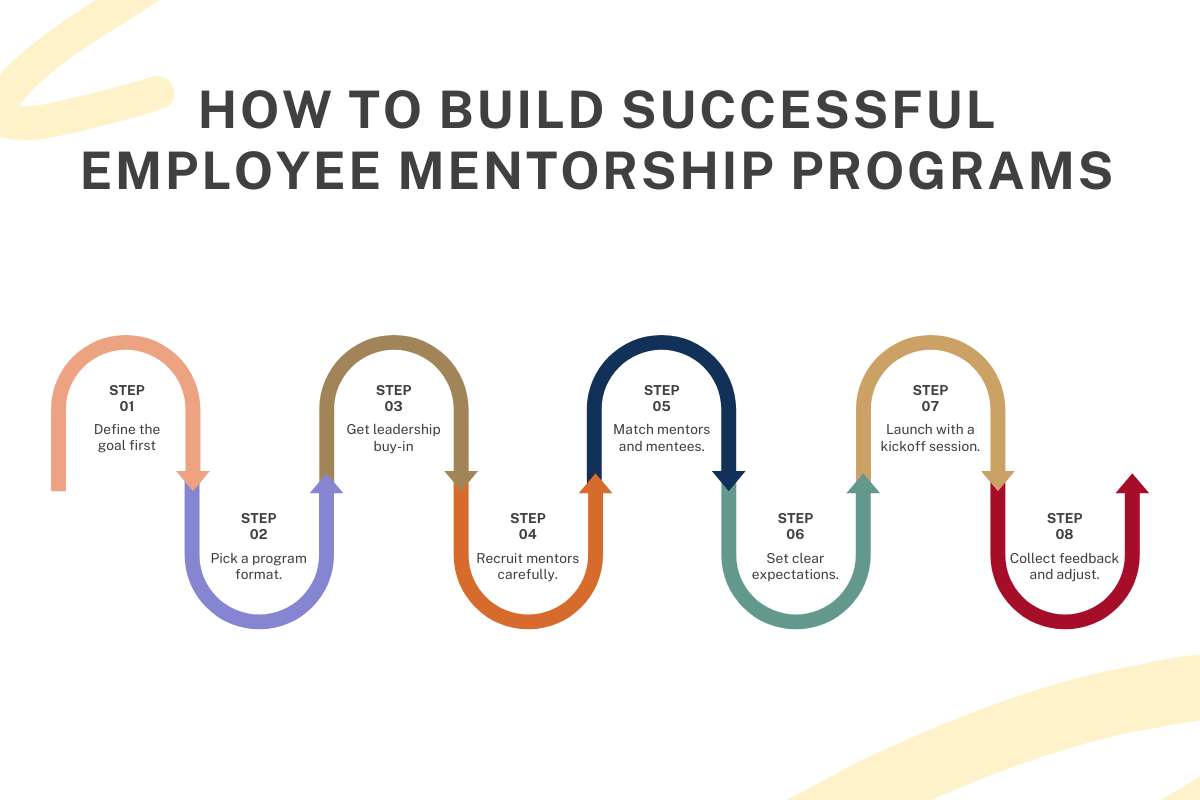
Building a program without a plan usually leads to a few excited sign-ups, then silence. Here’s a process that actually holds up.
Step 1: Define the goal first.
Are you trying to reduce turnover? Fill a leadership pipeline? Write the goal down in one sentence. Tie mentorship goals to a broader employee development plan.
“Set really explicit goals for what it is that you’re looking to receive out of the mentoring relationship.”
Fiona Fung, Anthropic Engineering Lead
Step 2: Pick a program format.
Use the table above. A 50-person startup needs something different than a 5,000-person enterprise.
Step 3: Get leadership buy-in.
Employee mentorship programs backed by leadership get more resources and higher participation. Ask a senior leader to sponsor the launch publicly.
Step 4: Recruit mentors carefully.
Don’t just ask for volunteers. Screen for people who communicate well, have time, and actually want to teach. A skilled expert with zero patience makes a poor mentor.
Step 5: Match mentors and mentees.
Match mentors and mentees based on goal alignment. This is the step most employee mentorship programs get wrong. We’ll cover exact matching rules in the best practices section below.
Step 6: Set clear expectations.
Give both sides a simple guide: how often to meet, what to discuss, how long the pairing lasts.
Step 7: Launch with a kickoff session.
A short virtual or in-person kickoff helps pairs break the ice and understand the program rules.
Step 8: Collect feedback and adjust.
Send a short survey after the first month. Fix problems early instead of waiting until the program ends.
Following these steps in order matters. Skipping straight to matching without clear employee development goals is why many programs stall after the first few weeks.
How to Manage a Mentorship Program (Structure, Cadence, and Metrics)?
Launching is the easy part. Managing it well over months is where most employee mentorship programs break down.
What Should the Program Structure Look Like?
A clear structure keeps pairs on track without feeling like extra homework. Here’s a simple framework that works for most companies:
- Duration: 6 to 12 months per cycle
- Meeting frequency: Every 2 weeks, 30 to 45 minutes
- Check-ins with program coordinator: Once a month
- Mid-point review: At month 3 or 6, depending on cycle length
- Wrap-up session: Final meeting to reflect and set next steps
What Should Mentors and Mentees Actually Talk About?
Give pairs a loose agenda. This ensures meetings in employee mentorship programs don’t turn into small talk:
- Progress on current goals
- One challenge from the past two weeks
- A skill or topic to explore next
- Quick feedback for each other
How Do You Measure If the Program is Working?

Track a mix of numbers and feedback. Don’t rely on just one signal.
| Metric | What It Tells You |
| Retention rate of participants | Are mentees staying longer than non-participants? |
| Promotion rate | Are mentees advancing faster? |
| Meeting completion rate | Are pairs actually meeting as scheduled? |
| Satisfaction survey scores | Do people find the sessions useful? |
| Skill assessment scores | Has the mentee’s competency improved? |
Track these alongside your broader employee development metrics. If completion rates drop below 70%, something in the structure needs fixing.
Best Practices for Running Effective Employee Mentorship Programs
Getting the match of mentor and mentee right matters more than almost any other step in the process. Here’s how to do it with precision.
Use specific matching criteria, not vague goals.
1. Match by skill gap:
A mentee who needs public speaking help should get a mentor known for strong presentations, even if they work in a different department.
2. Limit seniority gap to 2-3 levels:
Too large a gap often creates intimidation instead of comfort.
3. Match on working style, not just personality:
Pair a mentee who likes structure with a mentor who plans ahead, not one who prefers loose, spontaneous chats.
4. Avoid direct managers as mentors:
Mentees are less honest with someone who controls their performance review.
5. Rotate mentors every cycle if possible:
Fresh perspectives prevent stagnation after 6-12 months.
6. Use a short intake form:
Ask mentees to list 2-3 specific skills they want to build, then match based on mentor strengths.
Other practices that make a real difference
- Train mentors before pairing them. A one-hour session on active listening and goal-setting improves outcomes significantly.
- Keep a shared goal-tracking document, so progress is visible to both people, not just remembered in conversation.
- Set a clear end date. Open-ended pairings tend to fizzle out without one.
- Celebrate small wins publicly, like a shoutout in a team meeting, to keep momentum visible across the company.
Mary Barra, CEO of General Motors, discussed mentorship in The Washington Post’s leadership series and emphasized that mentoring can happen across organizational levels, including reverse mentoring, where newer employees mentor senior leaders.
What are the Main Benefits of Employee Mentorship Programs?

The payoff for doing this well is significant, and it shows up in numbers companies actually track. These gains mirror the wider employee development benefits:
- Lower Turnover: Employees with mentors are far more likely to stay with a company long-term.
- Faster Skill Development: Mentees pick up job-specific knowledge faster than through formal training alone. In a survey, 84 % agreed they became proficient faster with a mentor.
- Stronger Leadership Pipeline: Mentorship exposes high-potential employees to leadership thinking before they’re promoted.
- Better Engagement: Employees who feel invested tend to show up with more energy and commitment.
- Improved Diversity Outcomes: Structured mentorship, especially reverse and cross-department pairing, helps underrepresented employees access networks they might otherwise miss.
- Knowledge Transfer: When experienced employees retire or leave, mentorship ensures their knowledge doesn’t leave with them. This helps with employee development at the company level.
None of these benefits happen automatically. They come from running the program with the structure and rules covered above.
Conclusion
Employee mentorship programs need not be complicated to work. They need a clear goal, a format that fits your team size, and matching rules that go beyond “shared interests.” Set a realistic meeting cadence, give pairs a loose agenda so sessions stay useful, and check your numbers every quarter.
The companies that get this right treat mentorship as infrastructure. They fix weak spots as they show up, replace mentors who aren’t showing up, and keep the program tied to real business outcomes like retention and promotion rates. Start small if you have to. A well-run pilot with ten pairs beats a company-wide rollout that nobody manages.
FAQs
1. What are the 5 pillars of mentorship?
Most frameworks point to trust, communication, goal-setting, feedback, and accountability as the core pillars.
2. Can I use ChatGPT as a mentor?
AI tools like ChatGPT can help with skill practice, drafting, or quick advice. But they can’t replace human judgment, accountability, and real workplace context.
3. What is the role of a mentor?
A mentor guides a less experienced person through skill-building, career decisions, and workplace challenges by sharing knowledge and honest feedback.
4. What are examples of mentorship programs?
Common examples include onboarding mentorship for new hires, leadership development mentoring, reverse mentoring on technology, and peer mentoring circles for skill-sharing.
5. How to be an excellent mentor?
Excellent mentors listen more than they talk and give specific and honest feedback. They stay consistent with meeting schedules in employee mentorship programs.