

Employee development is the process of helping workers build skills and grow in their roles. This prepares them for future responsibilities. Companies that invest in it see higher retention, better performance, and stronger leadership pipelines. This guide covers the key types, strategies, and a five-step program framework. Plus, actionable prompts you can apply to your own team right away.
Businesses that invest in their people grow faster. 100% of top companies investing in career development are achieving positive business results.
Yet many companies still treat staff training as a box to check. The result is high turnover, skill gaps, and low morale. This guide explains what employee development means and why it matters. It also shows how to build a program that works, step by step.
What Does Employee Development Mean?
It is the process of helping workers build skills and grow in their roles. It includes training, mentoring, and on-the-job learning.
It is not the same as onboarding or a one-time course. The goal is steady, long-term growth. It benefits both the person and the business. Think of it this way: onboarding prepares someone for today’s job. A development program prepares them for the next one.
For example, Amazon runs a program called Career Choice that pays tuition fees for employees to learn new skills. It offers training for future-ready skills and industry certifications. The goal is to give workers a reason to stay and grow. Over 300,000+ employees have used the program since it launched in 2012.
What are the Main Types of Employee Development?
There are four broad types. Most programs use a mix of all four:
- Formal training: Courses, workshops, or certifications. Best for building set skills fast.
- On-the-job learning: New projects, stretch tasks, and job rotations. Works well because learning happens in real situations.
- Social learning: Mentoring, coaching, and peer feedback. Builds skills and trust at the same time.
- Self-directed learning: Books, online courses, and podcasts chosen by the worker. Works best when people have time and motivation.
No single type fits everyone. A new hire may need formal training first. A senior team member may grow more from coaching or a stretch assignment.
What Skills Does Employee Development Help With?
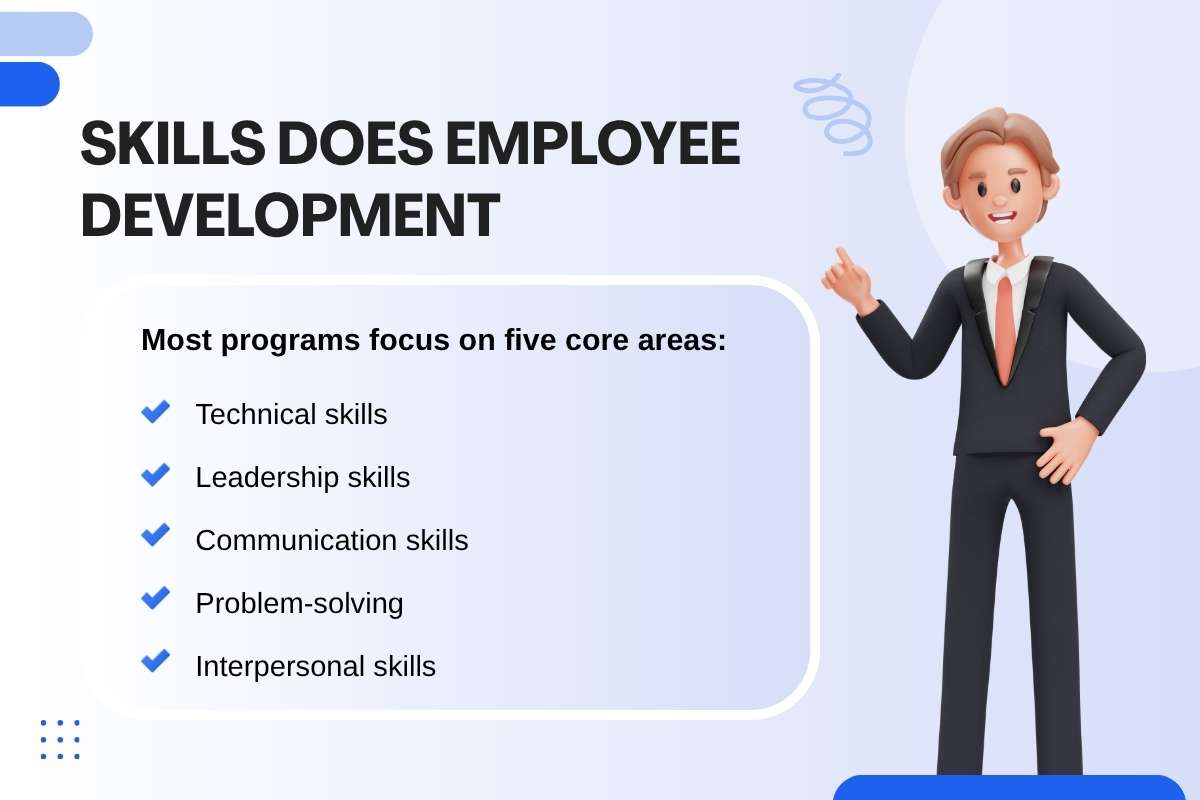
Most programs focus on five core areas:
- Technical skills: Tools and processes tied to the job, like data analysis, coding, or finance
- Leadership skills: Making decisions, giving feedback, and managing people
- Communication skills: Writing, speaking, listening, and presenting clearly
- Problem-solving: Thinking through issues and finding practical solutions
- Interpersonal skills: Working well with others, showing empathy, and resolving conflict
The right focus depends on the person’s current role and career goals. A good growth conversation starts by finding which area matters most right now.
What are the Best Strategies for Employee Development?
Strong companies use a mix of these:
1. Mentoring and Coaching:
Pair employees with senior leaders or outside coaches. Employees with mentors are promoted more often than those without.
2. Job Rotation:
Move people across teams for a set time. They learn how other parts of the business work. It also reduces silos and builds empathy across teams.
3. Online Learning Platforms:
Tools like Coursera for Business, LinkedIn Learning, and Udemy Business offer thousands of courses. Employees learn at their own pace. Managers can track who finishes what.
4. Stretch Assignments:
Give people tasks just beyond their comfort zone. This builds skill faster than classroom learning. It also shows employees that you trust them.
5. 360-Degree Feedback:
Get input from managers, peers, and direct reports. This helps spot blind spots. Use it to set focused growth goals.
6. Internal Workshops:
Short sessions run by in-house experts. These are low-cost and easy to tailor. A lunch-and-learn once a month can go a long way.
What Goes Into an Employee Development Plan?
It is a written document that maps out one person’s goals and the steps to get there. A good plan includes:
- Current skills and strengths
- Short-term and long-term goals
- Actions to take: courses, mentors, or projects
- A timeline with clear milestones
- How success will be measured
The most important rule: build the plan with the employee, not for them. When people have a say in their own growth, they follow through. Plans handed down without input are often ignored.
Review the plan every quarter, not just at annual reviews.
How Do You Build an Employee Development Program?

A solid program does not need to be complex. Work through the five steps below. Each step includes what to do, why it matters, and a prompt you can act on right away.
Step 1: Assess Needs
Talk to employees and managers. Find out where the skill gaps are at the individual, team, and company level.
Why it Matters:
You cannot build a useful program without knowing what is actually missing. Guessing leads to generic training that no one uses.
How to Do It:
- Hold short 1-on-1 conversations with team members and their managers
- Ask two questions: “What skill do you most want to build?” and “What skill gap slows your team down most?”
- Use a skills matrix to list roles in rows and required skills in columns. Then rate each person 1 (beginner) to 3 (confident). Gaps appear instantly.
Your Action:
List the top 3 skill gaps on your team before moving to Step 2.
You may also like: Build an Employee Development Program to Upgrade Your Team Right Now
Step 2: Set Clear Goals
Tie every development goal to a business result. Be specific enough that you will know when it is done.
Why it Matters:
Vague goals like “improve communication” are impossible to measure or act on. Specific goals give employees a clear target.
| Vague goal | Specific goal |
| Improve leadership | Lead one cross-team project by Q3 |
| Get better at data | Complete an Excel course and build a monthly report by June |
| Develop communication | Present to the senior team once per quarter, starting Q2 |
How to Do It:
- For each skill gap from Step 1, write one goal using this format: [Action] + [specific output] + [deadline]
- Link it to a business outcome so the employee understands why it matters
Your Action:
Write one development goal for each gap you identified. Use the format above.
Step 3: Choose the Right Methods
Match the learning method to the type of skill. The wrong method wastes time even if the goal is right.
Why it Matters:
A coding skill needs practice, not a leadership workshop. A communication skill needs feedback and repetition, not just a course.
| Skill type | Best methods |
| Technical (tools, systems, processes) | Online courses, certifications, hands-on projects |
| Leadership and management | Coaching, mentoring, and stretch assignments |
| Communication and soft skills | Role play, peer feedback, and presenting opportunities |
| Strategic thinking | Job rotation, cross-functional projects, senior shadowing |
How to Do It:
- Look at each goal from Step 2
- Pick at least two methods per goal: one formal (course or workshop) and one social (mentoring or peer feedback)
- Check what is already available before buying new tools (many teams have unused LinkedIn Learning or Coursera licences)
Your Action:
Match at least one method to each goal. Note what resources you already have access to.
Step 4: Allocate Resources
Set a budget, a timeline, and name one owner before starting the employee development program.
Why it Matters:
Programs with no owner and no deadline rarely happen. Setting these upfront removes the most common reason programs stall.
Typical Budgets:
- Small businesses: $1,000 – $1200
- Mid-size companies: $700 – $900
- Large enterprises: $400 – $600
How to Do It:
- Set a start date and an end date for the first program cycle (6 months is a good starting point)
- Assign one named owner. This person schedules check-ins, tracks progress, and removes blockers
- If the budget is tight, prioritize free resources first: internal mentors, stretch assignments, and free platforms like Google Career Certificates
Your Action:
Write down your budget per person, your start date, and the name of the program owner.
Step 5: Track and Adjust
Decide how you will measure success before the program starts. Review every six months.
Why it Matters:
Without a measure, you cannot tell if the program is working or where to improve.
What to Track:
| Metric | What does it tell you |
| Course completion rate | Whether employees are engaging with the program |
| Performance review scores | Whether skills are improving on the job |
| Promotion and internal mobility rate | Whether the program is building career-ready skills |
| Retention rate | Whether employees feel supported enough to stay |
| Manager feedback | Whether growth is visible in day-to-day work |
How to Do It:
- Pick 2 or 3 metrics from the table above that match your goals
- Set a baseline before the program starts so you have something to compare against
- Schedule a review at 3 months and again at 6 months (do not wait for the annual cycle)
Your Action:
Choose your 2–3 success metrics and note the current baseline for each.
Why Does Employee Development Matter? Benefits and Importance
Here is why companies make it a priority:
| Benefit | What it Means in Practice |
| Higher retention | Employees who grow are less likely to leave |
| Better performance | Skilled workers get better results |
| Leadership pipeline | Internal promotions cost less than outside hires |
| More engagement | Learning keeps people motivated |
| Adaptability | Trained teams handle change better |
Gallup found that companies with engaged employees see 23% higher profit. This is because companies with strong training earn more income per worker than those without. These numbers show that growing your people pays off.
You may also like: Why Employee Development Programs Matter More Than Ever in 2026
What are the Common Challenges in Employee Development?
Even well-funded teams face these issues:
- Time constraints: Employees feel too busy to learn. Fix this by building learning into the workday, not adding it on top.
- Low relevance: Generic courses feel disconnected from real work. Use internal experts or custom content to improve buy-in.
- No follow-through: Plans are made and then forgotten. Regular check-ins and clear ownership keep things on track.
- Weak manager support: Some managers skip team growth. Tying manager bonuses to team development helps change this.
- Hard to measure ROI: It is tough to link training to business results. Use proxies: promotion rates, retention, and performance scores.
Most of these problems come down to one thing: lack of follow-through. You do not need a big budget. You need consistent action.
What is the Role of Learning and Development (L&D)?

Learning and Development (L&D) is the HR function that runs growth programs. It is responsible for designing, running, and tracking them.
A typical L&D team handles:
- Finding training needs across the company
- Building or buying learning content
- Managing platforms and budgets
- Tracking who completes what
- Working with managers to support their teams
In large companies, L&D is a full team with designers and program managers. In smaller companies, one HR person often covers this role.
Either way, L&D works best when it is tied to business goals. It should not run as a separate department that trains people in isolation.
Conclusion
Strong teams are built, not hired. A steady focus on employee development closes skill gaps, lifts performance, and keeps good people around longer.
Start small if needed. One structured growth conversation per quarter is better than none. Pick one strategy from this guide and apply it well. The companies that treat learning as daily work, not a yearly event, are the ones that win long-term.
Frequently Asked Questions
1. What are the 4 stages of developing your team?
The four stages are: onboarding (new to the role), learning (building skills), performing (working with confidence), and mastery (leading or coaching others). These align with the Situational Leadership model by Ken Blanchard.
2. What are the 5 areas of improvement for employees?
The five most common areas are communication, time management, technical skills, teamwork, and leadership. The right focus depends on the person’s role and where they want to grow.
3. How often should development plans be reviewed?
Quarterly check-ins work better than one annual review. Short, regular talks help catch problems early and keep goals current.
4. What is the difference between training and employee development?
Training is short-term and task-specific, like learning a new tool. Development is broader and covers career growth, mindset, and future roles.
5. How do small businesses handle this on a tight budget?
Focus on low-cost methods: peer mentoring, stretch tasks, and free tools like Google Career Certificates. Even 30 minutes of learning a week adds up over a year.
/