

A Gallup-Strada survey found that about 51% of Americans who attended college would change at least one major decision, such as their choice of major, degree, or institution. Many of these regrets come from choices students make before fully understanding what a college is like.
Factors such as campus size, location, and programs can shape the college experience more than many students expect. In this guide, we focus on one of those factors: campus size. Many students imagine college as a few lecture halls and dorm buildings. However, some campuses in the United States are so large that they feel like small towns.
The largest colleges in the US stretch across thousands of acres. They include forests, lakes, research farms, and entire mountain areas. Some campuses are so big that students use bikes, buses, or even cars to get around.
When people search for a list of the biggest colleges in the US, they often see lists based on student population. That tells only part of the story. A university can have many students but a small campus.
How We Ranked the Largest Colleges in the US?
In this guide, we focus on something different: land area.
We ranked the colleges in the US by campus size. These schools offer huge spaces for research, sports, housing, and outdoor learning. Some even manage wildlife reserves and working farms.
To keep this guide clear and fair, we used one simple rule: total campus acreage. Many lists about the biggest colleges in the US mix different numbers. Some rank schools by student population. Others include areas that sit far away from the main campus.
For this list, we focused solely on the area the main campus covers.
Important notes
- Only the campus land area was used: Each school was ranked by the number of acres in its main campus. Land from separate campuses or faraway research sites was not included.
- Enrollment size was not used: Some universities have many students but a smaller campus. Since this guide focuses on the largest colleges in the US by land area, student population was not part of the ranking.
- Numbers came from official sources: Campus size numbers were taken from university websites and trusted education sources. If different sources showed slightly different numbers, we used the figure most often reported.
- The focus was on the main campus: Whenever possible, we counted continuous campus land instead of scattered properties. This keeps the comparison fair for schools on this list.
15 Largest Colleges in the US by Campus Acreage
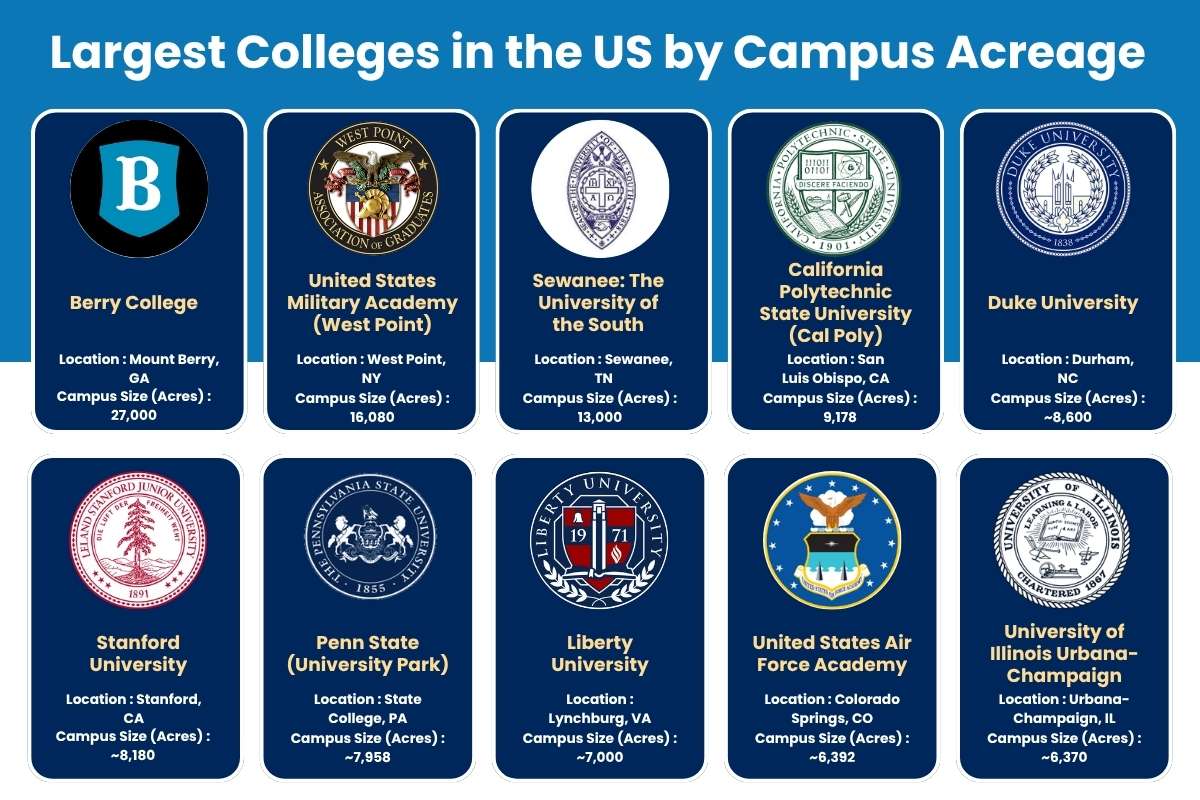
Before we look at the full list, here is a quick comparison of the biggest campuses in America.
| Rank | College | Location | Campus Size (Acres) |
| 1 | Berry College | Mount Berry, GA | 27,000 |
| 2 | United States Military Academy (West Point) | West Point, NY | 16,080 |
| 3 | Sewanee: The University of the South | Sewanee, TN | 13,000 |
| 4 | California Polytechnic State University (Cal Poly) | San Luis Obispo, CA | 9,178 |
| 5 | Duke University | Durham, NC | ~8,600 |
| 6 | Stanford University | Stanford, CA | ~8,180 |
| 7 | Penn State (University Park) | State College, PA | ~7,958 |
| 8 | Liberty University | Lynchburg, VA | ~7,000 |
| 9 | United States Air Force Academy | Colorado Springs, CO | ~6,392 |
| 10 | University of Illinois Urbana-Champaign | Urbana-Champaign, IL | ~6,370 |
| 11 | UC Davis | Davis, CA | ~5,300 |
| 12 | Texas A&M University | College Station, TX | ~5,200 |
| 13 | Michigan State University | East Lansing, MI | ~5,200 |
| 14 | Cornell University | Ithaca, NY | ~4,800 |
| 15 | Virginia Tech | Blacksburg, VA | ~2,600 |
Now let’s explore the institutions that make up the largest colleges in the US by campus size.
1. Berry College
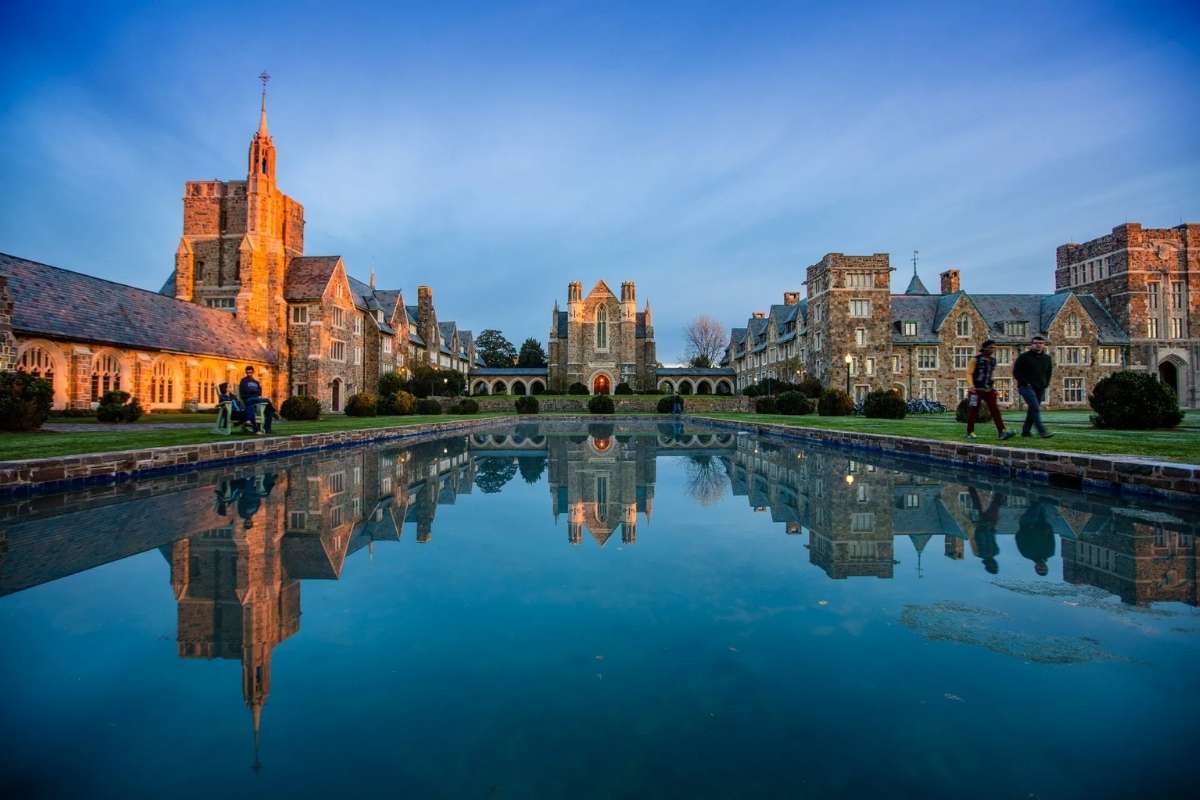
- Location: Mount Berry, Georgia
- Campus Size: ~27,000 acres
Berry College has the largest campus not only in the United States but also in the world. The school sits in the hills of northern Georgia and is surrounded by forests, fields, and small mountains.
The campus includes lakes, wildlife areas, and miles of natural trails that students can explore. Because of its size, much of the land is used for outdoor learning and research. Programs in environmental science, agriculture, and biology use the forests and farmland as living classrooms. This unique setting makes Berry one of the most well-known examples when people talk about the largest colleges in the US.
Key facts:
- Student population: about 2,200 students
- Acceptance rate: about 70%
- Known for strong programs in business, environmental science, and animal science
2. United States Military Academy (West Point)
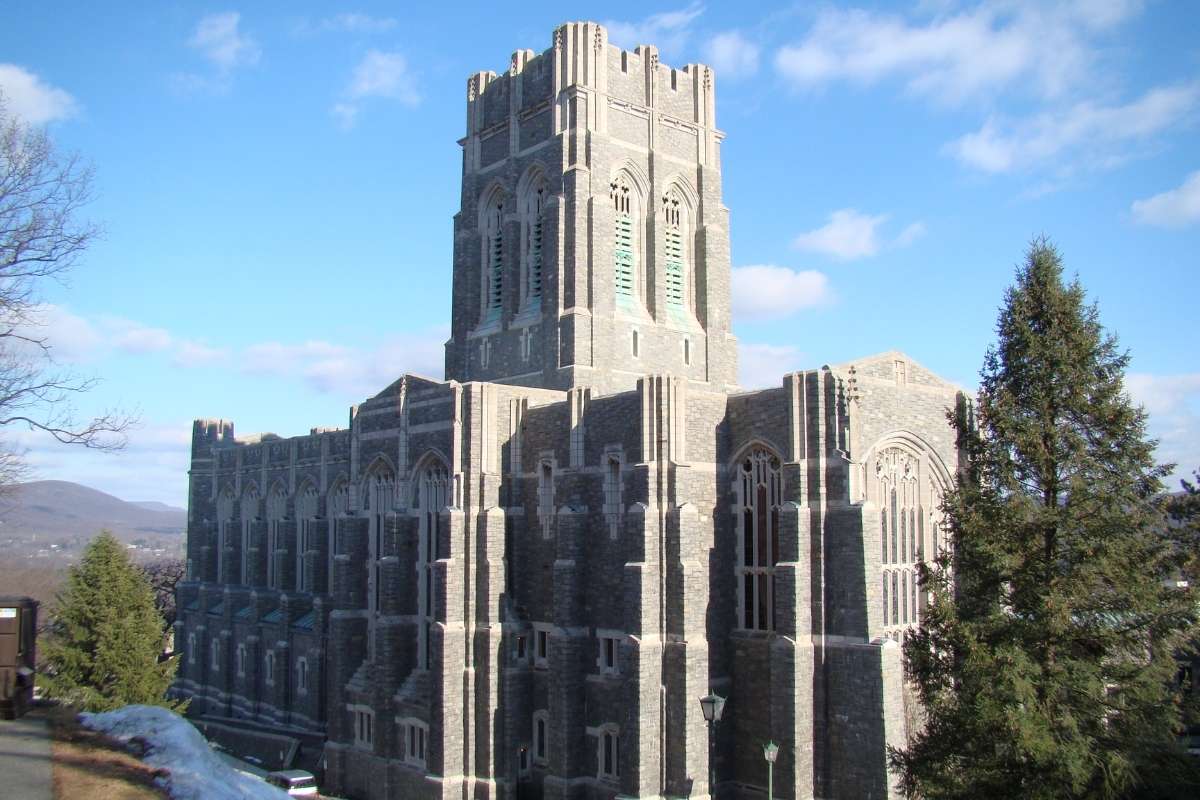
- Location: West Point, New York
- Campus Size: ~16,080 acres
The United States Military Academy at West Point sits along the Hudson River in New York and is surrounded by steep hills and forested land.
Much of the campus is used for military training, which requires large open areas and natural terrain. Cadets practice navigation, survival skills, and tactical exercises across the academy grounds.
The river and surrounding mountains give West Point one of the most scenic settings among major U.S. campuses. At the same time, the academy is one of the most selective institutions in the country, and graduates go on to serve as officers in the U.S. Army.
Key facts
- Student population: about 4,400 cadets
- Acceptance rate: around 10–12%
- Founded in 1802, making it one of the oldest U.S. service academies
3. Sewanee: The University of the South
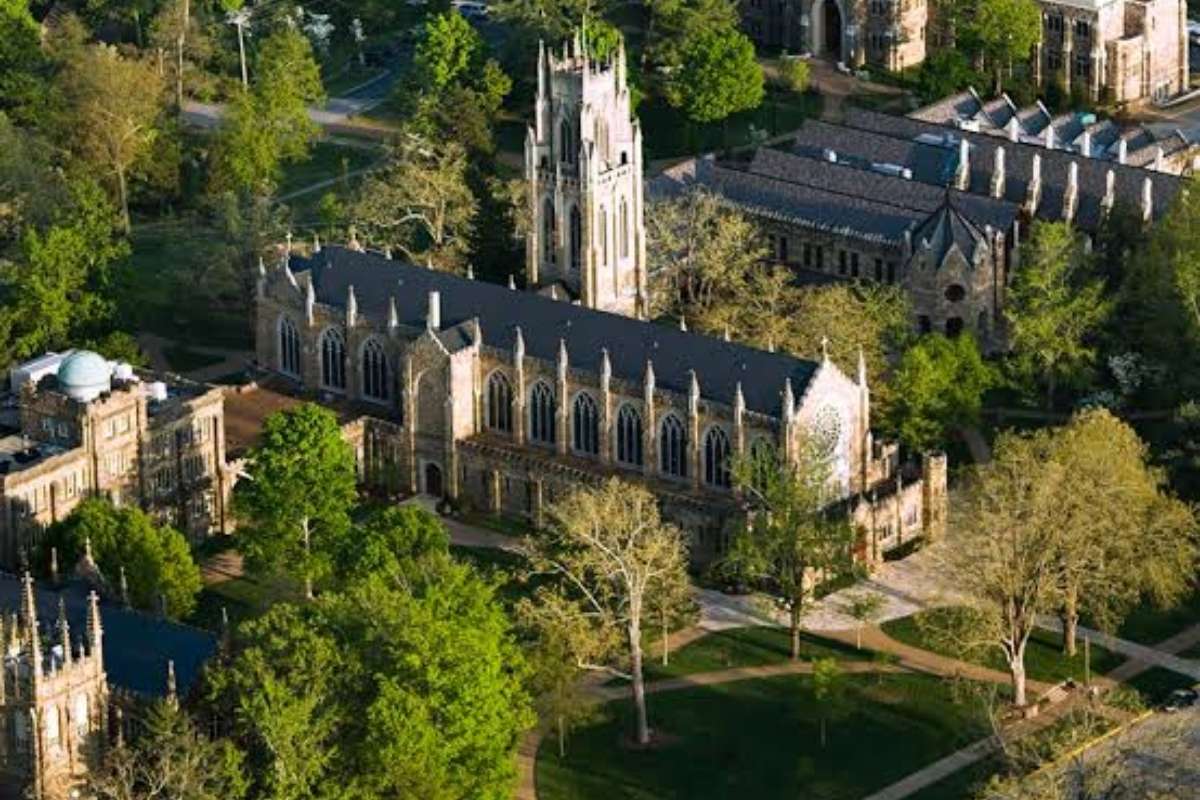
- Location: Sewanee, Tennessee
- Campus Size: ~13,000 acres
Sewanee sits on a large plateau in Tennessee known as “The Domain.” This area covers about 13,000 acres of forests, cliffs, and natural trails that surround the entire campus. The landscape plays a big role in student life, with many students hiking or biking between classes and residence halls.
The university also uses the surrounding forests for research and outdoor study. Environmental science, ecology, and forestry programs often take advantage of the natural setting.
Because of this large protected area, Sewanee is often recognized as one of the most scenic campuses among the largest colleges in the US.
Key facts
- Student population: about 1,700 students
- Known for strong programs in liberal arts and environmental studies
- More than 60 miles of hiking trails on campus
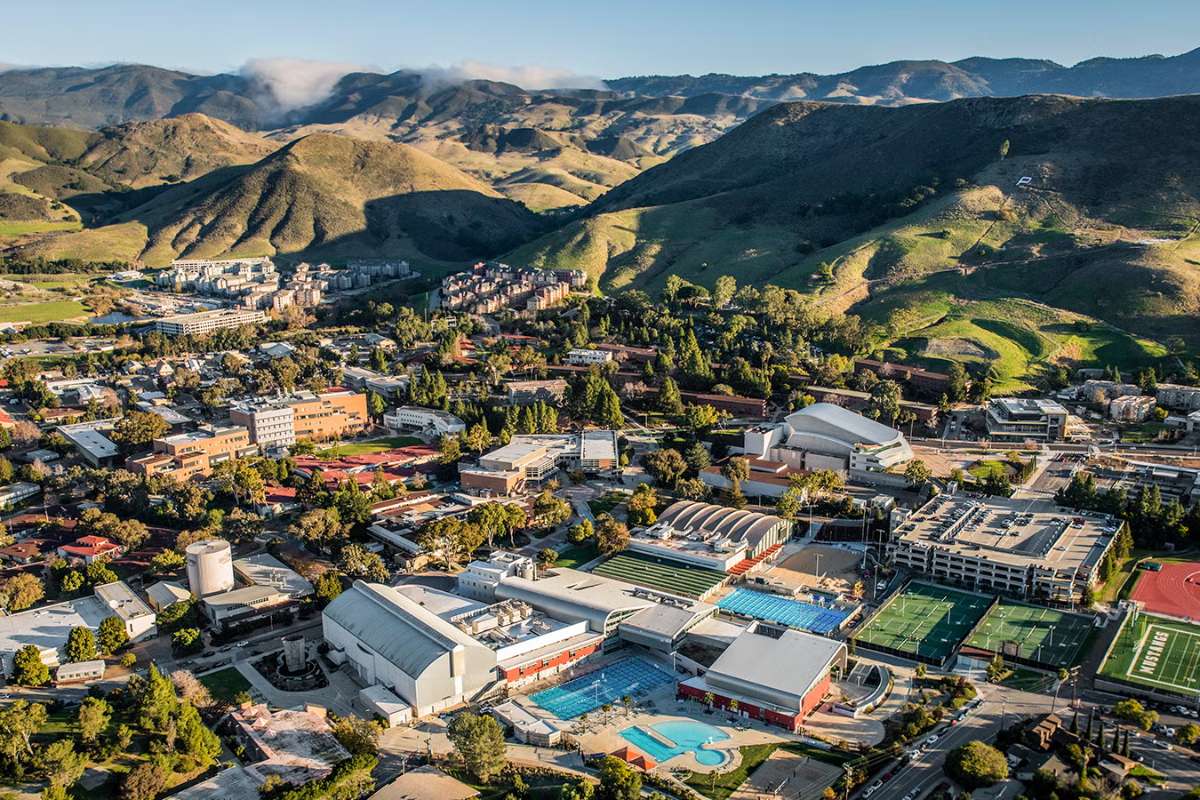
4. California Polytechnic State University (Cal Poly)
- Location: San Luis Obispo, California
- Campus Size: ~9,178 acres
California Polytechnic State University, commonly called Cal Poly, sits between the mountains and the Pacific coast in central California. Its campus includes farmland, research fields, and rolling hills that support many hands-on programs.
Cal Poly follows a “learn by doing” approach, which means students often work directly in labs, farms, and research facilities as part of their classes. Agriculture and engineering students, in particular, benefit from the large campus space.
The wide landscape also allows the university to host modern labs, housing areas, and recreational facilities across the property.
Key facts
- Student population: about 22,000 students
- Acceptance rate: around 30%
- Strong programs in engineering, architecture, and agriculture
Also Read:
- Best Colleges for Finance in the USA Where Top Students Land Six-Figure Jobs
- Looking for the Best Commerce Colleges in India? Here are the Top 10 Highest Ranking Colleges
5. Duke University
- Location: Durham, North Carolina
- Campus Size: ~8,600 acres
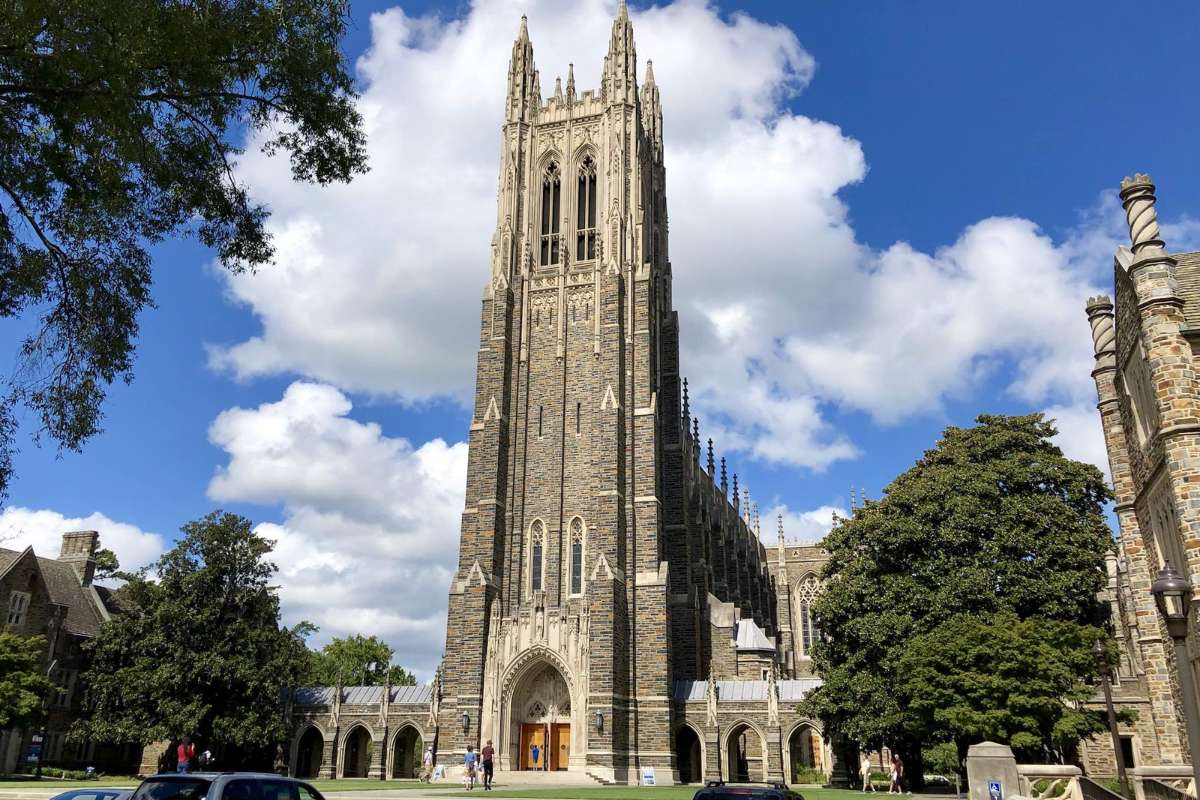
Duke University is known for its beautiful campus and large research facilities in Durham, North Carolina. The university includes forests, gardens, and academic buildings spread across thousands of acres.
One of its most notable areas is Duke Forest, a large research forest used by students and scientists studying ecology and environmental science. Duke also operates a major medical center and several research institutes that take advantage of the large campus.
This mix of nature, academic space, and research facilities makes Duke one of the most distinctive campuses among large U.S. universities.
Key facts
- Student population: about 17,000 students
- Acceptance rate: around 6%
- Known for programs in medicine, public policy, and engineering
6. Stanford University
- Location: Stanford, California
- Campus Size: ~8,180 acres
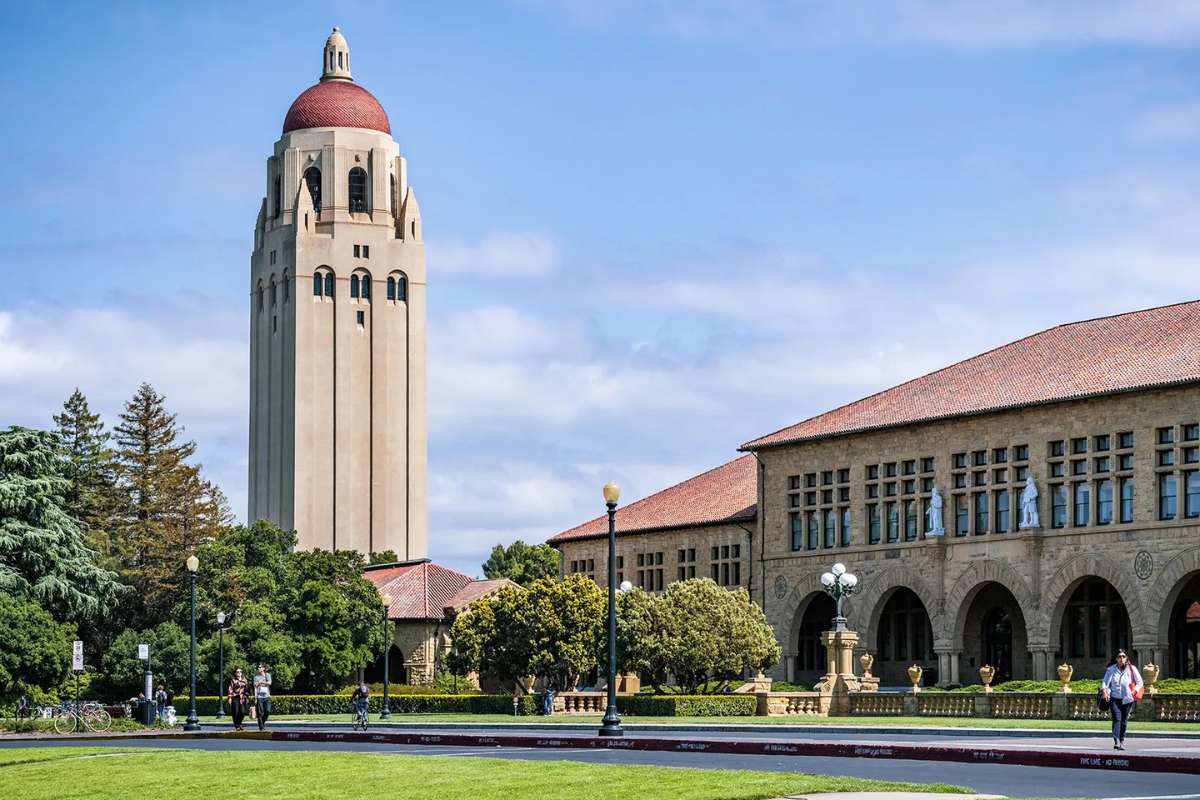
Stanford University sits in Silicon Valley between San Francisco and San Jose. Its campus covers thousands of acres and includes research centers, laboratories, and large residential areas for students.
The university is closely connected to the technology industry, and many startups and tech companies have grown out of Stanford research. The large campus allows room for innovation labs, engineering facilities, and collaborative spaces where students work on new ideas.
Stanford’s size also supports athletic facilities, parks, and housing communities that make it feel like a small town.
Key facts
- Student population: about 17,000 students
- Acceptance rate: about 4%
- Strong programs in computer science, engineering, and business
7. Penn State (University Park)
- Location: State College, Pennsylvania
- Campus Size: ~7,958 acres
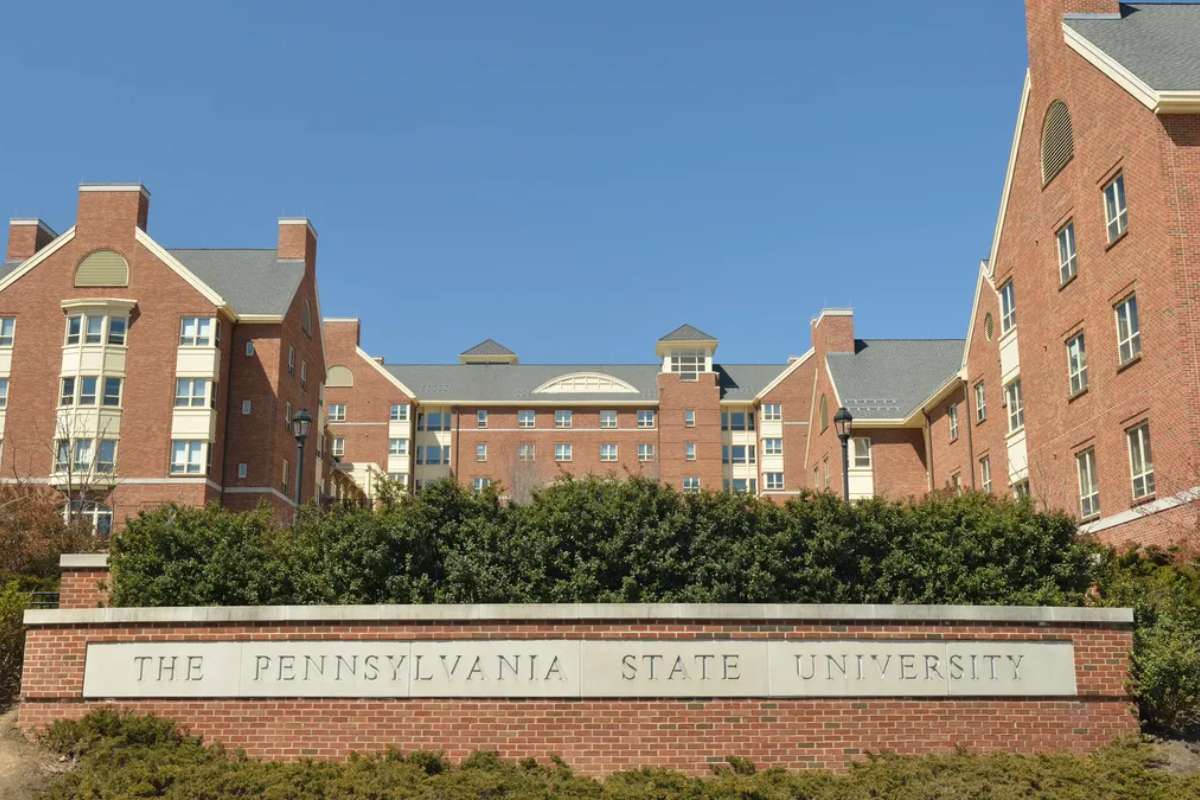
Penn State’s main campus, University Park, sits in central Pennsylvania and serves as the flagship campus of the Penn State system.
The university has large academic buildings, research facilities, and agricultural land spread across its campus. Because of its size, the university can support major programs in engineering, environmental science, and agriculture.
The campus also includes large stadiums, residence halls, and student centers that serve thousands of students each year. University Park is one of the largest colleges in the US.
Key facts
- Student population: about 48,000 students at University Park
- One of the largest public universities in the U.S.
- Known for strong programs in engineering, business, and communications
8. Liberty University
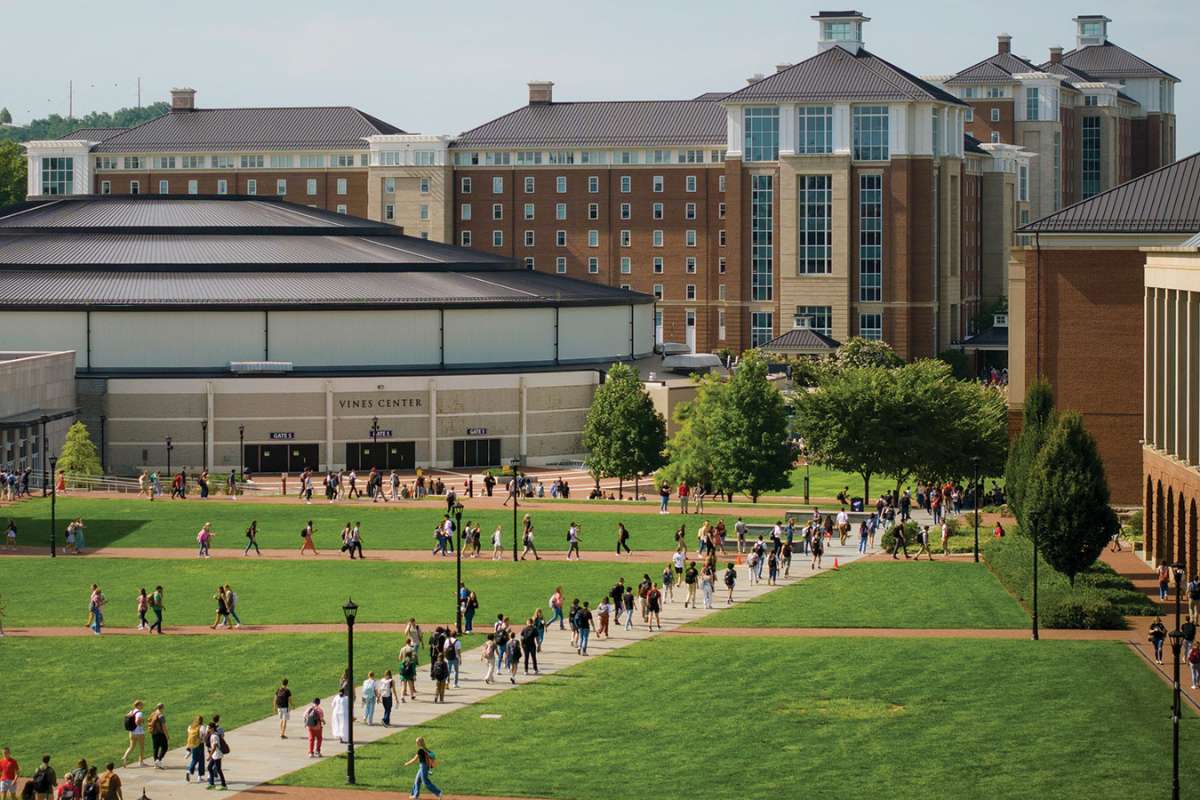
- Location: Lynchburg, Virginia
- Campus Size: ~7,000 acres
Liberty University sits near the Blue Ridge Mountains in Virginia and has grown rapidly over the past two decades.
The campus includes academic buildings, residence halls, sports complexes, and large training facilities. Liberty has also developed a major online education program, which has helped expand its student population.
The large campus provides space for recreation areas, athletic venues, and student housing communities. Its location near the mountains also gives students access to outdoor activities and scenic views throughout the year.
Key facts
- On-campus students: about 15,000
- Total students including online programs: 100,000+
- Known for programs in business, aviation, and communications
9. United States Air Force Academy
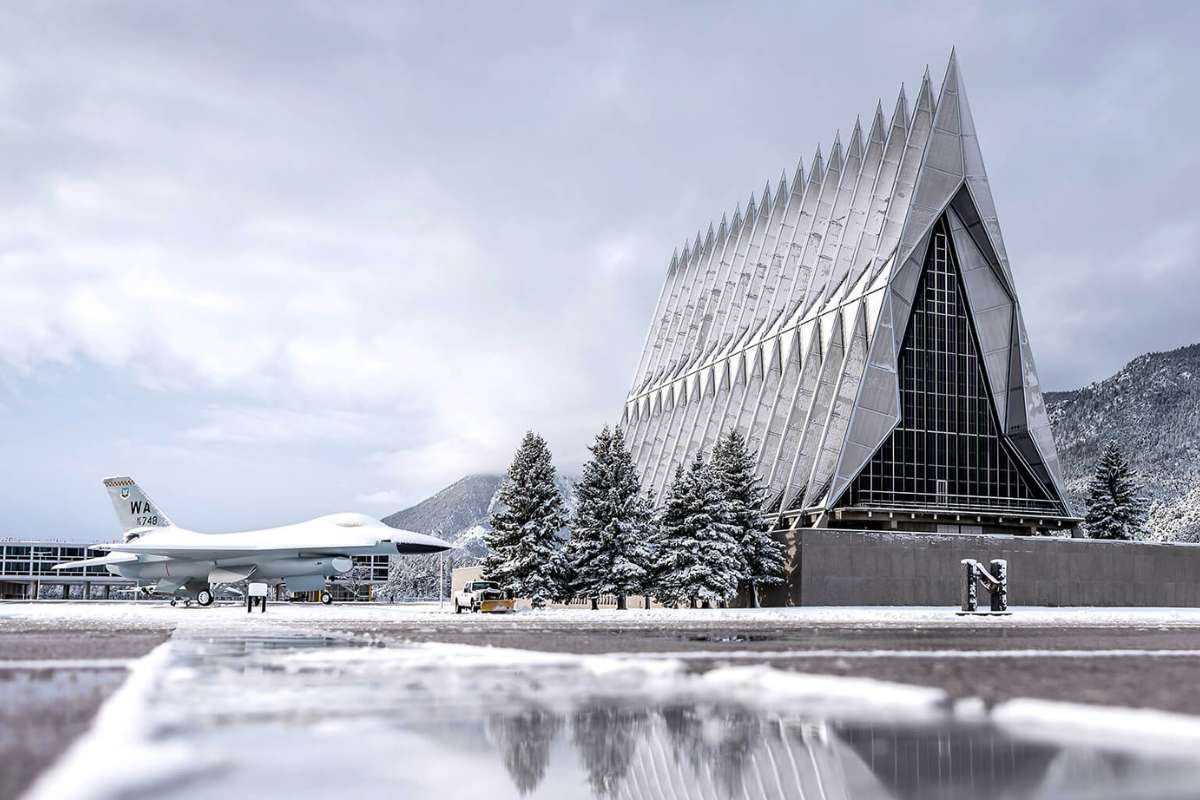
- Location: Colorado Springs, Colorado
- Campus Size: ~6,392 acres
The United States Air Force Academy sits near the Rocky Mountains in Colorado Springs and includes open plains, training fields, and academic facilities.
The campus was designed to support both military training and higher education. Cadets spend time in classrooms studying engineering and science, while also completing leadership training and physical exercises across the campus.
The mountain landscape adds to the academy’s dramatic setting. The wide campus allows room for flight training support facilities, athletic fields, and military training grounds.
Key facts
- Student population: about 4,400 cadets
- Acceptance rate: around 12%
- Strong focus on engineering, physics, and military leadership
10. University of Illinois Urbana-Champaign
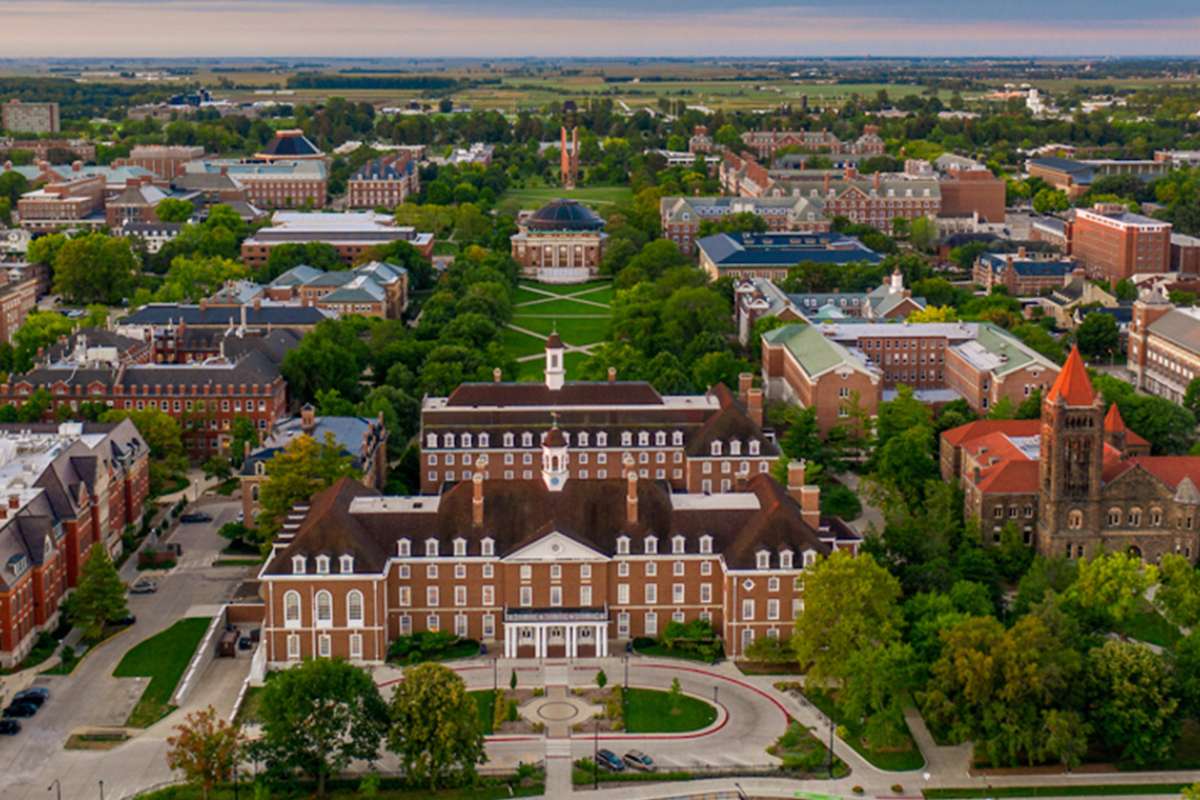
- Location: Urbana-Champaign, Illinois
- Campus Size: ~6,370 acres
The University of Illinois Urbana-Champaign is a major public research university known for its strong programs in engineering and technology and is among the largest colleges in the US.
Its campus includes academic buildings, laboratories, and agricultural research land that support a wide range of studies. Much of the surrounding farmland is used for research in agriculture, food science, and environmental studies.
Because of its large campus, the university can host research centers, housing communities, and recreational facilities that support a large student population.
Key facts
- Student population: about 56,000 students
- Known for top programs in computer science and engineering
- Member of the Big Ten academic alliance
Also Read:
- NEET 2026 Aspirants’ Guide: Top 15 Indian Medical Colleges to Secure Your Dream MBBS Seat
- Which Schools Shaped American Education? The 15 Oldest Colleges in the US Tell the Story
11. UC Davis
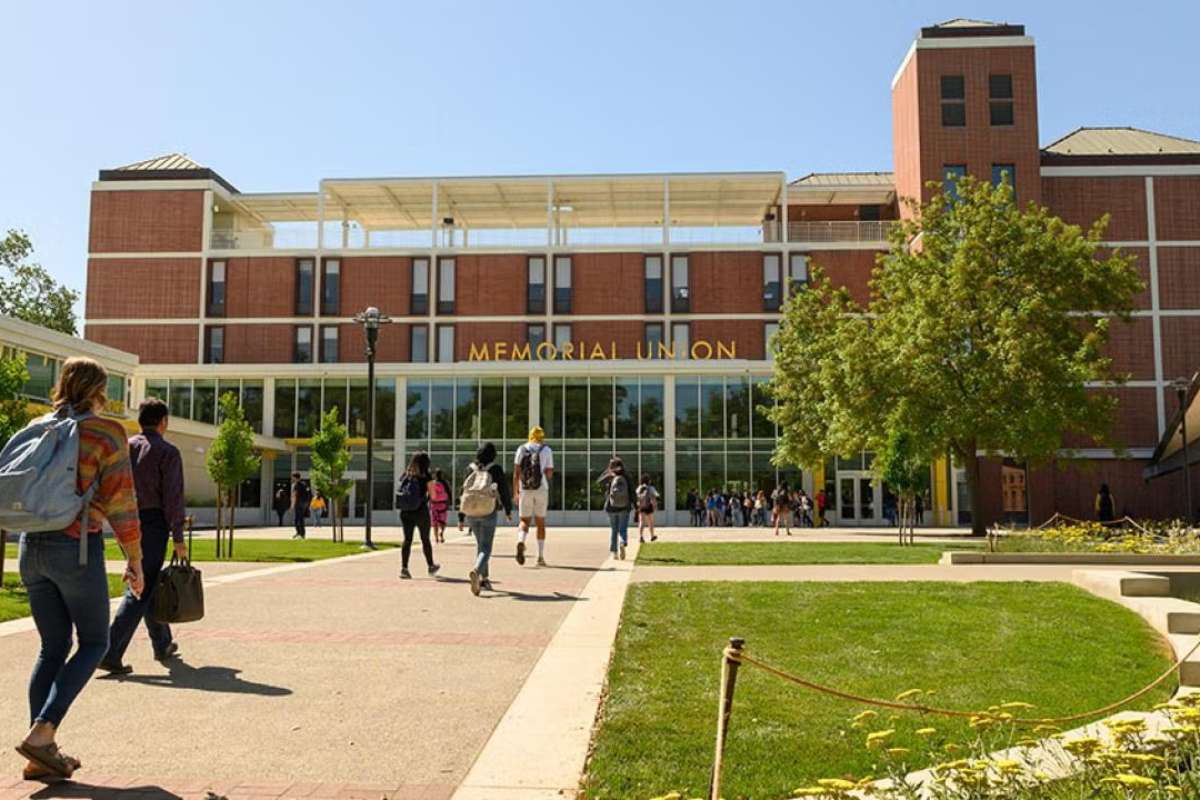
- Location: Davis, California
- Campus Size: ~5,300 acres
UC Davis began as an agricultural branch of the University of California system and remains a leader in agricultural and environmental research.
The campus includes farmland, research laboratories, veterinary facilities, and teaching centers. Many programs use the surrounding fields and greenhouses as part of hands-on learning.
The university is especially known for its work in animal science, plant science, and environmental studies. The large campus also supports student housing, recreation areas, and research institutes that attract scholars from around the world.
Key facts
- Student population: about 39,000 students
- Home to one of the top veterinary schools in the world
- Strong programs in biology, agriculture, and environmental science
12. Texas A&M University
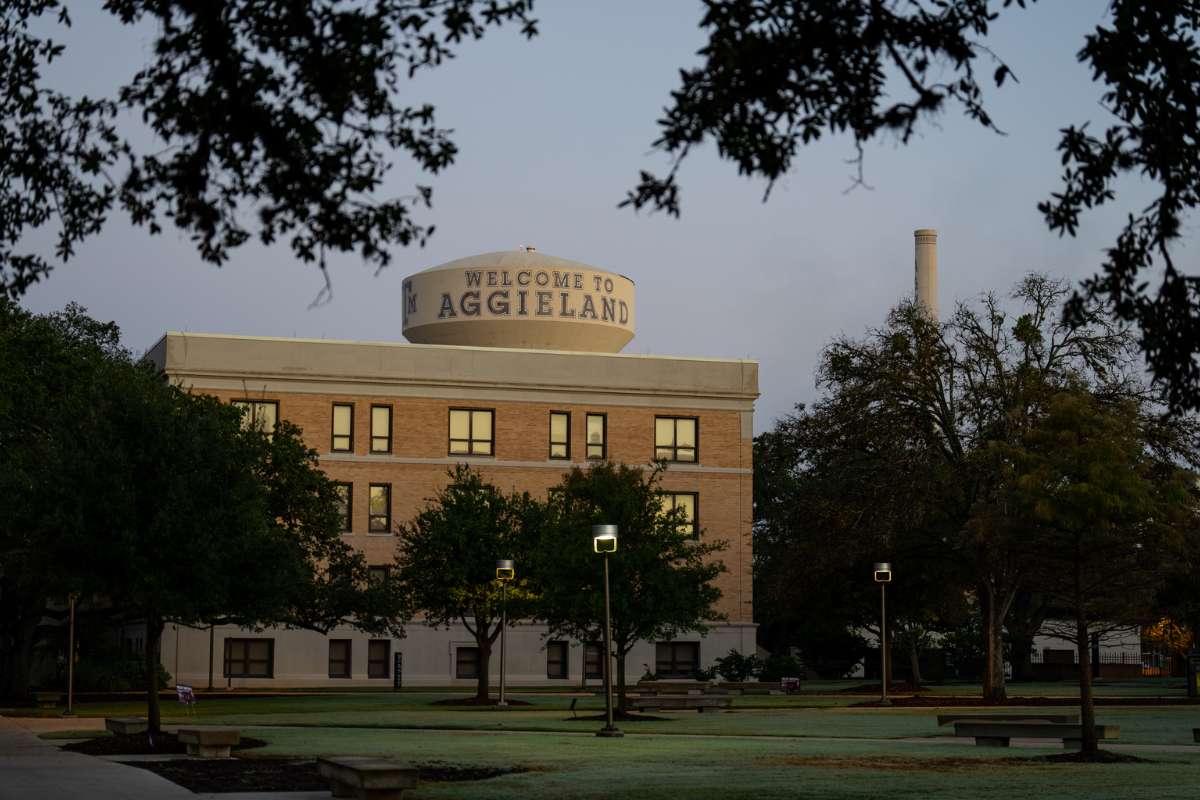
- Location: College Station, Texas
- Campus Size: ~5,200 acres
Texas A&M University is one of the largest public universities in the United States. It operates a massive campus in College Station, making it one of the largest colleges in the US.
The university supports thousands of acres of academic buildings, research centers, and agricultural land. Its large campus allows the school to host major engineering labs, athletic facilities, and housing for a large student body.
Texas A&M is also home to the Corps of Cadets, which adds a military leadership component to student life.
Key facts
- Student population: about 75,000 students
- One of the largest engineering schools in the U.S.
- Member of the SEC athletic conference
13. Michigan State University
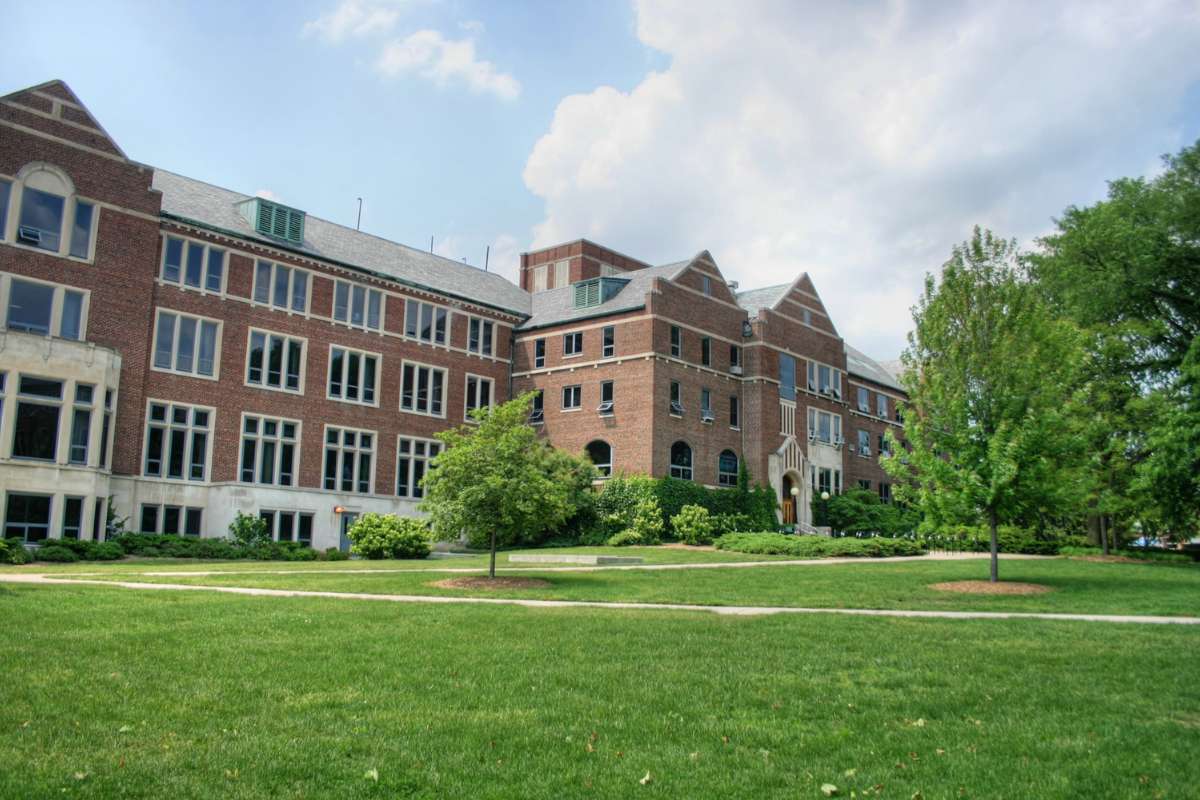
- Location: East Lansing, Michigan
- Campus Size: ~5,200 acres
Michigan State University sits along the Red Cedar River and has one of the largest continuous campuses in the United States.
The university includes academic buildings, parks, athletic facilities, and large agricultural research farms. As a land-grant university, Michigan State has long focused on agricultural science, environmental research, and public education.
The campus design combines natural green spaces with modern research buildings, giving students access to both outdoor study areas and advanced laboratories, a feature often seen in the largest colleges in the US.
Key facts
- Student population: about 50,000 students
- One of the first land-grant universities in the U.S.
- Strong programs in supply chain management and agriculture
14. Cornell University
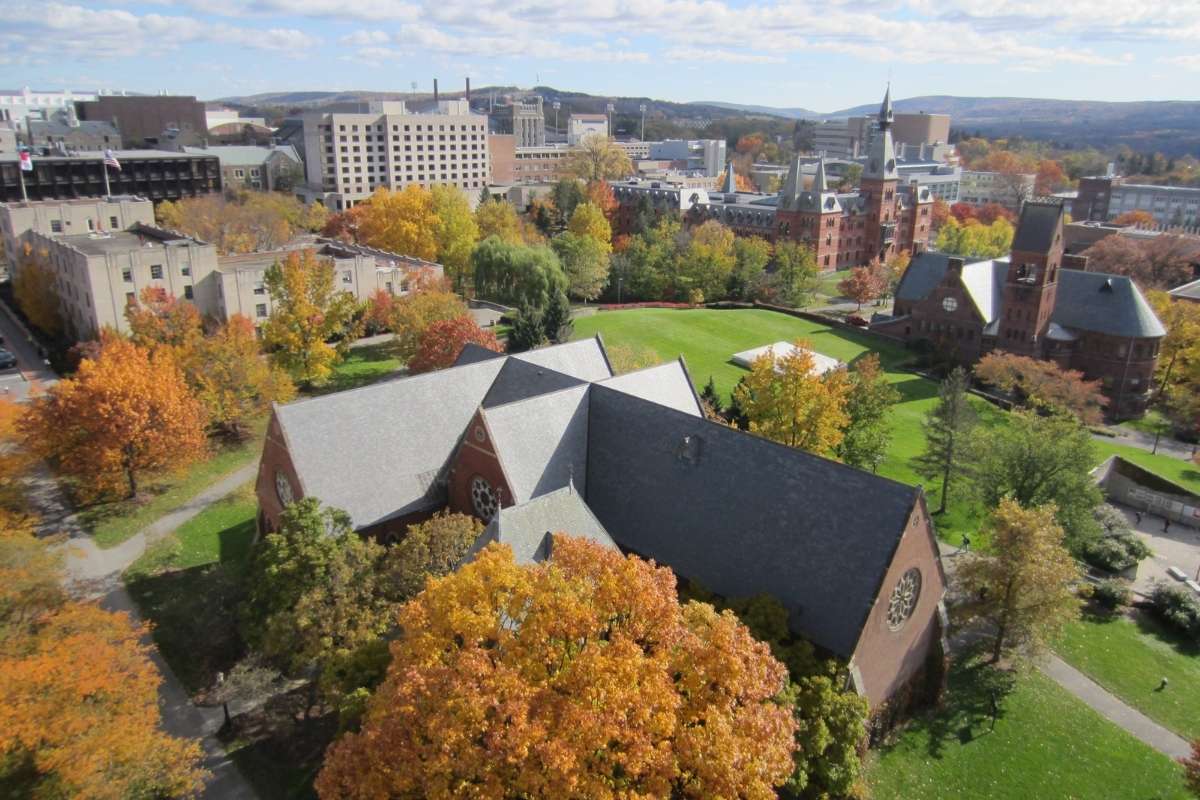
- Location: Ithaca, New York
- Campus Size: ~4,800 acres
Cornell University sits above Cayuga Lake in the Finger Lakes region of New York. The campus covers thousands of acres and includes hills, forests, and waterfalls. Many parts of the university overlook the lake and the surrounding valley.
Cornell also operates research farms and environmental study areas used for teaching and experiments. Students in agriculture, biology, and environmental science often work in these outdoor spaces.
As an Ivy League school, Cornell combines strong academics with large research facilities. This mix of nature and research gives students many ways to learn.
Key facts
- Student population: about 26,000 students
- Member of the Ivy League
- Known for programs in engineering, hospitality, and agriculture
15. Virginia Tech
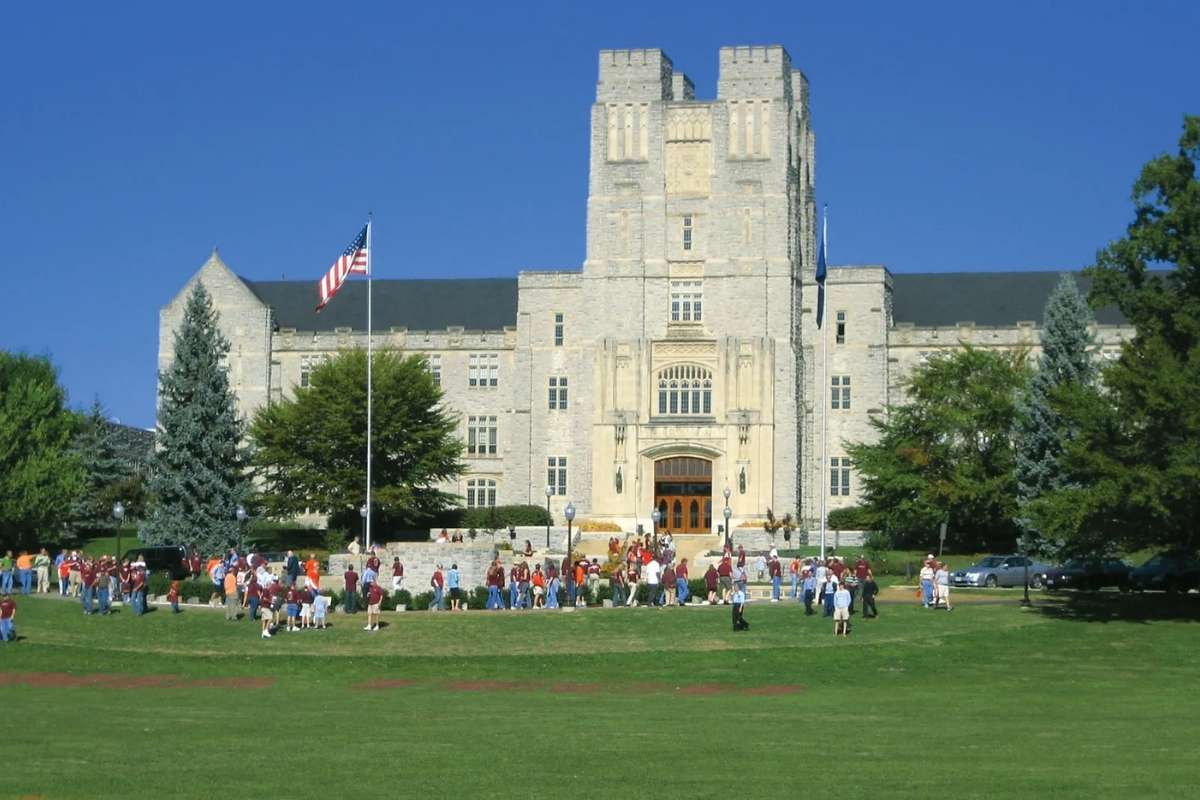
- Location: Blacksburg, Virginia
- Campus Size: ~2,600 acres
Virginia Tech sits in the mountains of southwestern Virginia and is known for its large stone buildings and open campus layout.
The campus covers a wide area and includes classrooms, research labs, and agricultural fields. Many programs use these spaces for hands-on learning, especially in engineering and agriculture.
Students often work in labs, research centers, and outdoor study areas as part of their courses. The surrounding Appalachian landscape also gives students access to hiking, biking, and other outdoor activities near campus.
Key facts
- Student population: about 38,000 students
- Known for strong programs in engineering and architecture
- Home to one of the largest engineering colleges in the U.S.
Why Students Choose the Largest Colleges in the US?
Many students like the feel of a big campus. These colleges in the US offer a lot of space, many buildings, and many things to do. Life on these campuses can feel like living in a small town.
Large campuses often give students more choices for learning, sports, and daily life.
Benefits of large Campuses Include:
- More research labs and facilities
Big universities often have many labs, study centers, and research buildings. This helps students in fields like science, engineering, and medicine. - Large sports and recreation areas
Many of these colleges in the US have stadiums, sports fields, gyms, and fitness centers. Students can join sports teams or stay active. - Outdoor learning opportunities
Some campuses include forests, farms, lakes, and nature trails. Students can study plants, animals, and the environment right on campus. - Room for new programs and buildings
Large campuses have space to grow. Universities can add new labs, housing, and classrooms as programs expand.
At many of the large colleges in the US, students can live in dorms, eat, study, work, and relax without leaving campus. This makes daily life easier and helps build a strong campus community.
What Life is Like on the Largest College Campuses?
Life at the largest colleges in the US can feel very different from life at a smaller school. These campuses cover thousands of acres, so the university often feels like a small town. Students may live, study, eat, and relax in different parts of campus throughout the day.
Because of the size, daily routines can look a little different. Many students plan their schedules around travel time between classes or activities.
Here are a few things students often experience on large campuses:
- Long walks between classes:
Buildings can be far apart. Students often walk, bike, or use campus buses to move around. - Many places to study and relax:
Large universities usually have several libraries, study halls, and student centers. - More clubs and events:
Bigger schools often host sports games, concerts, club meetings, and campus events. - Outdoor spaces and nature areas:
Some of the biggest colleges in the US include forests, farms, lakes, and trails that students can explore. - Large housing and dining areas:
Many students live in dorm communities with dining halls, gyms, and common spaces nearby.
For students who enjoy activity and space, these large colleges can offer a lively and flexible campus experience. Before we look at the full list, here is a quick comparison of the biggest campuses in America.
Are the Largest Colleges in the US Better for Students?
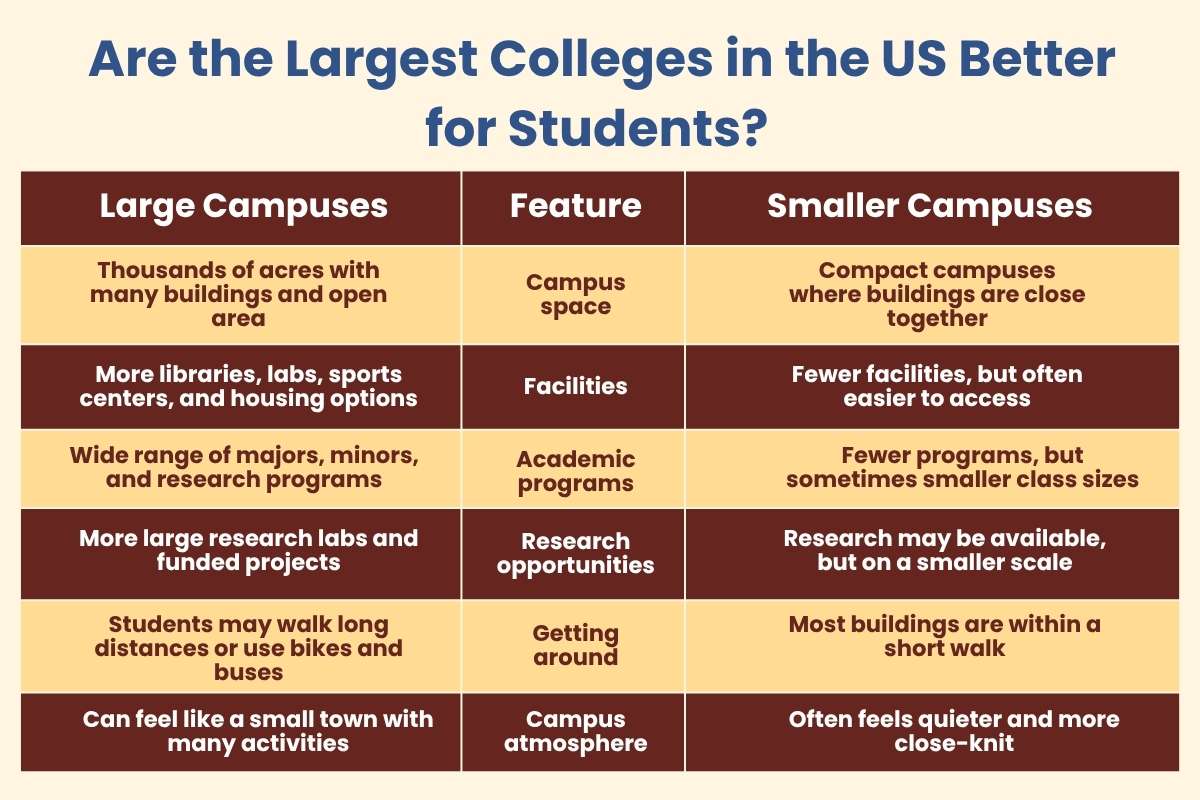
Not always. Campus size can change what daily life feels like in college. Some students enjoy big campuses with many buildings and activities. Others prefer smaller campuses where everything is close together.
Large campuses often offer more facilities, programs, and research spaces. At the same time, smaller campuses can feel easier to navigate and more personal.
The table below shows a simple comparison.
| Large Campuses | Feature | Smaller Campuses |
| Thousands of acres with many buildings and open areas | Campus space | Compact campuses where buildings are close together |
| More libraries, labs, sports centers, and housing options | Facilities | Fewer facilities, but often easier to access |
| Wide range of majors, minors, and research programs | Academic programs | Fewer programs, but sometimes smaller class sizes |
| More large research labs and funded projects | Research opportunities | Research may be available, but on a smaller scale |
| Students may walk long distances or use bikes and buses | Getting around | Most buildings are within a short walk |
| Can feel like a small town with many activities | Campus atmosphere | Often feels quieter and more close-knit |
For students who enjoy space, events, and many choices, the largest colleges in the US can be a strong option. Others may prefer a smaller campus where daily life feels simpler and more connected.
Conclusion
College campuses in the United States come in many sizes. Some sit in busy cities with only a few blocks of space. Others stretch across forests, farms, and open land.
The largest colleges in the US show how much space a university can use for learning and research. Schools like Berry College, Stanford University, and Texas A&M have campuses that cover thousands of acres.
This extra space allows universities to build research labs, sports centers, housing, and large outdoor study areas. Some campuses also include forests, farmland, and nature trails that students can explore.
For many students, these large campuses create a unique college experience. They offer room to study, relax, and take part in many activities.
Students who enjoy open space and big campus communities may find that these colleges offer the environment they are looking for.
FAQs
1. Are the largest colleges in the US mostly in rural areas?
Yes. Large campuses are often built outside major cities where more land is available.
2. Do large campuses include research land?
Many large universities operate farms, forests, or research fields used for teaching and studies.
3. How long does it take to walk across a large campus?
At some large universities, it can take 20 minutes or more to walk from one side to the other.
4. Do large campuses have their own services?
Some universities run their own transit, police, housing, and health services.