
Employee training and development help employees build skills for their current role and grow into future ones. This article explains the difference between training and development and how to build a program step by step. You’ll also understand what best practices look like in practice. Whether you are starting fresh or improving what you have, you will leave with a clear plan you can act on.
The average employee gets about 1 hour of learning per week. That’s less time than many of the team meetings. And yet, companies expect their people to keep up with faster technology and shifting markets.
The companies pulling ahead are not waiting for that gap to close on its own. They treat employee training and development as a core business strategy, not a box to check once a year.
This article covers exactly how to do that. You’ll find clear definitions and a step-by-step process to build your own program. You’ll also find the key reasons why investing in your people is one of the smartest business decisions you can make.
What is an Employee Training and Development Program?
The program is a structured set of activities designed to improve employee skills and performance. It covers both short-term skill building (training) and long-term career growth (development).
Key Components
| Component | Purpose |
| Skills training | Teach job-specific tasks and tools |
| Onboarding | Help new hires get up to speed |
| Leadership development | Prepare employees for senior roles |
| Compliance training | Meet legal and safety requirements |
| Career pathing | Align individual goals with company needs |
A strong employee training and development program does not focus only on what the company needs today. It also prepares employees for what comes next.
Employee Development Plan vs. Training Program: What’s the Difference?
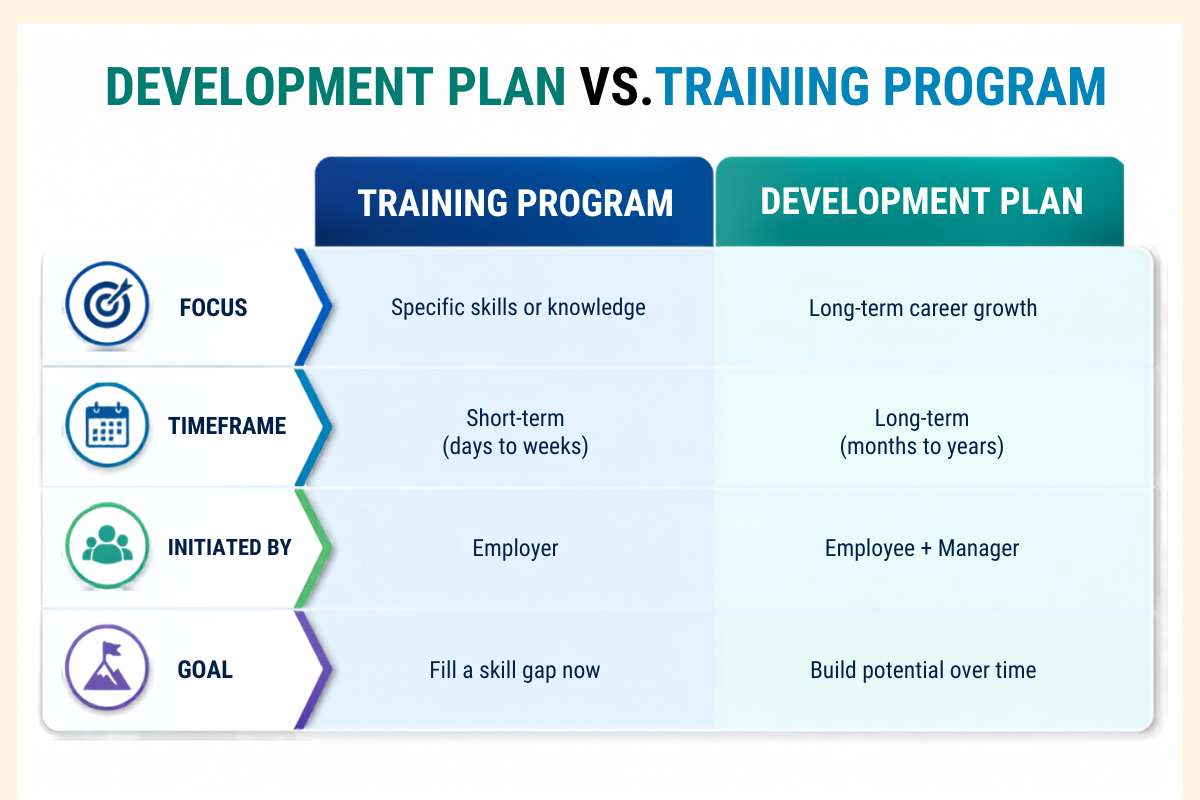
These two terms are often used together, but they serve different purposes.
| Training Program | Development Plan | |
| Focus | Specific skills or knowledge | Long-term career growth |
| Timeframe | Short-term (days to weeks) | Long-term (months to years) |
| Initiated by | Employer | Employee + Manager |
| Goal | Fill a skill gap now | Build potential over time |
Types of Employee Development Programs
- Mentoring: Pairing employees with experienced leaders for guidance
- Job Rotation: Moving employees across departments to broaden skills
- Leadership Accelerators: Fast-track programs for high-potential employees
- Tuition Reimbursement: Supporting external education
Also read: Why Employee Development Programs Matter More Than Ever in 2026
Types of Employee Training Programs
- Onboarding Training: For new hires joining the team
- Technical Training: Software, tools, equipment
- Soft skills Training: Communication, time management, teamwork
- Compliance Training: Workplace safety, data privacy, ethics
- Sales Enablement Training: Product knowledge, objection handling
How Do You Build an Employee Training and Development Program That Works?
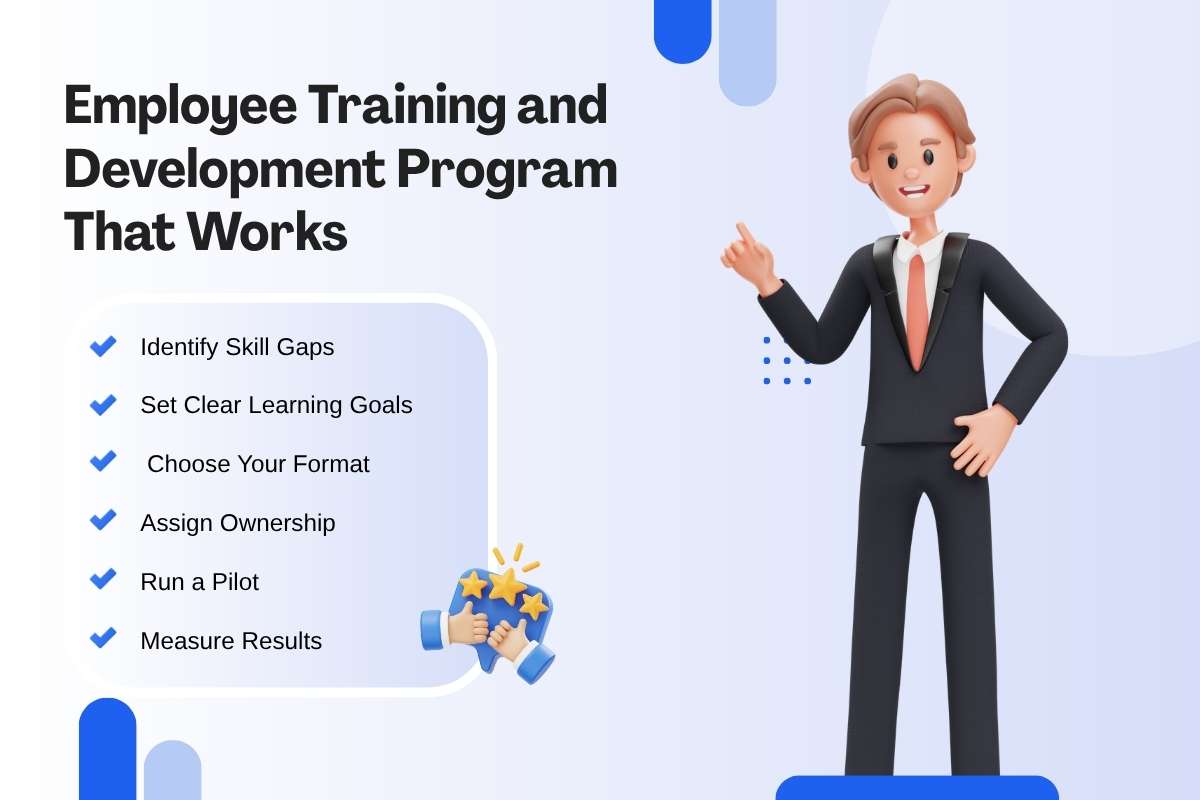
Building an effective program does not require a massive HR team. It requires the right process. Follow this six-step process to design something that delivers real results.
Step 1: Identify Skill Gaps
Start with a skills audit or a simple survey. Compare what employees can do today with what your business actually needs from them. Tools like 15Five or even a structured manager review can surface gaps quickly. Look at performance data, customer feedback, and error rates. These often point directly to where training is missing.
Step 2: Set Clear Learning Goals
Vague goals produce vague outcomes. Define what success looks like in specific, measurable terms. For example: “After training, customer service reps will resolve 90% of tickets without escalation.” A clear target also makes it much easier to evaluate the program later.
Step 3: Choose Your Format
There is no single best format. Match the method to the role and the content:
- In-person workshops (great for hands-on or collaborative topics)
- Self-paced e-learning via platforms like Coursera for Business or LinkedIn Learning
- On-the-job coaching (best for practical, role-specific skills)
- Blended learning – a mix of formats for flexibility
Remote and hybrid teams often do well with a blend of async modules and live check-ins.
Step 4: Assign Ownership
Every program needs a clear owner. Decide who is responsible for creating, delivering, and updating each training. L&D teams, direct managers, and external vendors all have a role depending on the topic and scale.
Step 5: Run a Pilot
Before rolling out company-wide, test with a small group. Collect honest feedback on what worked and what did not. A pilot saves time and avoids scaling something that is not working yet.
Step 6: Measure Results
Use the Kirkpatrick Model to evaluate impact at four levels:
- Level 1: Did employees enjoy and engage with the training?
- Level 2: Did they actually learn something new?
- Level 3: Did their behavior change back on the job?
- Level 4: Did it move the needle on business results?
Tracking all four levels gives you a full picture, not just whether people liked the session, but whether it changed anything.
Best Practices to Build Effective Employee Training and Development Programs
Here are the practices that high-performing companies actually follow:
- Make learning continuous, not one-off. Offer short, recurring sessions rather than annual training.
- Personalize where possible. Let employees choose learning paths based on their role and career goals.
- Connect training to performance reviews. Tie development to real career outcomes so employees take it seriously.
- Use managers as coaches. Employees learn best from direct feedback, not just formal programs.
- Track completion and impact. Completion rates tell you very little. Measure behavior change.
Real Example: Google’s Project Oxygen
Google noticed that employees on well-managed teams performed better and stayed longer. So they studied what their best managers did differently. The answer was simple. The best managers gave regular feedback, supported career growth, and coached their teams rather than just telling them what to do.
Google used these findings to build a manager training program. Managers learned coaching skills, employees got structured feedback, and progress was tracked over time. Both team performance and employee satisfaction improved.
Why Do Employee Training and Development Programs Matter?
Three reasons stand out. First, skill gaps are growing faster than most companies can handle. Without structured development, teams fall behind. Second, employees expect it. People who feel invested are far more likely to stay. Third, the performance impact is real. Better-trained employees can solve problems faster and need less guidance.
Is Employee Training & Development Crucial for Organizations?

Yes. Beyond individual performance, training shapes the entire organization.
- It reduces turnover costs (replacing an employee can cost 50–200% of their annual salary)
- It accelerates onboarding for new hires
- It builds a pipeline of future leaders internally
- It keeps the company compliant with industry regulations
- It improves customer satisfaction when frontline employees are skilled
A well-run employee training and development strategy is not just an HR function; it is a business growth driver.
Benefits at a Glance
| Benefit | Who Gains |
| Higher productivity | Company |
| Faster promotion readiness | Employee |
| Lower turnover | Company + Employee |
| Stronger compliance | Company |
| Better morale and engagement | Employee |
| Competitive advantage in hiring | Company |
Conclusion
A strong employee training and development program does two things at once. It helps the business perform better today, and it prepares people for what the company needs tomorrow.
Start small if you must. Pick one skill gap, design one clear training path, measure the outcome, and build from there. The companies winning in this space are not the ones with the biggest budgets. They are the ones who treat learning as a priority, not an annual checkbox.
Frequently Asked Questions
1. What is the difference between training and development?
Training builds skills for an employee’s current role. Development prepares them for future roles and bigger responsibilities.
2. How often should employee training programs run?
Aim for formal training every quarter; for everything in between, short on-demand modules keep learning going without overwhelming anyone.
3. Who is responsible for employee development?
It is a shared effort. HR builds the framework, managers coach day to day, and employees take ownership of their own growth.
4. How do you measure the ROI of a training program?
Use the Kirkpatrick Model to track what employees learned and how their behavior changed. Then compare performance numbers before and after.