
Key Takeaways
- Stanford University and SLAC will lead several SLAC AI projects under the U.S. Department of Energy’s Genesis Mission.
- The projects will use AI to speed up research in clean energy, biology, and more.
- Scientists will build AI tools that can run experiments faster.
Stanford University and SLAC National Accelerator Laboratory will lead new AI projects that aim to solve major science challenges faster through the U.S. Department of Energy’s Genesis Mission.
Stanford and SLAC Take the Lead
Stanford University and SLAC National Accelerator Laboratory will lead several Phase I SLAC AI projects in the Genesis Mission. The program brings together universities, national labs, and companies. They will build AI tools that help scientists solve problems faster.
The projects focus on clean energy, advanced materials, biology, particle physics, and critical minerals. Scientists want to shorten the time needed for research. They also want AI to help them make better decisions during experiments.
One Stanford project is called ORACLE. It will build AI tools that can spot unusual patterns during experiments. The system will also help scientists understand why those patterns appear. This could help researchers make discoveries sooner.
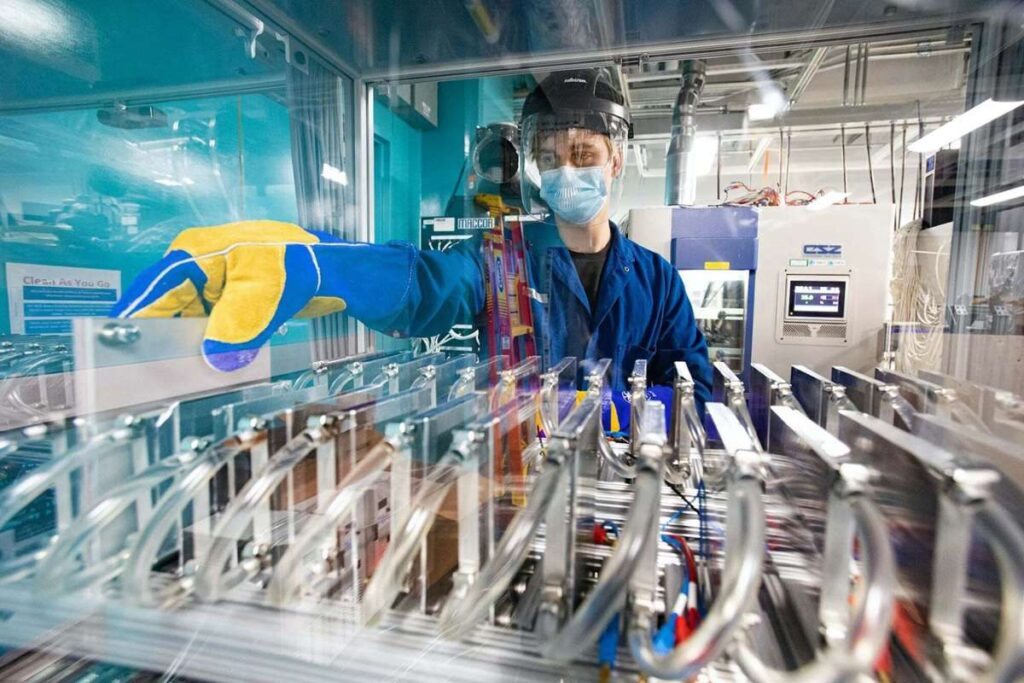
SLAC will lead another project that focuses on battery recycling. As part of the SLAC AI projects, they will use AI to find and recover valuable metals from used batteries. Better recycling could improve the supply of important minerals for electric vehicles and clean energy systems.
AI Will Help Scientists Save Time
Modern research labs create huge amounts of data every day. Scientists cannot review all of it by hand. AI can sort, study, and organize the data much faster.
Some Genesis Mission SLAC AI projects will build digital labs that use AI. These systems will collect data, watch experiments, and suggest the next steps. Scientists can make changes while an experiment is still running instead of waiting until it ends.
Other projects will use AI to improve chip design, plant science, quantum research, and advanced manufacturing. Some teams will combine AI with powerful computers to solve problems that take much longer with current methods.
AI can also handle many routine jobs in the lab. This gives scientists more time to plan experiments, test ideas, and study the results. The goal is not to replace researchers. The goal is to help them work faster and more accurately.
Program Aims to Speed Up Discovery
The Genesis Mission aims to change how scientific research happens in the United States. It encourages experts from many fields to work together. They will also share research tools, computers, and data.
Stanford and SLAC have already used AI in many research projects. The new program expands that work into more areas of science. Researchers hope the new tools will support advances in energy, biology, chemistry, materials science, and physics.
The projects also show how AI is becoming an important research tool. Scientists expect it to speed up experiments, improve data analysis, and reduce routine work. This could help research teams solve difficult problems much sooner.
The Phase I SLAC AI projects are the first step in the Genesis Mission. The teams will test new AI models and improve them over time. If the work succeeds, scientists across many fields could use these tools to make faster discoveries and tackle some of the world’s biggest science and technology challenges.