
Artificial intelligence tools like ChatGPT, Google Gemini, and Microsoft Copilot are now common in schools. A 2025 report from the Higher Education Policy Institute found that 92% of university students use AI tools in some form for their studies. Students use them to brainstorm ideas, summarize long readings, and prepare for tests. These tools can save time and make studying easier.
But there is a problem. Some students use AI to do their work for them. When they submit AI-written work as their own, it can break school rules. It can also hurt their writing, thinking, and research skills.
This is where AI academic integrity becomes important. It means using AI honestly and responsibly. In this guide, you will learn what it means, why it matters, the risks of misuse, and practical tips for students and teachers.
What is AI Academic Integrity?
It means using artificial intelligence tools honestly and fairly. It means following your school’s rules and making sure the final work shows your own thinking. Groups like the International Center for Academic Integrity stress that students should use AI responsibly.
Think of AI like a calculator or a tutor. It can help you understand ideas, check grammar, or create practice questions. But it should not do the whole assignment for you.
Some uses are usually allowed, such as brainstorming topics, fixing grammar, and making study quizzes. Rewriting your full essay is questionable. Submitting AI-generated work as your own is not allowed.
It also means being open about how you used AI. Many schools now ask students to include a short note explaining the help they received.
Why AI Academic Integrity Matters More Than Ever?
It matters more than ever because AI tools can create essays, computer code, and answers in just a few seconds. This makes schoolwork faster, but it also makes honesty more important.
1. AI Makes Shortcuts Easy
Students can get complete assignments with one prompt. This can be tempting when they are busy or stressed.
2. Trust Depends on Honesty
Using AI responsibly helps teachers trust that submitted work reflects a student’s real effort and understanding.
3. Learning Matters More Than Speed
Quick answers do not build strong writing, research, and thinking skills. Students learn best when they do the work themselves.
4. Employers Want Real Skills
Employers care about what you can actually do, not just the grades on your transcript. AI academic integrity helps students build skills they will use in college and at work.
In the end, it protects the true purpose of education. It helps students earn their results honestly and gain the knowledge they need for future success.
Best Practices for Students

AI academic integrity starts with good habits. Students can use AI as a helpful study tool while still doing their own thinking and writing.
Student Checklist
- Check your school policy: Read the rules for your course and assignment.
- Use AI for support, not substitution: Brainstorm ideas, create study questions, and improve grammar.
- Verify every fact: Double-check sources, quotes, and citations.
- Keep your drafts: Save outlines, notes, and earlier versions of your work.
- Disclose AI use: Explain how AI helped with the assignment.
- Ask when unsure: Talk to your teacher before you submit your work.
Sample AI Disclosure Statement
“I used AI to brainstorm topic ideas and check grammar. All analysis and final writing are my own.”
Following these steps helps protect artificial intelligence academic integrity and ensures that your assignments reflect your own understanding. When used responsibly, AI can support learning without replacing the skills you need to build for school, college, and future work.
Role of Teachers and Schools in Honest AI Use
Teachers and schools play a central role in protecting AI academic integrity. Organizations such as UNESCO recommend clear policies, teacher training, and responsible classroom practices.
1) How Teachers Can Support Responsible AI Use
Teachers should set clear rules for each assignment so students know what is allowed. Requiring outlines, drafts, and revision history helps students show their work. Short oral check-ins and follow-up questions can confirm that students understand their own answers. Assignments that include personal reflection or connect to class discussions are also harder to outsource to AI.
2) How Schools Can Strengthen Ethical AI Use
Schools should create consistent policies for all classes and train teachers to apply them fairly. Students should receive guidance on responsible AI use from the start. Schools also need to protect student privacy when digital tools are used and review their policies each year as technology changes. When misconduct is suspected, there should be clear consequences and a fair appeals process.
3) Assignment Design Checklist
Before assigning work, teachers can ask three simple questions: Can students show their process? Is reflection required? Does the assignment connect to class learning? If the answer is yes, the assignment is more likely to support AI academic integrity.
Responsible AI Use in Action
Responsible and ethical use of AI becomes easier to understand when you look at real classroom examples.
Example 1: Responsible Study Support
A student uses AI to create practice quiz questions before a history test. The student studies the questions, checks the facts, and includes a note explaining how AI was used. This follows ethical use of AI because the student still does the learning.
Example 2: Misuse of AI
A student submits an essay written almost entirely by AI and does not disclose it. The teacher reviews the work, and the student faces disciplinary action for violating ethical AI rules.
Example 3: Process-Based Assignments
A teacher asks students to submit outlines, drafts, notes, and a short reflection. This approach helps students show their thinking and makes their work easier to verify.
How AI is Changing Education?
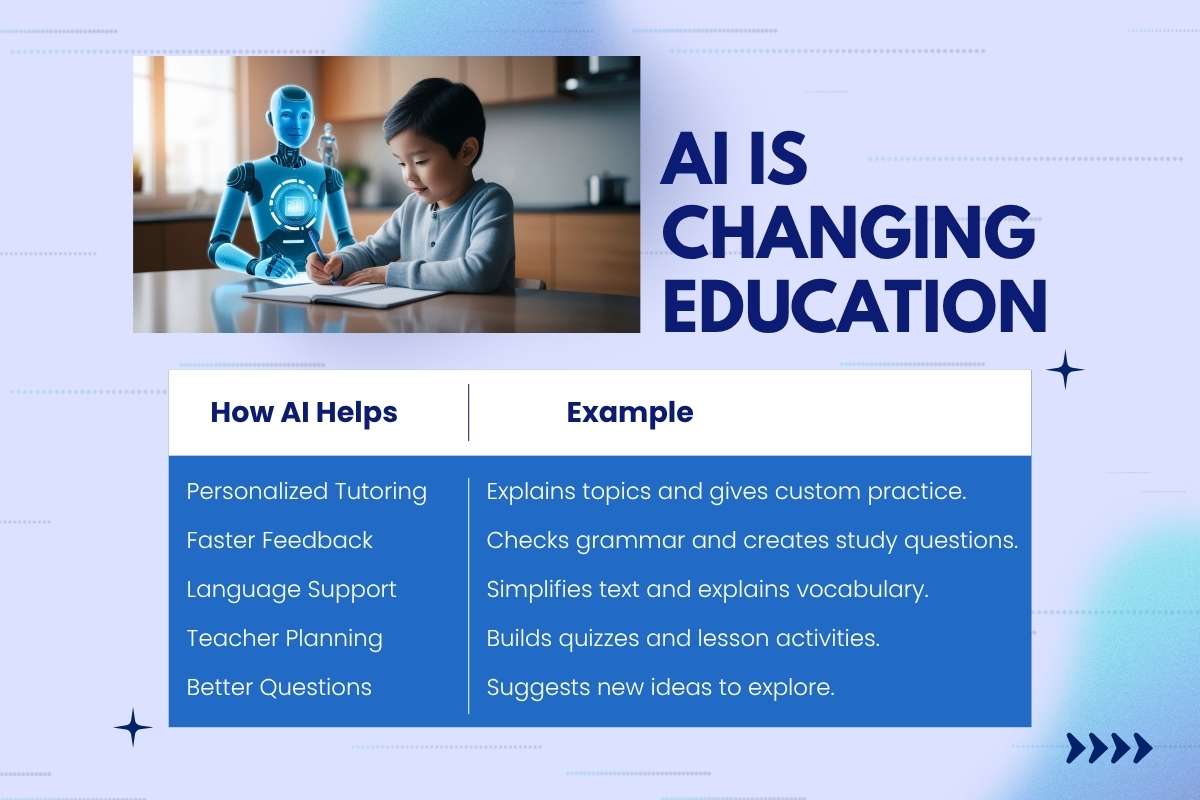
Ethical AI use in education is becoming more important as AI changes the way students and teachers work. AI is now a regular part of education and is increasingly used for studying, writing, and lesson planning.
| How AI Helps | Example |
| Personalized Tutoring | Explains topics and gives custom practice. |
| Faster Feedback | Checks grammar and creates study questions. |
| Language Support | Simplifies text and explains vocabulary. |
| Teacher Planning | Builds quizzes and lesson activities. |
| Better Questions | Suggests new ideas to explore. |
Many schools are moving away from banning AI. Instead, they are teaching students how to use it responsibly while following academic integrity rules.
Major Challenges and Benefits of AI Academic Integrity
Ethical AI use in education can be difficult to maintain because school policies are still catching up with new technology. At the same time, when students use AI honestly, it can support stronger learning and better long-term outcomes. Universities such as UC Berkeley Center for Teaching and Learning and MIT Teaching + Learning Lab recommend clear rules and open communication.
| Challenges | Benefits |
| Hard to tell if AI wrote the work | Stronger understanding of the subject |
| Different teachers may have different rules | Better writing and research habits |
| Students may not know what is allowed | Greater trust between students and teachers |
| AI can invent false facts and citations | Fair grading for all students |
| Uploading assignments may raise privacy concerns | Better preparation for college and careers |
| AI detectors can make mistakes | Stronger editing and critical thinking skills |
The Detection Problem
AI detectors are not fully reliable. In a widely cited Stanford study, seven popular detectors incorrectly labeled 61.2% of essays written by non-native English speakers as AI-generated. This shows that honest students can be flagged by mistake. Because of this, many schools review drafts, notes, revision history, and class discussions instead of relying only on software.
Clear expectations and honest communication are essential for protecting AI academic integrity and helping students use AI as a learning tool rather than a shortcut.
Risks of Poor Academic Integrity in the AI Era

When students misuse AI, the consequences can be serious. Poor AI academic integrity can affect grades, school records, and long-term success.
Common Risks
- Plagiarism allegations
- Lower grades or failed assignments
- Suspension or other disciplinary action
- Weak writing and critical thinking skills
- Loss of trust in teachers
- Poor preparation for college and work
Understanding Skill Debt
Poor AI academic integrity can create skill debt. This happens when students earn good grades but do not build the skills their courses are meant to teach. Over time, these gaps become harder to fix.
Using AI as a shortcut may help in the short term, but it can leave students unprepared for future classes and real-world responsibilities.
The Future of AI Academic Integrity
It will shape how students and teachers use technology in the years ahead. AI is likely to remain a regular part of education, much like calculators and search engines are today. Instead of trying to ban these tools, more schools will focus on teaching students how to use them responsibly and honestly.
School policies will become more detailed and more consistent across classes. Students will be expected to build skills in AI literacy, ethics, and fact-checking. AI disclosure statements may also become as common as citations and reference lists, with students routinely explaining how AI assisted their work.
At its core, the future of artificial intelligence academic integrity is about protecting real learning. AI can be a valuable study tool, but it should never replace original thinking. When students, teachers, and schools follow clear rules, technology supports education while honesty and trust remain at the center.
Frequently Asked Questions
1. Is using AI always considered cheating?
No. It depends on your school’s rules and how you use AI.
2. How should students disclose AI use?
Add a short note explaining how AI helped with the assignment.
3. Can AI detectors prove misconduct?
No. Detectors can be wrong and should not be the only evidence.
4. What are safe ways to use AI for schoolwork?
Brainstorming, grammar checks, and practice quizzes are usually acceptable.
5. Why is AI academic integrity important?
It protects honest learning, fair grading, and trust in education.