
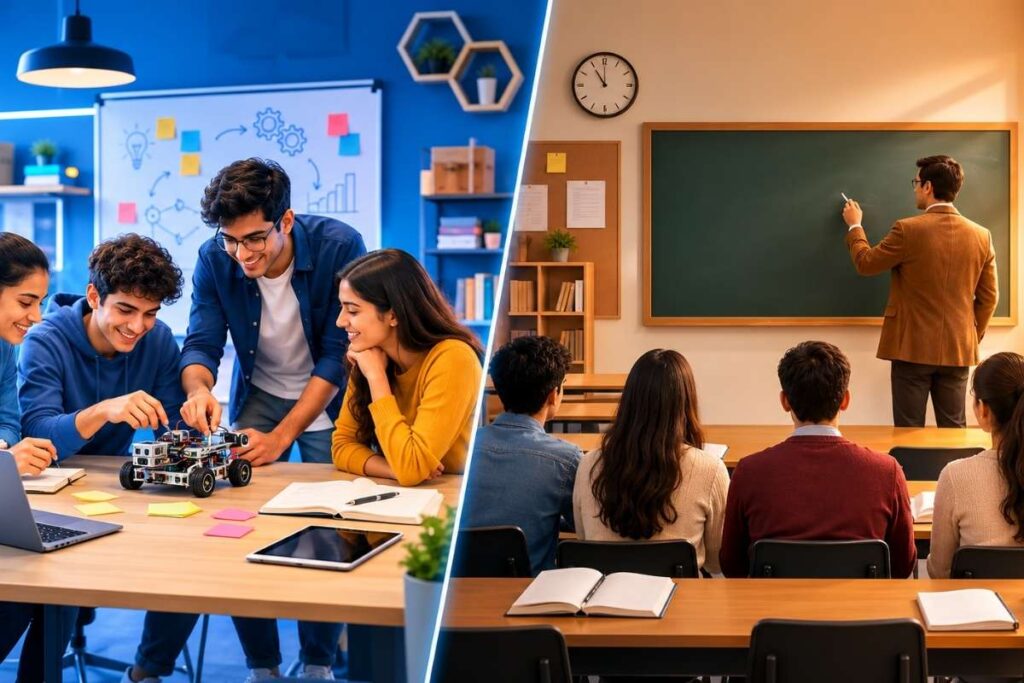
Neither wins outright; Experiential Learning vs Traditional Learning depends on your goal. Experiential learning builds skills and judgment, while traditional learning covers theory faster. This article shows the key differences and which method fits school, university, or work. By the end, students will stop guessing and start using a method helpful for them. Educators will understand when to use each method.
Think back to a class you barely remember. Now think of one you’ll never forget. Chances are, the one you remember involved doing something. It wasn’t just listening to someone talk.
Maybe it was a science experiment that went wrong in a fun way. Maybe it was a group project that taught you how to deal with a tough teammate. Maybe it was an internship where the theory finally made sense.
Many students and educators compare Experiential Learning vs Traditional Learning to understand which approach builds knowledge, skills, and confidence more effectively. Both have shaped classrooms and training rooms for over a century. Both still matter. This article explains what each method means. It shows the pros and cons of both approaches and where each one works best.
Experiential Learning vs Traditional Learning: What Sets Them Apart?
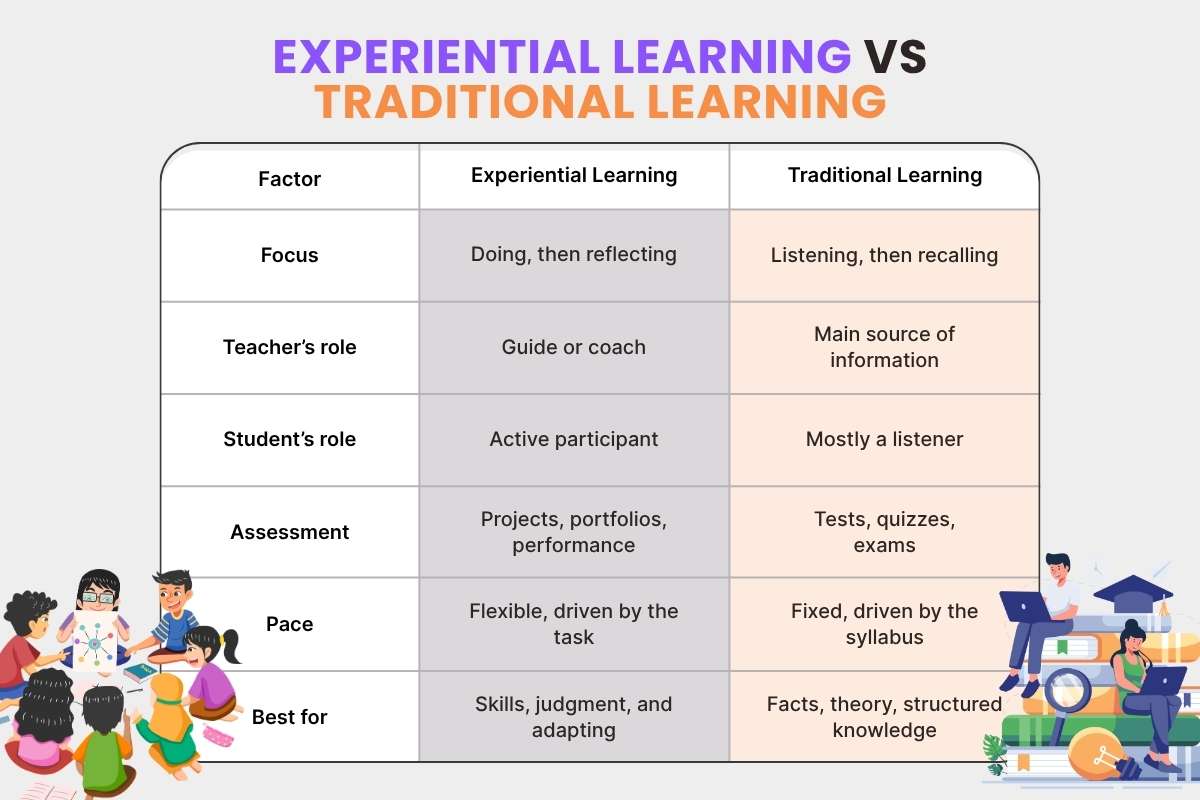
Before understanding the differences between experiential and traditional learning, let’s quickly go through what they mean.
Experiential learning means learning by doing. Instead of hearing a lecture about a skill, learners practice it. Then they think back on what happened. For example, a biology student doesn’t just read about cell division. They look at real cells under a microscope. They sketch what they see. Then they compare it to the textbook picture.
Traditional learning is the style most people grew up with. A teacher shares information through lectures, textbooks, and notes. Students take in this information. Then they prove they understood it through tests, quizzes, or essays. For example, a history class covers the causes of World War II. Students take notes and are later tested on dates, names, and events.
The biggest difference between them comes down to one question: who does the work? In traditional learning, the teacher is the main source of knowledge. In experiential learning, the learner builds knowledge through action. A guide helps them make sense of it afterward.
| Factor | Experiential Learning | Traditional Learning |
| Focus | Doing, then reflecting | Listening, then recalling |
| Teacher’s role | Guide or coach | Main source of information |
| Student’s role | Active participant | Mostly a listener |
| Assessment | Projects, portfolios, performance | Tests, quizzes, exams |
| Pace | Flexible, driven by the task | Fixed, driven by the syllabus |
| Best for | Skills, judgment, and adapting | Facts, theory, structured knowledge |
Let’s look more closely at each factor of the experiential learning vs traditional learning comparison.
Focus:
Traditional learning centers on listening and recalling. A student hears a lesson and later remembers it when needed. In experiential learning, the student acts first, then reflects on what happened. This reflection step is key. Without it, an experience is just an event. With it, the experience becomes a lesson.
Teacher’s Role:
In a traditional setting, the teacher holds the knowledge and hands it down. In an experiential setting, the teacher steps back. They set up the task, then guide the learner through questions like “What happened?” and “What would you do differently?”
Student’s Role:
Traditional learning puts students in listening mode. They take notes and store facts. This approach is passive, but it’s good when extra effort is not needed. Experiential learning puts students in action mode. They make choices, test ideas, and deal with real outcomes.
Assessment:
Traditional courses use tests and quizzes to measure students’ understanding. Experiential courses use projects, portfolios, or live performance, since the goal is to build something that is visible and shows a skill.
Pace:
A traditional class follows a fixed schedule set by the syllabus. This makes learning and course delivery more predictable. An experiential activity moves at the pace of the task itself. A simulation might run long if the group needs more practice, and that’s fine.
Best for:
Traditional learning fits topics with a clear right answer, like formulas or vocabulary. Experiential learning fits skills that need judgment, like leading a team or handling a tough client call.
So which one fits best in real life? It depends on the goal.
Picture a new lifeguard. Reading a manual about rescue steps won’t build real confidence. They need to jump into the water, practice a rescue, and get feedback on their form. That’s a perfect fit for experiential learning.
Now picture a student prepping for a driving theory exam. They need to know road signs, speed limits, and traffic laws cold. Flashcards and practice quizzes do that job well. That’s a perfect fit for traditional learning.
School vs University vs Workplace: Which Learning Method Suits Each?

The best choice between experiential learning vs traditional learning depends on the learner, setting, and learning goals.
School students need a strong base first. Reading, writing, and basic math usually need structured teaching before hands-on methods can build on top. Young kids also have less patience for open-ended tasks without guidance. A teacher-led start helps keep the class on track. Still, hands-on activities like science fairs, field trips, and group projects boost interest. They help ideas stick once the basics are in place.
University students benefit from a mix. Experiential learning matters more as courses get more hands-on. Medical students learn anatomy from a book. Then they confirm it in a lab. Engineering students learn formulas in class. Then they apply them in a final project. A 2025 analysis found that hands-on learning raised STEM exam scores by about half a standard deviation compared to straight lectures.
Employees tend to learn best through experience. Job success depends on judgment, not just facts. On-the-job training, simulations, mentor shadowing, and real projects build skills faster than a slideshow. A new hire who plays with the company software often remembers more than one who just watches a video. Traditional training still matters for rules and policy. Here, consistent facts matter more than personal opinion.
| Setting | Better Fit | Why |
| School | Traditional, with hands-on add-ons | It builds the basics first |
| University | Experiential, especially in applied majors | Links theory to real practice |
| Workplace | Experiential, traditional for rules/policy | Judgment matters more than recall |
Experiential Learning vs Traditional Learning: Pros and Cons Explained
Every teaching method involves trade-offs. What makes experiential learning powerful is often what makes it slow and costly. What makes traditional learning fast is often what makes it easy to forget.
| Method | Pros | Cons |
| Experiential Learning | Helps ideas stick, since learners connect them to real practice | Takes more time, space, and gear |
| Builds problem-solving skills | Harder to grade fairly | |
| Boosts interest and motivation | Not great for covering lots of facts quickly | |
| Prepares learners for messy, real-world situations | Needs skilled guides, not just teachers | |
| Traditional Learning | Covers a lot of content fast | Lower interest and recall over time |
| Easy to standardize and grade | Passive learning can turn into memorizing without real understanding | |
| Works well for basic facts and theory | Doesn’t always prepare learners for real use | |
| Familiar format, low cost to run | Leaves little room for personal pace or style |
When to Use Experiential Learning vs Traditional Learning?

Many educators consider experiential learning the “modern” choice. That’s not entirely fair. Each method wins in different spots.
Choose Experiential Learning When:
- The skill needs physical coordination or fast decisions, like surgery, flying, or public speaking.
- Learners must use judgment in unclear situations, such as in customer service.
- Retention matters more than speed, like in leadership training.
- The group is small enough for hands-on guidance.
Choose Traditional Learning When:
- The topic is fact-heavy and must be covered fast, like legal codes or vocabulary.
- Class sizes are large, or resources are tight.
- Learners need shared background knowledge before they can safely practice, like anatomy lectures before a nursing student touches a patient.
- Success is measured by a standard test or a certification exam.
In real life, most strong training programs use both. A flight school teaches the science of flight in a classroom first. Then it moves students to a simulator. Then, finally, to a real cockpit with an instructor. Traditional learning builds the base. Experiential learning proves it works.
Conclusion
There’s no clear winner in the experiential learning vs traditional learning debate. Traditional methods still make sense for building basic knowledge fast and cheaply, especially in big classrooms or fact-heavy subjects. Experiential methods make more sense when the goal is skill, judgment, or confidence under real conditions.
The best programs blend both. Traditional methods build the theory, and experiential methods put it to the test. The smart move isn’t picking a side. It’s matching the method to the goal, the learner, and the setting.
FAQs
1. Is experiential learning better than traditional learning?
Neither one is always better. Experiential learning works best for skills and judgment. Traditional learning works best for facts and theory.
2. Can experiential learning work without any traditional teaching?
Rarely on its own. Most hands-on activities work better when learners already have some background from traditional lessons.
3. What’s an example of experiential learning at work?
A new sales hire shadows a senior rep on real client calls, then talks through what worked afterward.
4. Is traditional learning outdated?
No. It’s still an efficient way to cover a lot of content, especially in schools with limited time and resources.
5. Experiential learning vs traditional learning: Which is better for exam-based courses?
Traditional learning usually fits exam-based courses better. It directly practices the same recall skills the exam will test.