
Key Takeaways
- Scientists discovered two previously unknown ghost human lineages hidden in modern DNA.
- One ghost lineage contributed DNA to all living humans over 50,000 years ago.
- New genome analysis reveals extinct ancestors without requiring ancient fossil DNA.
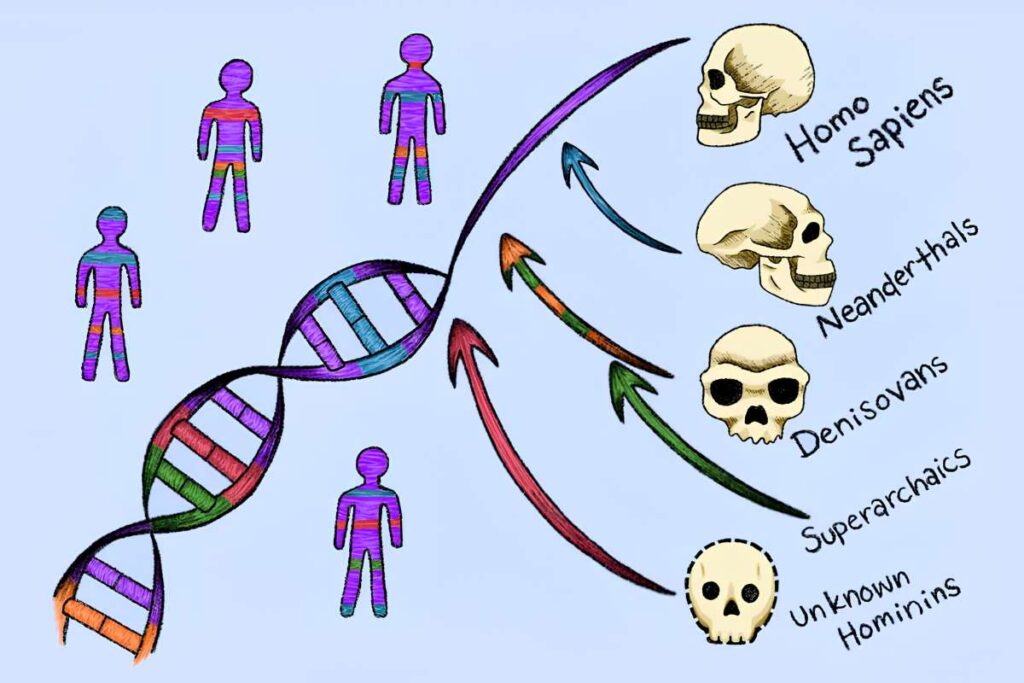
Scientists have identified two previously unknown “ghost” human lineages that contributed DNA to modern humans, using a new genome analysis method that reconstructs ancestry without relying on ancient fossil DNA, according to a study published Thursday in Science.
The research, led by scientists at the University of California, Berkeley, found that one of the ghost human lineages contributed DNA to all living humans, while another, much older lineage dating back nearly 2 million years, left traces only in people from Oceania. Researchers said the findings offer new insight into human evolution and the role of interbreeding among ancient human groups.
New Method Reveals Hidden Human Ancestors
Researchers analyzed more than 500 complete genomes from present-day people worldwide. They developed a technique that reconstructs family trees across the human genome to identify DNA inherited from ancient populations that split from modern humans long ago.
Unlike earlier methods, the approach does not require preserved fossil DNA. Instead, it detects genetic segments in living people that originated from extinct human groups.
“These extinct populations may have lived hundreds of thousands — or even more than a million — years ago, yet traces of their genetic legacy remain preserved in our genomes today,” said study co-author Priya Moorjani, a human evolutionary geneticist at the University of California, Berkeley.
The team tested the method by successfully identifying known Neanderthal and Denisovan ancestry before uncovering evidence of previously unknown interbreeding events.
Researchers Find DNA Shared Across Modern Humans
Scientists found that one ghost human lineages contributed about 0.5% to 1% of the DNA found in all modern humans. They said the interbreeding likely occurred in Africa more than 50,000 years ago before modern humans migrated out of the continent.
The researchers estimated that this lineage separated from the ancestors of modern humans about 800,000 years ago, roughly the same time as Neanderthals and Denisovans.
Study co-author Yulin Zhang, a computational biologist at UC Berkeley, said the research showed the unknown ancestry exists in all living humans rather than only in African populations.
Researchers suggested Homo heidelbergensis could be a possible source of this ghost lineage because the species lived in Africa and Europe between about 700,000 and 200,000 years ago.
“I agree with their speculation that this ghost could have been the species Homo heidelbergensis,” said Chris Stringer, a paleoanthropologist at the Natural History Museum in London who was not involved in the research.
Findings Reshape Understanding of Human Evolution
The study also found traces of a second ghost human lineages, described as a “super-archaic” lineage in people from Oceania. Researchers estimated that this population split from the ancestors of modern humans about 1.8 million years ago.
The ancient DNA accounts for about 0.002% of Oceanian genomes and appears within Denisovan DNA, suggesting it entered modern humans after Denisovans interbred with the older population.
Fernando Villanea, a population geneticist at the University of Colorado Boulder who was not involved in the study, said the super-archaic DNA may have originated from Homo erectus, although more genetic evidence is needed.
Researchers found that DNA from both ghost human lineages is concentrated in parts of the genome linked to the immune system and metabolism. They said these inherited genes may have helped early humans adapt to new diseases and food sources.
Moorjani said the technique could help scientists uncover additional ghost lineages, particularly in regions such as Africa and South Asia where ancient DNA remains scarce. The researchers also said the method could be used to study the evolutionary history of other species with limited fossil DNA.
Visit Future Education Magazine For The Most Recent Information.