

Kolb’s Experiential Learning Theory defines learning as a four-stage cycle of experience, reflection, thinking, and action. This guide breaks down each stage and explains the four learner types. Also, you’ll learn how the model has evolved since 1984. Walk away with a clear, practical understanding of one of education’s most referenced frameworks and how to apply it.
Think about the last time you truly learned something. Chances are, you didn’t just read about it. You tried it, made mistakes, thought about what went wrong, and tried again.
That is the core idea behind Kolb’s Experiential Learning Theory (ELT). Developed by educational theorist David A. Kolb in 1984, it argues that real learning comes from experience, not passive instruction. Nearly four decades later, educators, trainers, and organizations worldwide still use it as a foundation for designing meaningful learning experiences.
This article breaks down the theory, its four stages, four learning styles, and how Kolb himself updated it in later years.
What is Kolb’s Experiential Learning Theory?
Kolb’s ELT defines learning as “the process whereby knowledge is created through the transformation of experience.” — David Kolb, 1984.
Kolb first introduced his Learning Style Inventory (LSI) in 1976, and formalized the full theory in his book Experiential Learning: Experience as the Source of Learning and Development (1984). He drew heavily from the work of John Dewey (the father of experiential education), Jean Piaget (cognitive development), and Kurt Lewin (action research and group dynamics).
The Central Argument:
Learning is not just about absorbing information. It requires a cycle of four linked stages: having an experience, reflecting on it, drawing conclusions, and then acting on them.
Why it Matters:
Traditional classroom models treat the learner as a passive receiver. Kolb challenged this by placing the learner at the center of an active, continuous process.
What are the 4 Stages of Kolb’s Learning Cycle?
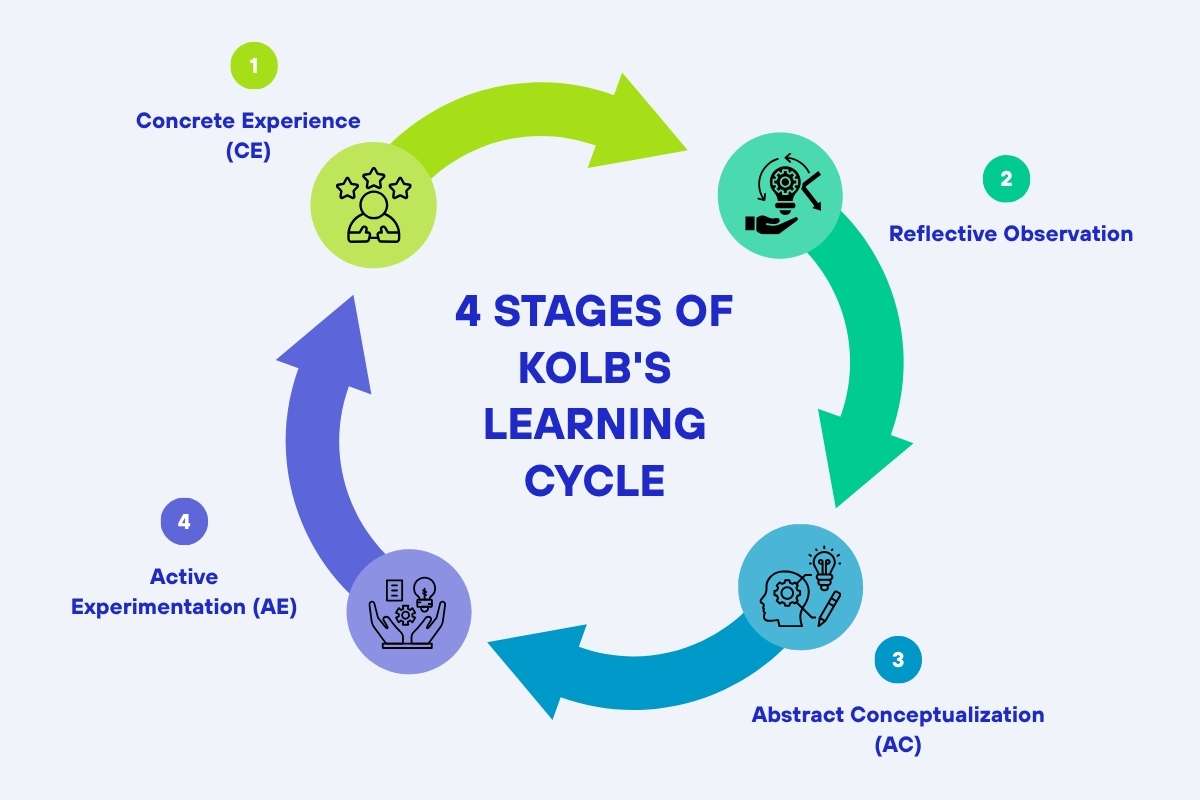
Kolb’s model is often called the Experiential Learning Cycle. It has four stages that feed into each other in a loop. A learner can enter the cycle at any stage, but effective learning requires passing through all four.
| Stage | Also Called | Core Question |
| Concrete Experience | “Feeling” | What happened? |
| Reflective Observation | “Watching” | What did I notice? |
| Abstract Conceptualization | “Thinking” | What does it mean? |
| Active Experimentation | “Doing” | What will I try next? |
Stage 1: Concrete Experience (CE)
This is where learning begins: doing something real. It could be a lab exercise, a job simulation, a client meeting, or any hands-on activity. The learner engages directly with a task without necessarily analyzing it yet.
Example: A medical student practices taking a patient’s blood pressure for the first time.
Stage 2: Reflective Observation (RO)
After the experience, the learner steps back and observes. They think about what happened, what surprised them, and what they noticed. This is thoughtful, not reactive.
Example: The student reflects on why the reading was inconsistent and what they might have done differently.
Stage 3: Abstract Conceptualization (AC)
Here, the learner draws conclusions and builds understanding. They connect their reflection to theory, rules, or broader patterns. This is the “thinking” stage.
Example: The student reads about cuff placement and learns why proper technique affects accuracy.
Stage 4: Active Experimentation (AE)
The learner applies their new understanding to a fresh situation. They test their conclusions, making this the bridge back to a new Concrete Experience.
Example: The student tries again with the correct technique and achieves a consistent reading.
As per Kolb’s Experiential Learning Theory, this cycle does not end. Each action creates a new experience, feeding the next loop.
What are Kolb’s 4 Learning Styles?
While the learning cycle describes how learning happens, Kolb also identified four distinct learning styles. These emerge from a person’s preference for certain stages of the cycle.
Each style sits at the intersection of two stages:
| Learning Style | Preference | Strengths | Best Suited For |
| Diverging | Feel + Watch (CE + RO) | Imagination, generating ideas, seeing multiple viewpoints | Arts, humanities, counseling |
| Assimilating | Think + Watch (AC + RO) | Logical reasoning, building models, organizing information | Science, research, data analysis |
| Converging | Think + Do (AC + AE) | Problem-solving, applying theory to practice | Engineering, technology, medicine |
| Accommodating | Feel + Do (CE + AE) | Hands-on action, intuition, adaptability | Business, sales, leadership |
A 2024 study on 142 undergraduate medical students using Kolb’s LSI found that the most common learning style was Converging. The results are consistent with the problem-solving demands of clinical training.
Important Note: Kolb did not say one style is better than another. Most people have a dominant style but use all four at different times. The goal is to design learning environments that work for each type.
How Do Experience, Reflection, Thinking, and Action Shape Effective Learning?

The four stages described in Kolb’s Experiential Learning Theory work as a system. Remove any one of them, and learning becomes incomplete.
- Experience without reflection leads to repeated mistakes. You keep doing the same thing without questioning why it did or did not work.
- Reflection without action leads to analysis paralysis. You think endlessly but never apply anything.
- Thinking without experience leads to abstract knowledge that feels disconnected from reality.
- Action without thinking leads to trial-and-error with no real growth.
A 2025 nursing education study published in Frontiers in Medicine tested a Kolb-based curriculum on 57 master’s students. The group that followed all four stages scored significantly higher on final assessments (96.54 vs. 93.07, p < 0.001) and showed stronger critical thinking compared to the control group.
This aligns with Kolb’s Experiential Learning Theory. It says, “effective learning only occurs when a learner is able to execute all four stages of the model.” No single stage works on its own.
What This Means for Students:
Knowing the cycle gives you a personal learning checklist. After any class, project, or task, ask yourself: Did I reflect on what happened? Did I draw a conclusion? Did I actually apply it? If you skipped a step, go back. Students who build this habit learn faster and retain more, because they are not just collecting experiences but processing them.
What This Means for Educators:
The cycle is a design tool. Instead of planning lessons around content alone, structure them around all four stages. Give students a hands-on task, build in time for reflection, connect it to theory, then create space to apply it. Even small changes, like adding a short debrief after an activity, can shift passive learning into active understanding.
How Did Kolb Revise His Theory? The “Learning Spaces” Concept

Kolb did not stop at 1984. In 2005, he and Alice Kolb introduced the concept of learning spaces in the Academy of Management Learning & Education journal. It ranked among the 100 most-cited works in management education research.
A learning space is the physical and social environment where learning happens. Kolb argued that the space around a learner shapes what is possible, not just the content being taught.
In the revised second edition (2015), Kolb made three key updates:
- Learning styles are not fixed. They shift based on context.
- A person’s self-image as a learner affects how they engage with the cycle.
- Learning is shaped by social and cultural context, not just individual thinking.
These updates responded to criticism that the original model was too focused on the individual.
Conclusion
Kolb’s Experiential Learning Theory offers a clear, practical map of how humans learn best. At its core, it says experience alone is not enough. What you do with that experience, how you reflect on it, make sense of it, and apply it, determines whether real learning occurs.
The four-stage cycle and four learning styles give educators and organizations a framework that is both flexible and evidence-backed. From nursing classrooms in China to business schools in the US, the model continues to shape the design of learning environments.
Kolb’s later revisions remind us that the theory is not a fixed formula. It is itself a product of the cycle it describes: constantly tested, reflected on, and refined.
FAQs
1. What is the main idea behind Kolb’s Experiential Learning Theory?
It proposes that learning is a four-stage cycle. Experience, reflection, thinking, and action build on each other, and real understanding comes from passing all four stages.
2. Can a learner skip stages in Kolb’s cycle?
No. A learner can enter the cycle at any stage, but skipping stages produces incomplete learning.
3. Are Kolb’s learning styles scientifically proven?
The styles have strong practical support in education and corporate training. Some researchers have criticized the LSI’s reliability, but Kolb himself clarified things in 2015.
4. How is Kolb’s model used in workplaces?
Many organizations use it to design onboarding programs and leadership training. It is also used to design performance reviews that combine hands-on tasks and reflection rather than lecture-only formats.
5. What is the difference between the learning cycle and learning styles in ELT?
The cycle describes the process of learning (four stages). On the other hand, learning styles describe a person’s preference for certain stages of that process.