

The principles of experiential learning are the ideas behind learning through real experience. They involve reflection and practice instead of passive listening. This guide breaks down each principle, from process over outcome to whole-person learning, with real examples from schools, colleges, and workplaces. Read it to see exactly which principle to lean on, so your next lesson or training session actually sticks.
A teacher once handed her class a textbook chapter on volcanoes. The students didn’t seem much interested. The next week, she brought in baking soda, vinegar, and a plastic model. The same students stayed after the bell to run the experiment twice. Nothing about the topic changed; only the method did.
This gap between reading and doing sits at the center of the principles of experiential learning. It is a set of ideas that explain why hands-on work sticks in a way that lectures rarely do. These ideas now shape how schools, colleges, and workplaces train people for real skills. This article looks at what these principles mean, why each one works, and how they shape education.
What are the Principles of Experiential Learning, and Where Do They Come From?
The principles explain how people learn best. They learn through real experience, careful thinking, and practice. They do not just listen or memorize facts. A thinker named John Dewey said in the early 1900s that school should connect to real life. Years later, a psychologist named David Kolb built on this idea. He created a model called the Experiential Learning Cycle that teachers and trainers still use today.
Kolb’s model has four simple steps. First, you have an experience, like doing an activity. Second, you reflect, which means you think about what happened. Third, you form an idea based on that thinking. Fourth, you test that idea in a new situation. These four steps are the basis of the key principles used today.
Each principle builds on Kolb’s model. But each one focuses on a different part of how learning happens. Knowing each one helps teachers and trainers plan better lessons.
Here are the 6 Main Principles of Experiential Learning You Should Know
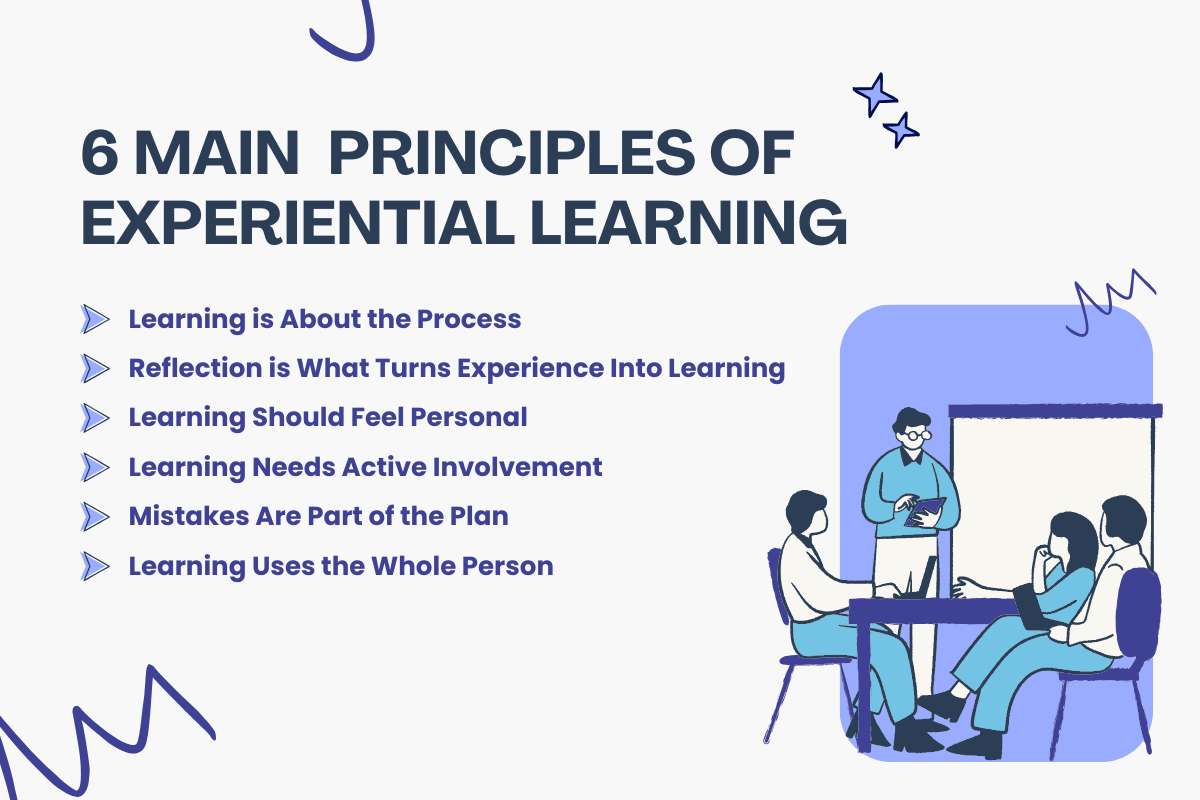
Learning by doing is only half the story. The other half happens in how that experience gets processed and applied. The section below breaks down each of the core principles that make experiential learning work in real settings, from a hospital ward to a college lab.
1. Learning is About the Process
In short: The struggle along the way teaches more than the final score does.
Experiential learning cares about the journey, not just the final score. Grades and test results only capture a small slice of what someone actually learns. The real growth happens in the small moments along the way: the wrong turn, the second attempt, the moment something finally clicks. A method that only rewards the result misses most of the value the process itself creates.
See it in action: A nursing student practices on a training dummy before she ever touches a real patient. She misses a vein twice before finding it correctly, and that struggle builds hand control no lecture could teach. Hospitals now build entire simulation labs around this idea.
2. Reflection is What Turns Experience Into Learning
In short: An experience means little until you stop and think it through.
Just doing something is not enough on its own. Without reflection, an experience is just something that happened, with no lasting value attached to it. This is one of the principles of experiential learning that gets skipped most often, since reflection takes more effort than the activity itself. Reflection forces the brain to slow down, connect the dots, and pull out a lesson from raw events.
See it in action: A college debate team reviews match recordings after every round. The coach pauses at key moments, and students hear the gaps in their own arguments that they missed live. That replay is what turns a loss into a real lesson.
3. Learning Should Feel Personal
In short: A lesson tied to your own goals sticks far longer than a generic one.
People learn faster when the lesson connects to their own goals or interests. A generic lesson with no personal stake rarely holds attention for long, no matter how well it is taught. When learners see a direct link between the task and something they care about, their focus and memory both improve. This is why personal relevance is treated as a core driver of learning, not a nice bonus.
See it in action: A culinary student who dreams of opening her own bakery remembers the chemistry behind yeast and gluten far better than a classmate who is only there to pass the class. Many colleges now let students pick capstone projects tied to their career goals instead of one generic project for everyone.
4. Learning Needs Active Involvement
In short: Doing the work yourself locks in a skill far better than watching someone else do it.
Sitting and listening rarely builds a lasting skill on its own. Passive learning keeps the brain in a low-effort state, where information passes through without sticking. Active involvement forces learners to make choices, apply knowledge, and deal with the results of those choices in real time. That extra effort is exactly what locks a skill into long-term memory.
See it in action: A marketing class runs a simulated business where students set prices and plan campaigns, then watch how those choices move sales on a mock dashboard. Workplaces use the same idea through on-the-job training, where new hires shadow a task briefly before taking it on themselves.
5. Mistakes Are Part of the Plan
In short: A mistake is just data pointing straight at what to fix next.
Trial and error is a normal part of learning. Every mistake carries information about what does not work, and that information is often more useful than getting something right on the first try. A learning method that punishes every error tends to make people cautious instead of curious. Treating mistakes as data, not failure, is one of the principles of experiential learning that keeps learners willing to take the next attempt.
See it in action: Engineering students build a small bridge model, and it collapses under weight. That failure points straight to the weak spot in their design, teaching them more about load distribution than a lucky success would.
6. Learning Uses the Whole Person
In short: Real learning grabs the mind, the emotions, and the hands all at once.
Experiential learning brings together thinking, feeling, and doing at the same time. It does not treat them as separate. A lesson that only targets the mind and ignores emotion or physical action tends to fade quickly. When all three work together, the experience becomes far more memorable. This is why the strongest training programs rarely rely on facts alone.
See it in action: A student who volunteers at a homeless shelter is not just learning facts about social work from a textbook. She is also building empathy and people skills through direct contact, and that mix is what makes the experience stay with her long after the shift ends.
Here is a quick summary table of these principles of experiential learning:
| Principle | Core Idea | Example |
| Process over outcome | Growth happens during the task | Practicing a skill on a training model |
| Reflection | Thinking about the experience builds meaning | Reviewing debate recordings or running a sprint retrospective |
| Personal relevance | A personal link boosts memory | Picking a project tied to a career goal |
| Active involvement | Doing beats watching | Running a mock trial in a law class |
| Trial and error | Mistakes teach real lessons | Fixing broken computer code |
| Whole-person learning | Mind, body, and feelings work together | Team-building activities at work |
Which Principles of Experiential Learning Matter Most, and Where?

Not every principle matters the same in every place. Here is how the focus changes across schools, colleges, universities, and jobs.
| Setting | Most Important Principles | Why |
| Schools | Active involvement, whole-person learning | Young kids learn best through play and movement |
| Colleges | Personal relevance, reflection | Students are picking a career path and need a personal link |
| Universities | Trial and error, process over outcome | Research work rewards testing and experimenting |
| Workplace | Reflection, active involvement | Workers must use skills fast and learn from real results |
Knowing which principle to focus on helps teachers and managers build better training. It beats using the same plan for every group.
Also Read: Benefits of Experiential Learning: What Neuroscience and Real Classrooms Reveal?
How Do These Principles of Experiential Learning Shape Education?
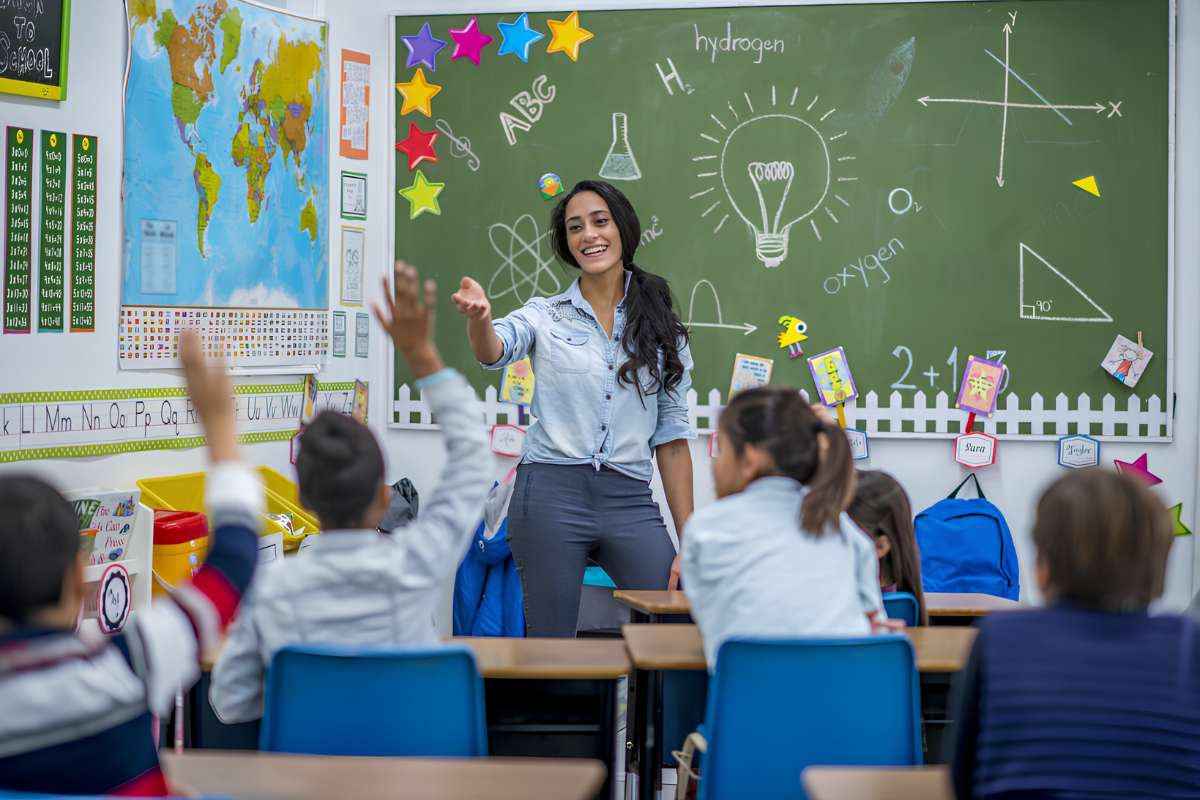
These principles change how teachers plan lessons. Instead of asking students to memorize facts, teachers build activities where students use knowledge right away.
These same ideas also help students remember more. A 2025 study of first-year medical students found that 79.7% agreed active teaching methods boosted engagement, while 75.2% reported improved retention. This is part of why project work, internships, and lab classes are now common in schools.
Experiential learning (pillar keyword) also lifts motivation. 75% of elementary school students reported stronger engagement after teachers introduced active learning methods. Teachers also use these ideas to build a stronger bond with the lesson, since students who care about an activity tend to stay motivated even when the work gets hard.
Conclusion
Picture that same teacher with the volcano model years later, still choosing baking soda over another slide deck. That choice is the whole point of the principles of experiential learning. Reflection turns experience into a lesson. Relevance keeps a learner in the room instead of checked out. Mistakes teach faster than a perfect first try ever could.
None of this works as a single trick pulled out once a semester. It works as a habit, built lesson by lesson, shift by shift. Teachers, professors, and managers who treat these principles as daily practice end up with people who actually remember what they learned.
FAQs
1. What is the main idea behind experiential learning?
People learn best by doing something directly, then thinking about what happened. This is the main idea behind the principles of experiential learning.
2. Who created the theory of experiential learning?
David Kolb built the modern version of this theory in the 1980s, based on earlier ideas from John Dewey.
3. Why does reflection matter so much in this style of learning?
Reflection turns a raw experience into a real lesson by helping learners see what worked, what did not, and why.