

Employee Upskilling Programs help businesses build future-ready teams by teaching employees the skills they need for current and future roles. This blog explains what these programs are and how to create them. In addition, you’ll get the best training methods, useful tools, and proven strategies from leading companies. Learn practical ways to close skill gaps, improve retention, and prepare your workforce for long-term success.
Your best employee today might be missing tomorrow’s most important skill. That’s not really their fault. Technology moves fast, and job requirements move with it. Employers expect nearly 39% of core job skills to change by 2030. Already, 63% call skills gaps the biggest barrier to business growth, according to the World Economic Forum’s Future of Jobs Report 2025.
This is where employee upskilling programs come in. They train current staff on new tools, new roles, and new business goals. There’s no need to pay the cost and delay of hiring from outside. Done well, these programs close skill gaps and improve retention. They also get the company ready for whatever comes next. This guide covers what these programs look like, how to build one, which tools can help, and the results they deliver.
Employee Upskilling Programs: Definition and Key Formats
Employee upskilling means teaching current staff new skills tied to their present role or a role they’re moving toward. It’s different from reskilling, which prepares someone for a completely different job. At its core, employee upskilling builds on what a person already knows instead of starting from zero.
Programs for employee upskilling are strategic ways companies actually do this in practice. A program puts structure around it: clear goals, a set format, and a way to track progress. This turns upskilling into a repeatable system the business can rely on.
These programs use a few common delivery formats, often mixed together:
- Instructor-led Training: Live sessions, workshops, or webinars run by an internal expert or an outside trainer.
- E-learning Courses: Self-paced modules delivered through platforms like LinkedIn Learning or Coursera.
- On-the-job Mentoring: Pairing newer staff with experienced colleagues for hands-on guidance.
- Job Shadowing and Rotation: Letting employees observe or briefly work in a different role.
- Microlearning: Short, focused lessons of five to ten minutes, usually delivered through an app.
- Certification Programs: Formal courses that end in an industry-recognized credential.
Most companies combine two or three formats of employee upskilling programs. A sales team might pair e-learning with live role-play, while an IT department may lean more on certifications and mentoring.
Employee Upskilling Strategies Used by Top Companies

Many companies believe in employee upskilling. Let’s understand the strategies top companies use to solve a real business need.
1. Use AI to guide learning paths
ServiceNow built a tool called frED that maps each worker’s goals and suggests matching courses. Over 65% of staff used it in the first month itself.
2. Try funding training at scale
Amazon put over $1.2 billion into its Career Choice program. It has trained hundreds of thousands of workers in tech, health, and data skills.
3. Open in-house training academies if possible
Walmart’s academies have reached hundreds of thousands of workers. Many moved into higher-paid roles.
4. Target the skills your field needs most
AT&T gave over 50,000 workers formal AI training in 2025. The goal was to prep staff for wider use of AI tools.
5. Get managers on board early
Managers who actively support employee upskilling programs see far higher completion rates. Teams left to figure it out alone tend to fall behind.
These examples share one idea. Pick a strategy that fits your budget and goals, then stick with it long enough to see real results.
How Do You Build Employee Upskilling Programs, Step by Step?
Having a structured way of creating programs makes the process easier. Follow the steps below when building your own program:
1. Identify business goals and skill gaps
Start with your company’s goals for the next two to three years. Then identify the skills each team needs to achieve them. For example:
- Sales: Negotiation, CRM, consultative selling
- Operations: New software, automation, safety
Compare these needs with employees’ current skills using surveys, performance reviews, or skills assessments. Focus first on the gaps that have the biggest business impact.
2. Set SMART goals
Avoid vague goals like “improve sales skills.” Instead, use SMART goals that are specific, measurable, achievable, relevant, and time-bound.
For example: “80% of the sales team will complete advanced negotiation training by the end of Q3 and pass a role-play assessment.”
3. Choose the right training format
Match the format to the skill:
- Technical skills: E-learning and certifications
- Soft skills: Coaching and role-play
- Compliance training: Short microlearning videos
- Hands-on skills: Simulations or job shadowing
4. Build or buy content
Use ready-made courses for common skills like Excel or project management. Create custom content for company-specific tools or processes. Most successful employee upskilling programs combine both approaches.
5. Run a pilot
Test the program with one team for four to six weeks. Choose a group with mixed skill levels, gather feedback after each module, and compare results with your goals before expanding.
6. Measure results and improve
Review progress every month or quarter. Track course completion, engagement, job performance, and retention. If learners struggle with a module, update the content instead of lowering expectations.
7. Recognize progress
Keep employees motivated by celebrating achievements. Recognize completed training in team meetings, newsletters, or internal profiles. Link new skills to promotions, new responsibilities, or pay increases, and encourage managers to acknowledge progress during one-on-one meetings.
A simple rollout timeline can help keep the project on track:
| Phase | Duration | Focus |
| Planning | Weeks 1–2 | Skills audit, goal setting |
| Pilot | Weeks 3–6 | Test with one team |
| Rollout | Weeks 7–12 | Company-wide launch |
| Review | Ongoing | Quarterly check-ins |
Following these steps helps turn employee upskilling programs into an ongoing part of how the business runs.
Top Tools and Platforms to Support These Programs
The right software makes upskilling easier to manage, track, and scale. Here are some widely used options for different needs and budgets:
- LinkedIn Learning: A large course library with built-in skill assessments and LinkedIn profile integration.
- Coursera for Business: University-backed courses, including certificates from schools and companies like Google and IBM.
- Udemy Business: A broad catalog covering both technical and soft skills, often at a lower cost per seat.
- Docebo: A learning management system built for mid-size to large companies that need detailed reporting and automation.
- 360Learning: Combines a learning platform with collaborative course creation, useful for building internal content quickly.
- Degreed: A skills intelligence platform that maps employee skills against future business needs.
- WorkRamp: Supports employee and customer training within a single system.
Most companies pair a learning management system with a content library instead of building everything from scratch. Smaller teams may only need one tool, while larger companies often connect several platforms through integrations.
Best Practices to Make These Programs More Successful
A few habits separate employee upskilling programs that stick from ones that quietly fade out.
1. Keep sessions short
Microlearning modules under 15 minutes tend to see higher completion rates than long courses crammed into a busy week.
2. Protect the time
Blocking dedicated hours on the calendar works better than asking employees to “find time” on their own.
3. Involve managers directly
Managers who understand or complete the same training reinforce it on the job instead of treating it as a distraction.
4. Refresh content often
Skills and tools change fast, so a course written two years ago may already be out of date.
5. Measure outcomes, not attendance
Track whether skills are actually applied on the job, not just who clicked “complete.”
Companies that follow these habits tend to see stronger participation and better long-term results from their programs, since the training feels connected to daily work rather than an extra task on top of it.
What Benefits Do Employee Upskilling Programs Deliver?
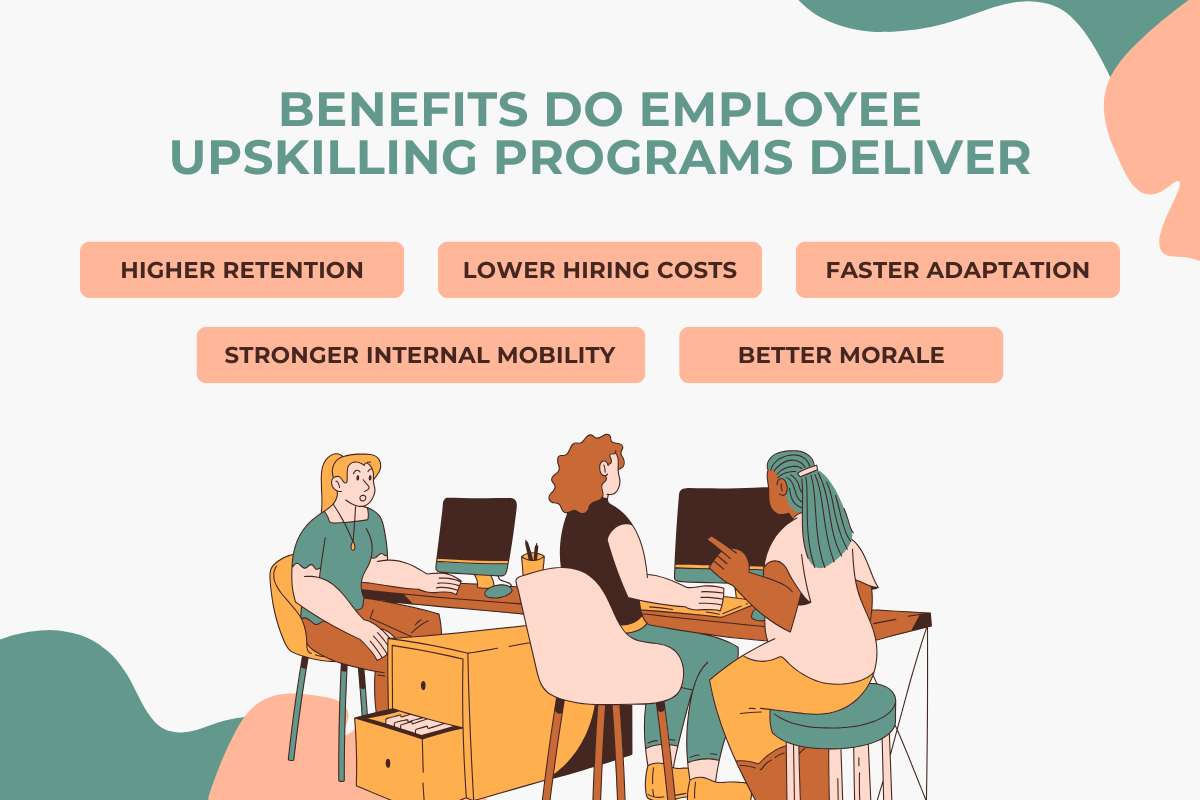
The payoff shows up in several places across a business, not just in individual skill levels.
| Benefit | Why It Matters |
| Higher retention | Employees who see a clear growth path are less likely to leave. |
| Lower hiring costs | Filling roles internally cuts recruiting and onboarding expenses. |
| Faster adaptation | Trained teams adjust more quickly to new tools, especially AI. |
| Stronger internal mobility | Skilled employees can move into new roles as the business grows. |
| Better morale | Investing in people signals that the company values their future. |
Beyond these direct gains, upskilling also lowers the risk tied to skill obsolescence. Skills now go out of date roughly twice as fast as they did a decade ago, based on workforce research from Fuel50. Companies that build ongoing training into their culture tend to handle that shift better than those relying only on outside hiring.
Conclusion
Skills will keep changing, and no company can out-hire that pace forever. Employee upskilling programs offer a practical way to close the gap using the talent already on the payroll. They cost less than constant rehiring. They also build loyalty and prepare teams for whatever comes next, whether that’s new software, new processes, or new ways of working.
The companies that believe in this build employee upskilling into how the business runs. They review it regularly and connect it to real career growth. Start small if needed. Even one well-run pilot can show leadership what’s possible before scaling it company-wide.
FAQs
1. What is the difference between upskilling and reskilling?
Upskilling builds on an employee’s current skills to help them grow in their existing role. Reskilling trains them for a completely different one.
2. How long does an upskilling program usually take?
Most programs run anywhere from a few weeks for a single skill to several months for broader initiatives, depending on how deep the training goes.
3. How much should a company budget for upskilling?
Spending varies by company size and industry. Most companies set a per-employee training budget and adjust it based on program scope and tools used.
4. Do small businesses need employee upskilling programs too?
Yes. Even small teams benefit, since focused training can run on low-cost tools like e-learning subscriptions instead of large custom programs.
5. Can upskilling actually improve employee retention?
Yes. Employees with real growth options are much more likely to stay, since ongoing training signals real investment in their long-term career.