
Key Takeaways
- Linda McMahon colleges initiative urged colleges to publicly commit to policy reforms before year-end.
- The proposal emphasizes transparency, campus governance and restoring public trust.
- Higher education leaders defended institutional autonomy against political influence.
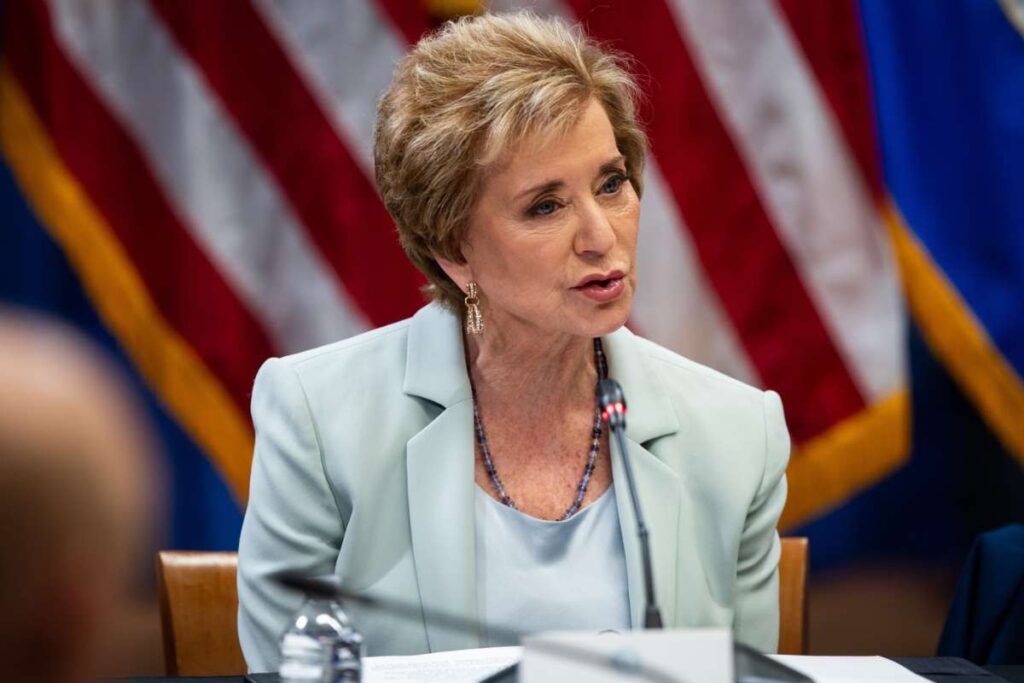
U.S. Education Secretary Linda McMahon on Monday urged colleges to publicly commit to sweeping policy reforms by the end of the year, calling for greater transparency, clearer admissions policies and broader faculty viewpoints to rebuild public trust in higher education.
McMahon Calls for Public Reform Commitments
Linda McMahon’s college initiative issued a “National Call to Action” asking colleges and universities to publish statements on their websites outlining planned reforms. She said institutions should clearly explain how they will address key issues affecting confidence in higher education.
“Only full candor and transparency can begin to strengthen the bonds between higher education and the American people,” McMahon wrote in her letter.
The proposal echoes many priorities included in the Trump administration’s 2025 higher education compact, which encouraged institutions to adopt policy changes in exchange for priority consideration for federal research funding. Most of the nine colleges approached last year declined the proposal, citing concerns over institutional independence.
Unlike the earlier compact, the Linda McMahon colleges request does not require specific policy changes or tie participation to federal funding.
Education Department Cites Declining Public Confidence
Linda McMahon colleges reforms are needed because public confidence in higher education has fallen to historic lows.
A recent Lumina Foundation-Gallup poll found that only 38% of U.S. adults expressed high confidence in higher education. The figure is only slightly above the record-low 36% reported in both 2023 and 2024.
Jonathan Pidluzny, deputy chief of staff for policy and programs at the U.S. Department of Education, said the department developed the initiative after months of discussions with college leaders.
“We’re quite thrilled and gratified” to find presidents who believe higher education has an opportunity to change, Pidluzny said.
He said colleges that choose not to respond will not face direct penalties. However, he added that institutions refusing to engage in the effort may send a message through their silence.
The Linda McMahon colleges proposal encourages colleges to explain how they plan to manage disruptive campus protests, reduce costs, address grade inflation, prepare students for workforce needs, use artificial intelligence responsibly, promote diversity of thought and guard against foreign influence.
Higher Education Leaders Stress Institutional Independence
Linda McMahon colleges initiatives highlighted several recent university-led efforts that align with her concerns. She pointed to a Yale University committee report that identified unclear admissions policies, grade inflation and free speech concerns as major factors contributing to declining public trust.
She also cited a report commissioned by Vanderbilt University and Washington University in St. Louis examining academic standards in the humanities. The report concluded that political considerations had, in some cases, replaced scholarly standards, though it also drew criticism from some academics who questioned its findings and recommendations.
McMahon further praised colleges that have adopted institutional neutrality, a policy under which university leaders avoid taking public positions on political issues unrelated to their institutions.
Ross Mugler, president and CEO of the Association of Governing Boards of Universities and Colleges, said many colleges share concerns about public trust but warned that reform decisions must remain independent.
“The U.S. system of higher education has been built and strengthened by the principles of board independence, institutional autonomy, and mission-driven leadership,” Mugler said. “It is vital that we protect these principles to ensure reforms are shaped by fiduciary responsibility and the long-term interest of our institutions and their students, not by political coercion.”
Under the Linda McMahon colleges initiative, the Education Department has asked institutions to publish their commitments before the end of 2026. Officials say the initiative is intended to encourage public accountability rather than impose new federal requirements.
Visit Future Education Magazine For The Most Recent Information.