

The future of learning management systems will depend on AI, better data, and flexible tools. These changes can help teams tailor training, track skills, and improve learning results. But not every new feature is ready for wide use.
Some tools can improve an existing platform, while others need more testing. Replacing an entire system may not be the best choice. This guide covers six key trends, suggests their readiness, and shows when to keep, extend, unbundle, or replace your current LMS.
What Makes Up a Modern LMS Stack?
A learning management system (LMS) has four main layers: records, content, user experience, and data. Each layer serves a clear purpose. Knowing how they work helps teams improve learning without replacing the whole system.
| Layer | Purpose | Examples |
| System of record | Stores user and course details | LMS database, HR system, student information system (SIS) |
| Content | Holds learning materials | Videos, courses, quizzes, and guides |
| Experience: LMS vs LXP | Shapes how users access learning | Dashboards, mobile apps, AI assistants |
| Data | Tracks progress and results | Reports, skill records, and analytics |
These layers can link through APIs, which let different tools share data. For example, a company can keep its LMS and add a separate tool for reports. A college can add a new study tool without changing its main platform.
This setup can save time and reduce the cost of change. Teams can test new tools before making a larger move.
6 Key Trends Shaping the Future of Learning Management Systems
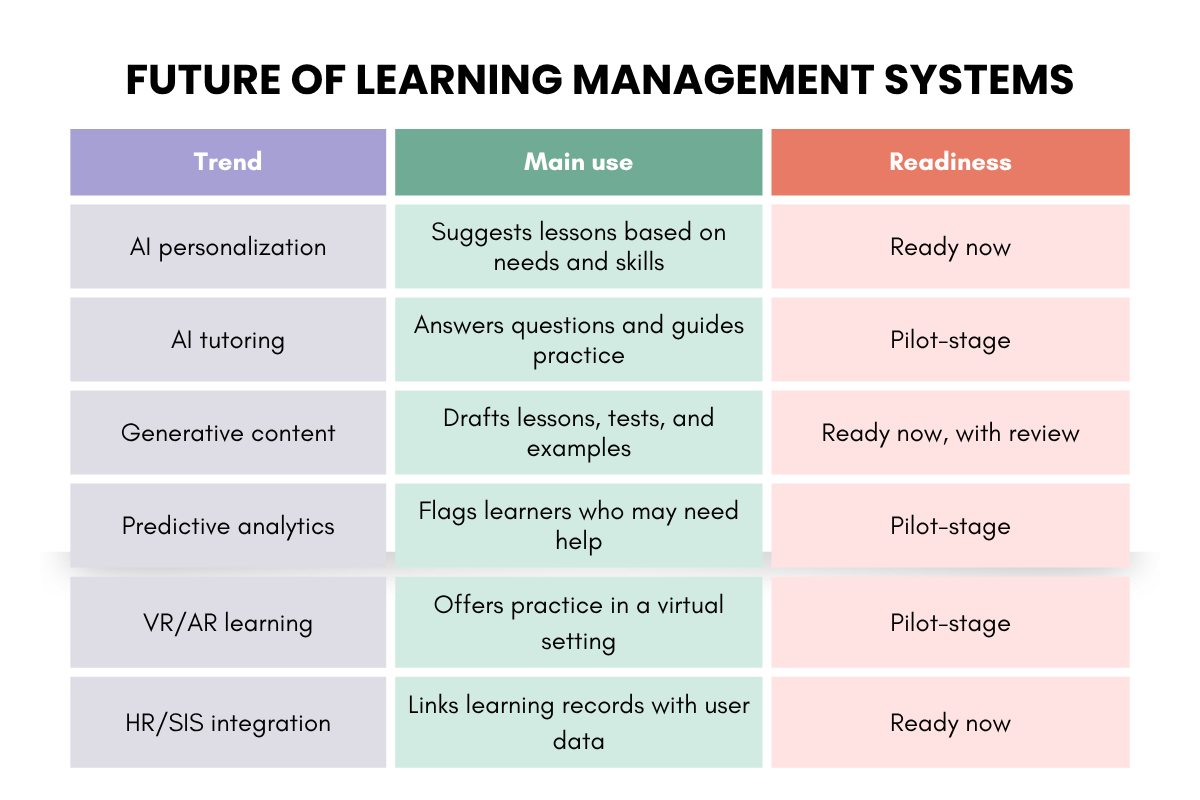
The future of LMS will take shape through tools at different stages. AI-based learning and system links can meet clear needs today. AI tutors, data forecasts, and VR tools may need more testing before wide use.
The table below shows the main use and current readiness level of each trend:
| Trend | Main use | Readiness |
| AI personalization | Suggests lessons based on needs and skills | Ready now |
| AI tutoring | Answers questions and guides practice | Pilot-stage |
| Generative content | Drafts lessons, tests, and examples | Ready now, with review |
| Predictive analytics | Flags learners who may need help | Pilot-stage |
| VR/AR learning | Offers practice in a virtual setting | Pilot-stage |
| HR/SIS integration | Links learning records with user data | Ready now |
1. AI Personalization
AI personalization suggests lessons based on a learner’s role, skills, or past results. For example, a sales worker may need more practice with product details. The system can suggest lessons to close that gap.
Industry data supports this shift. LinkedIn’s 2025 Workplace Learning Report found that 71% of L&D professionals were exploring, testing, or integrating AI into their work. This points to growing interest in using AI to support learning AI in learning management systems and skill development.
2. AI Tutoring
AI tutors can answer questions, explain ideas, and guide practice. They may help learners get support without waiting for a teacher or trainer. This can be useful when staff or teacher time is limited and shows how the future of learning management systems may offer more personalized support.
But AI tutors can give wrong answers. Test them with a small group first. Use approved content and let learners reach a human expert when needed.
3. Generative Content
Generative AI can draft quiz questions, lesson plans, and sample tasks. It can help teams build new courses or update old ones faster. It can also create versions of content for different skill levels.
Adoption is growing. Synthesia’s 2026 report found that 60% of L&D teams use AI for content and quiz drafting. This shows how AI is becoming part of course design and training.
A human should review every draft before use. Check facts, bias, reading level, and fit with learning goals. Teams should also review copyright and data risks before sharing content.
4. Predictive Analytics
Predictive analytics uses past data to spot signs of a problem. For example, missed tasks or low test scores may show that a learner needs help. Staff can then offer support before the learner falls further behind, making it a useful trend in the future of learning management systems.
Still, a warning is not proof of poor results. Test how well the tool predicts real outcomes. Limit access to private data, and do not use risk scores alone to make key decisions.
5. VR and AR
Virtual reality creates a digital setting for practice. Augmented reality (AR) adds digital details to the real world. Both can help with tasks that are hard to teach through slides or videos.
Research also supports their potential. A 2025 systematic review and meta-analysis examined 53 studies on mixed reality in vocational training. It found positive effects on behavioral, cognitive, and emotional learning outcomes compared with control groups.
Examples include safety drills, equipment training, and complex work tasks. Compare costs, access needs, and learning gains before investing in VR or AR.
6. HR and SIS Integration
An LMS can link with an HR system or SIS to cut manual work. It can sync staff roles, student lists, course access, and completion records. This helps teams keep records up to date across systems.
First, decide which system owns each type of data. Set rules for who can view or change records. Test data sync and plan for errors when staff or students change roles.
How Do These LMS Trends Change Employee Development?

The six LMS trends can help L&D and HR teams build skills faster LMS for Employee Development, tailor training, and link learning to job needs, shaping the future of learning management systems.
Ravin Jesuthasan, Global Transformation Services Leader at Mercer, explains how AI can reshape workplace learning: “Gen AI allows for personalized learning, firm-wide knowledge sharing, and real-time career mapping as skills are acquired.”
| LMS trend | Impact on employee development |
| AI personalization | Recommends lessons based on job roles, skill gaps, and progress. |
| AI tutoring | Gives employees on-demand help and practice as they learn. |
| Generative content | Speeds up the creation of role-based courses, quizzes, and practice tasks. |
| Predictive analytics | Flags skill gaps and employees who may need extra support. |
| VR/AR learning | Lets employees practise complex tasks in safe, realistic settings. |
| HR system integration | Links learning records with job roles, skills, and career paths. |
However, these tools need clear goals and sound data. L&D teams should track skill gains, time to proficiency, and changes in job performance. They must also protect employee data and review AI suggestions for accuracy and bias.
What Does the Future of Learning Management Systems Mean for Schools and Colleges?

Schools and colleges need tools that support learning and protect student data. The future of LMS will rely on easy tool links, access for all, and clear rules for AI use. Needs differ between higher education and K-12 schools.
1. Higher Education
Colleges often use separate tools for courses, tests, and student records. Learning Tools Interoperability (LTI) helps an LMS connect with other learning tools. Before adding a tool, check that it works with your LMS and supports smooth data sharing.
In the future of learning management systems, academic integrity also matters as students use AI in their studies. Set clear rules for AI use and design assessments that test real understanding.
2. K-12 Education
K-12 schools must protect student data when choosing learning management systems. In the United States, FERPA protects education records, while COPPA covers certain online data collection involving children under 13.
Before adopting a tool, check what data it collects, how it uses that data, and who can access it. Schools should also set clear rules for AI use and avoid sharing student details with unapproved tools.
Should You Keep, Extend, Unbundle, or Replace Your LMS?
The best LMS choice depends on what your current system can do. Keep it if it meets your needs. Add tools or replace the platform only when there is a clear reason to change.
Use these four options to guide your decision.
| Option | When it fits | Example |
| Keep | The LMS meets your main needs | Improve courses and reports |
| Extend | One key feature is missing | Add an AI tutor or report tool |
| Unbundle | A separate tool does one task better | Use a separate VR training tool |
| Replace | Core limits affect safety, scale, or use | Move to a platform that meets new needs |
Start by listing the main problems you need to solve. Then compare cost, ease of use, data safety, access, and tool fit. Include the people who will use and manage the system.
Conclusion
The future of learning management systems will bring smarter AI tools, better data links, and more ways to learn. But each trend has its own costs and risks. Focus on clear results, protect learner data, and test new tools before wider use. Review your current LMS, choose the right path, and build an upgrade plan around your most urgent needs.
FAQs
1. What is the future of learning management systems?
AI, linked data, and personal learning paths will shape the next stage of LMS tools.
2. Will AI replace learning management systems?
No. AI will add new features, but LMS platforms will still manage users, courses, and records.
3. How will AI change LMS platforms?
AI will help tailor lessons, draft content, answer questions, and track learner progress.
4. Should an organization replace its current LMS?
Not always. Keep or extend the system if it meets core needs and works well.
5. How can schools choose a future-ready LMS?
Check data safety, access, SIS links, AI rules, and support for learning standards.