
AI is moving faster than workplace training. Nearly 49% of employees say AI is advancing faster than their company’s training programs can keep up. This gap is pushing companies to rethink how they deliver learning.
AI in learning management systems can make training more relevant, personal, and easier to manage. It can recommend courses, create quizzes, find skill gaps, answer learner questions, and reduce routine work for L&D teams. This article explores the main uses of AI in an LMS, its benefits and risks, and practical ways companies can adopt it.
What is the Role of AI in Learning Management Systems?
Traditional LMS platforms mainly help companies store, assign, deliver, and track learning. AI adds a layer that can analyze information and assist with learning decisions.
For example, a basic LMS may show that an employee scored 65% on a course quiz. An AI-enabled system may go further and identify the topics the employee struggled with, suggest a short lesson, and recommend a follow-up quiz.
Common AI functions in an LMS include:
| AI function | What it can do |
| Course recommendations | Suggest content based on skills, roles, goals, and past activity |
| Content creation | Help create quizzes, summaries, lesson drafts, and practice questions |
| Learning assistants | Answer common questions and guide learners to useful content |
| Skill analysis | Compare current skills with role requirements |
| Personalization | Adjust learning paths based on progress and performance |
| Predictive insights | Flag learners who may need extra support |
| Content search | Help users find relevant information with natural language questions |
| Admin support | Reduce manual work such as tagging, grouping, and course setup |
These AI functions work alongside core LMS features such as course management and learner tracking.
How Can AI Personalize Learning Paths?

One of the strongest uses of AI in learning management systems is personalization. 78% of learners said they want course recommendations based on their career goals and skill gaps, showing the demand for more tailored learning.
A standard LMS may assign the same training plan to every person in a role. AI can use more signals to build a more focused path. These signals may include test results, completed courses, job role, skill level, learning goals, and past activity.
Imagine a sales team learning a new CRM system. One employee may already know how to manage contacts but struggle with reports. Another may need help with the basics. An AI system can recommend different lessons instead of sending both employees through the same full course.
AI can personalize learning by:
- Recommending courses at the right level
- Skipping topics a learner already understands
- Adding practice when quiz scores are low
- Suggesting refresher lessons after a period of inactivity
- Connecting learning to a target skill or role
- Reordering content based on learner progress
This can make training feel less like a fixed checklist and more like a guided path. However, personalization should not become a black box. Employees should still be able to see why a course was recommended and how it connects to their goals.
Can AI in Learning Management Systems Create Content Faster?
Creating learning content can take a large amount of time. Teams may need to turn policies, product guides, presentations, and other documents into courses. Generative AI can help with parts of this work.
For example, a training team can use approved source material to create:
- Course outlines
- Short summaries
- Quiz questions
- Flashcards
- Practice scenarios
- Discussion prompts
- Knowledge checks
- Different reading levels for the same lesson
AI in learning management systems can speed up these tasks, but human review remains important. AI can produce content that sounds correct but contains errors or misses key details. This is especially risky for compliance, safety, legal, financial, or technical training.
A better workflow is:
Source material → AI draft → expert review → LMS publishing → learner feedback → content update
This keeps AI in a supporting role while subject experts control the final content.
How Can AI Improve the Learner Experience?

Employees do not always need another course. Sometimes they need a quick answer while doing their work.
An AI learning assistant can help users search an LMS with natural language. Instead of browsing course menus, a learner might ask, “How do I handle a customer refund?” The system can point to the relevant policy, lesson, or short guide.
This creates a useful bridge between training and daily work. AI in learning management systems helps learners by:
- Explaining difficult topics in simpler language
- Summarizing long lessons
- Generating practice questions
- Providing feedback on practice tasks
- Gamification in LMS
The best experience is usually a quick answer that helps the employee complete a task and return to work.
Also Read: Unlocking the Potential of Learning Management Systems (LMS) in Education
Can AI Help Companies Find Skill Gaps?
Skill gap analysis is another area where AI in learning management systems can add value. This can make an LMS for employee development more focused on the skills employees need to build. 63% of employers identify skill gaps as a major barrier to business transformation, according to the World Economic Forum.
Companies often have information about job roles, training records, assessments, and employee skills, but these data points may sit in different places. An AI-enabled LMS can help connect them.
For example:
Required skill level − Current skill level = Skill gap
Suppose a role requires a data-analysis skill at Level 4, while an employee is assessed at Level 2. The LMS can identify a gap of two levels and recommend learning that helps close it.
AI can also group common gaps across teams. This is more useful than simply knowing who completed a course.
How Can AI Help Managers and L&D Teams?
AI can reduce some of the manual work that learning teams face. Adrienne Smith, manager of global learning and AI development at Samsara, recommends starting with “high-friction, low-variability tasks” when looking for L&D work that AI can automate.
Instead of checking many reports, an L&D manager may get a summary of important changes, such as falling quiz scores, low course engagement, or skill gaps in a specific team.
Managers may also use AI to answer questions such as:
“Which employees have not completed the required training?”
“Where is my team showing the largest skill gap?”
“Which courses are linked to our most common development goals?”
This makes LMS data easier to act on.
Still, AI recommendations should support manager judgment, not replace it. A learner may have low activity because they are working on a high-priority project, for example. Data needs context.
What are the Risks of Using AI in Learning Management Systems?
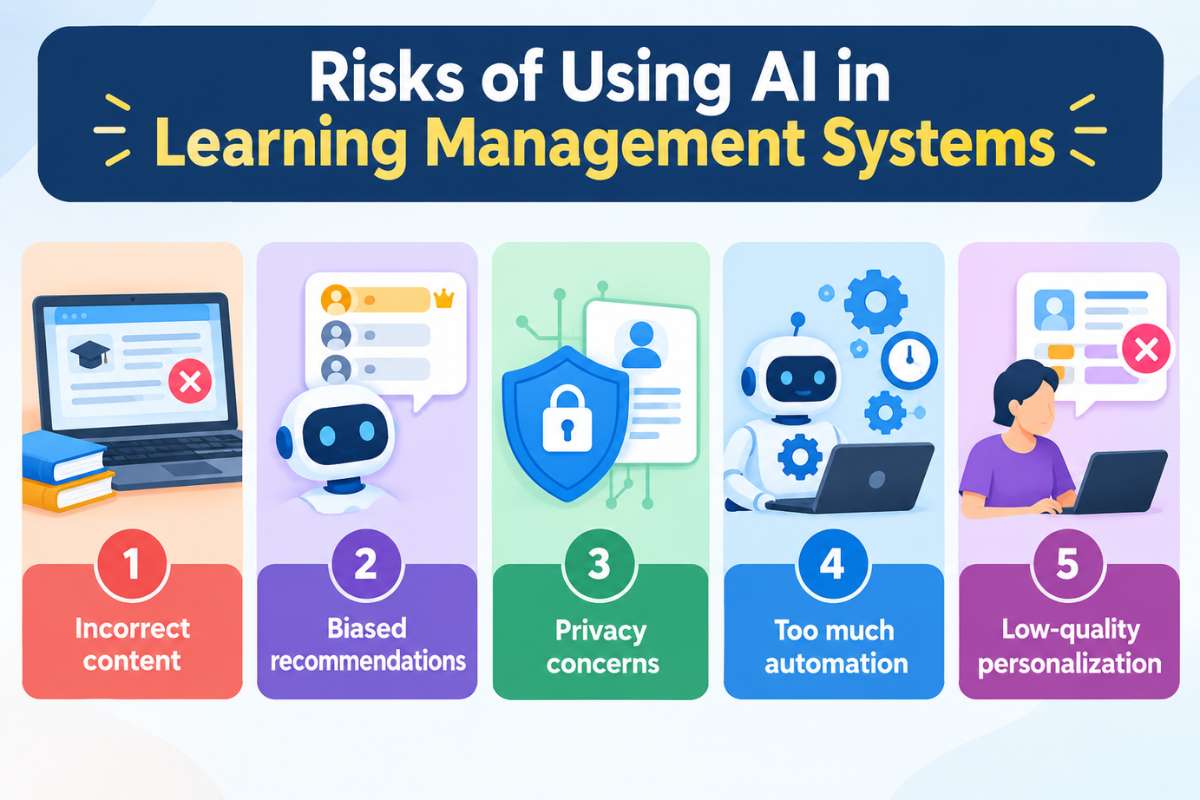
AI can improve learning, but it also introduces new risks.
1. Incorrect content
AI-generated answers may be wrong or incomplete. Human review is needed for important topics.
2. Biased recommendations
AI systems learn from data. Poor or uneven data can lead to poor recommendations.
3. Privacy concerns
LMS data may include assessment results, learning behavior, career goals, and other employee information. Companies should limit data access and clearly explain how it is used.
4. Too much automation
Not every learning decision should be automated. Employees still need teachers, managers, mentors, and subject experts.
5. Low-quality personalization
More data does not always mean better learning. A system may recommend content based on clicks or completion history without understanding the learner’s real goal.
A useful rule is simple: automate low-risk tasks first and keep human control over high-impact decisions.
Also Read: 9 Best AI Tools for Students to Study Smarter, Not Harder | Future Education Magazine
Conclusion
AI can make an LMS more useful by turning learner data into practical actions. It can personalize courses, speed up content creation, improve search, identify skill gaps, and reduce routine work for L&D teams.
Yet technology alone will not improve learning. Strong content, clean data, clear rules, privacy controls, and human review still matter.
Companies should treat AI in learning management systems as a tool for better decisions. The best results will come from using AI where it saves time or improves relevance while keeping humans responsible for important learning choices.
FAQs
1. What is AI in a learning management system?
AI uses learner data to personalize training, automate tasks, and recommend content.
2. How does AI personalize LMS learning?
AI uses learner data to suggest relevant content and learning paths.
3. Can AI create LMS courses?
Yes, AI can create lesson drafts, quizzes, summaries, and practice questions.
4. Is AI safe to use in an LMS?
Yes, with strong privacy rules, data controls, and human review.
5. What are the benefits of AI in LMS platforms?
AI in learning management systems can personalize learning, save time, find skill gaps, and improve content search.