
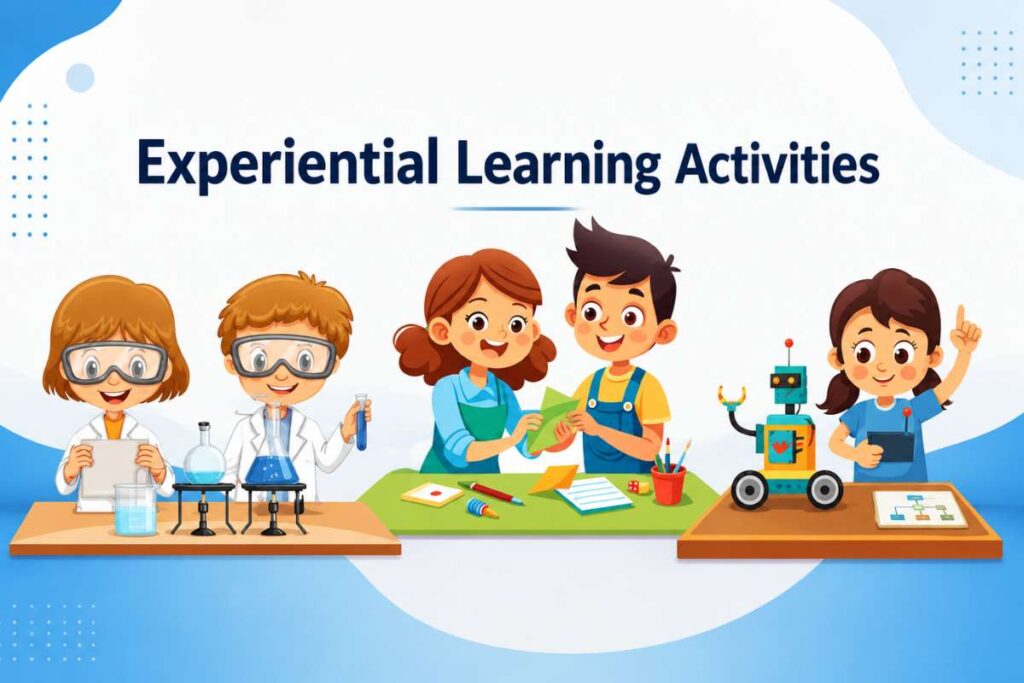
Experiential learning activities are hands-on exercises where people learn by doing, then reflecting on what happened. They do this rather than just listening or reading. This guide breaks these activities down by audience, from classrooms to remote teams. You’ll understand how each one maps to Kolb’s learning cycle and best practices for applying it. Read it to pick the right activity for your group and see improvement in how well lessons stick.
Sitting through a lecture rarely changes how someone acts the next day. Building something, solving a real problem, or role-playing a tough conversation usually does. That gap is exactly what experiential learning activities are designed to close.
They turn abstract ideas into lived experience, so learners remember not just what was said, but what happened. This shows up everywhere once you start looking for it. For example, a teacher running a classroom simulation, a manager rehearsing a feedback conversation, or a student running a field experiment.
This article breaks down what these activities look like, how to run them well across different settings, and how to tell if they’re actually working.
What Makes Experiential Learning Activities Different?
Most training methods hand learners information and hope it sticks. Experiential learning flips that order: learners act first, then make sense of what happened. The approach traces back to psychologist David Kolb, whose Experiential Learning Cycle describes four connected stages:
- Concrete Experience: Doing or encountering something firsthand
- Reflective Observation: Reviewing what happened and how it felt
- Abstract Conceptualization: Drawing lessons or theories from that reflection
- Active Experimentation: Testing those lessons in a new situation
A few core characteristics show up in all strong experiential learning activities:
- Learner-driven Action: The person doing the activity makes decisions, not just follows instructions.
- Realistic Stakes: Mistakes have consequences, even small ones, which sharpen attention.
- Built-in Reflection: Time is set aside to unpack what happened, not just move to the next task.
- Transfer to Real Life: The skill or insight is meant to travel beyond the activity itself.
Without reflection, an activity is just an event. The reflection step is what turns experience into learning, a point Valdosta State University’s teaching guide on experiential learning makes clear as well.
What Do Experiential Learning Activities Look Like in Different Settings?
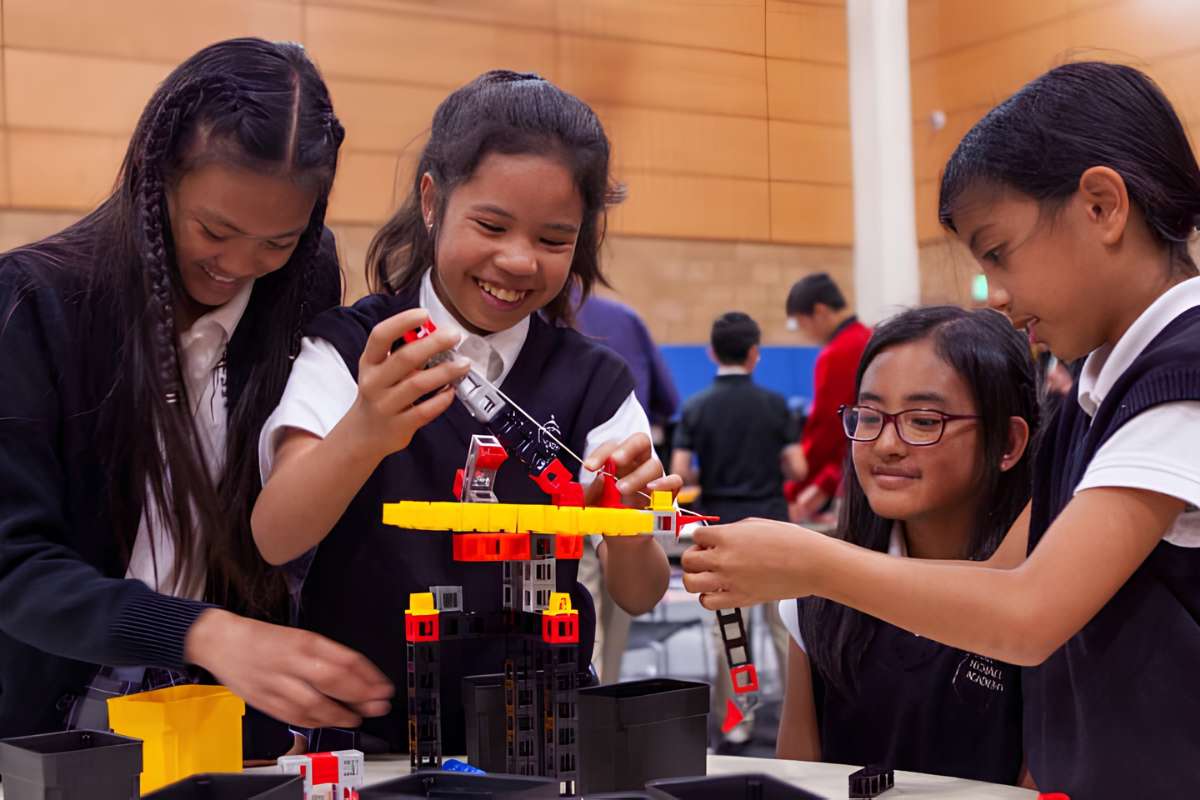
The core idea stays the same everywhere, but the format changes a lot depending on who’s learning and why. Below is a breakdown by audience, with each activity mapped to Kolb’s four stages.
K-12 Classrooms
Young students learn best through play with a clear goal. Good formats here include hands-on science projects, group games, mock events like trials or elections, and simple money tasks. Keep the steps short. Let students see results fast.
| Example Activity | Concrete Experience | Reflective Observation | Abstract Conceptualization | Active Experimentation |
| Classroom ecosystem terrarium | Students build and observe a sealed terrarium | Journal daily changes over two weeks | Discuss the water cycle and interdependence | Design a second terrarium, testing one variable |
| Mock trial | Students argue a fictional court case | Debrief what arguments landed and why | Connect to concepts of evidence and persuasion | Revise arguments for a second round |
| Budgeting simulation (play money) | Students “earn” and spend a weekly allowance | Track where money went | Discuss needs vs. wants, saving | Set a savings goal for the next round |
Higher Education
College students can take on longer, harder projects. Strong formats include research work with real community partners, negotiation exercises, lab design challenges, and internships tied to coursework. End with something real, like a report or a prototype. These experiential learning activities work best when they match the student’s field of study.
| Example Activity | Concrete Experience | Reflective Observation | Abstract Conceptualization | Active Experimentation |
| Community-based research project | Students collect data with a local nonprofit | Write reflective field notes | Link findings to course theory | Present recommendations to the partner org |
| Case study negotiation (business/law) | Students negotiate a contract in pairs | Group debrief on tactics used | Study negotiation frameworks | Re-negotiate with a new counterpart |
| Lab-based engineering challenge | Teams build a working prototype | Log failures and design changes | Apply relevant physics or materials theory | Redesign for a second constraint set |
Also Read: Why Experiential Learning in Higher Education is No Longer Optional
Corporate and Remote Teams
Working adults need activities that respect their time and tie back to real job tasks. Simulations, role-play for tough talks, job shadowing, and short scenario drills all work well, even on a video call. The best ones copy a real situation the employee will soon face. Skip the generic team-building games.
| Example Activity | Concrete Experience | Reflective Observation | Abstract Conceptualization | Active Experimentation |
| Virtual crisis simulation | The team responds to a mock PR crisis in real time | Debrief decisions and communication gaps | Map response to crisis management models | Run a second simulation with new roles |
| Cross-functional shadowing | An employee spends a day with another department | Share observations in a team meeting | Identify workflow gaps between teams | Propose one process change |
| Role-play difficult conversations | Managers practice giving hard feedback | Peer feedback on tone and clarity | Study feedback frameworks (e.g., SBI model) | Apply the model in a real conversation |
Neurodivergent and Life-Skills Learners

This group learns best from real daily tasks practiced in a safe, low-pressure setting. Good formats include guided practice trips, like grocery shopping or riding a bus, step-by-step role-play, and repeat rehearsal with a coach close by. Clear steps and repetition matter more here than new or flashy activities.
| Example Activity | Concrete Experience | Reflective Observation | Abstract Conceptualization | Active Experimentation |
| Grocery store role-play | Learner practices selecting items and paying | Talk through what felt hard or easy | Break down the steps into a checklist | Repeat the trip with less support |
| Public transit practice run | Learner rides a bus route with a coach | Discuss any confusing moments | Identify cues to watch for (stops, signs) | Try the route independently |
| Job interview rehearsal | Learner practices answering common questions | Watch a recording and note strengths | Discuss what interviewers look for | Do a mock interview with a new interviewer |
Notice how the format shifts from games and simulations for younger learners to project-based and role-play formats for adults. What stays constant is the loop: act, reflect, conceptualize, try again.
How Do You Run Experiential Learning Activities Successfully?
Even well-designed activities can fall flat without the right setup. A few practices consistently make the difference between an activity that’s fun and one that actually builds skill.
- Set a clear learning goal before you pick the activity. Choose the format to fit the goal, not the other way around.
- Explain the “why,” not just the “what.” Learners engage more when they understand the purpose behind an exercise.
- Keep group sizes manageable. Smaller groups (4-6 people) tend to produce more honest reflection than large ones.
- Build in a real debrief, not just a wrap-up. Five rushed minutes at the end aren’t enough for genuine reflection.
- Allow for failure. Mistakes made in a low-stakes activity are often the most memorable teaching moments.
- Adapt for accessibility. Offer alternate ways to participate for learners with different physical, sensory, or cognitive needs.
How Do You Evaluate and Reflect on Learning?

Reflection is often the step that gets skipped when time runs short, but it’s where most of the learning actually happens. A simple structured template can keep it consistent across sessions.
Reflection Template (usable after any activity):
- What happened? Describe the activity in a few sentences; no judgment yet.
- What did you notice? What worked, what surprised you, what felt uncomfortable?
- Why do you think that happened? Connect it to a concept, pattern, or prior experience.
- What will you do differently next time? Name one specific change.
- How will you know it worked? Define a simple success marker for the next attempt.
This template works well for a classroom journal, a team retro, or a coaching talk. The Association for Experiential Education has a free guide for evaluating experiential programs for anyone building a larger program.
Why Do Experiential Learning Activities Matter?
Traditional instruction is efficient for delivering information, but it’s weak at building judgment. Activities involving experiential learning matter because they train the parts of a skill that can’t be taught through explanation alone. For example, timing, tone, and decision-making under pressure.
Research on retention consistently favors doing over listening. Learners tend to recall far more from activities they actively participated in than from material they simply heard. That’s part of why fields like medicine, aviation, and teaching all rely heavily on simulation and supervised practice rather than lectures alone.
There’s also an engagement effect. Activities that involve choice and consequence tend to hold attention better than passive formats, which matters just as much in a corporate training session as it does in a middle school classroom.
Final Thoughts
Experiential learning activities aren’t a replacement for good instruction. They’re what make instruction stick. The format can be as simple as a five-minute role-play or as involved as a semester-long research project. The pattern stays the same either way: act, reflect, understand, and try again.
You don’t need a big budget or a full day to start. Pick one activity from this guide, run it with a small group, and use the reflection template afterward. Notice what worked and what felt rushed. Adjust the format to match the audience in front of you, then build from there. Small, consistent practice beats one big, complicated event every time.
FAQs
1. What age group are experiential learning activities best suited for?
They work at any age, but the format should match the learner’s developmental stage. Hands-on games for children and project-based work for adults.
2. How long should an experiential activity last?
Anywhere from 15 minutes to several weeks. The length should match the complexity of the skill being practiced, not a fixed rule.
3. Can experiential learning work in a fully remote setting?
Yes. Virtual simulations, role-plays, and group projects can copy the same experiential learning loop used in person.
4. How is experiential learning different from hands-on learning?
Hands-on learning just means physical activity. Experiential learning adds a reflection step after the activity, which is what turns it into lasting knowledge.