

Leadership development programs are structured plans that build the skills people need to lead others. It combines training, coaching, and real-world practice over time. This article covers the skills, methods, and frameworks behind strong programs, plus a step-by-step process for building one from scratch. Read on to learn how to grow confident leaders who boost retention, strengthen trust, and keep your team ready for whatever comes next.
Most managers never asked to lead people. They got promoted because they were good at their old job, then handled a team with no real training on how to do it. That leads to confused priorities, low trust, and teams that quietly disengage.
Leadership Development Programs (LDPs) solve this problem. They turn accidental managers into confident leaders who can coach, plan, and make hard calls under pressure. Research backs this up. Companies with a strong program in place report an average turnover rate of 15%, compared to 30% in those without such programs.
This article explains what LDPs are, the skills they should build, and the methods and frameworks behind them. Continue reading to learn how to design one that works for your organization.
Leadership Development Programs: Meaning, Components, and Types
A leadership development program is a plan that helps people build the skills to lead others. It combines training, coaching, real projects, and feedback. Good programs run for weeks or months.
A good example is General Electric’s leadership program at Crotonville, New York. It’s one of the oldest and most well-known corporate leadership schools in the world. GE built an ongoing system that spots strong employees early. It gives them tough assignments, moves them to new locations, and offers steady coaching as they grow. The program focuses on hands-on practice. This approach helped it become a model that many other companies still copy today.
Here are the core components of successful leadership development programs, like the one mentioned above:
| Component | What It Does? |
| Needs assessment | Finds skill gaps before training starts |
| Structured curriculum | Covers key leadership skills step by step |
| Coaching or mentoring | Gives leaders real feedback, not just theory |
| Real-world application | It lets leaders practice on live projects |
| Measurement | Tracks progress with clear numbers |
Types of Programs by Organizational Level
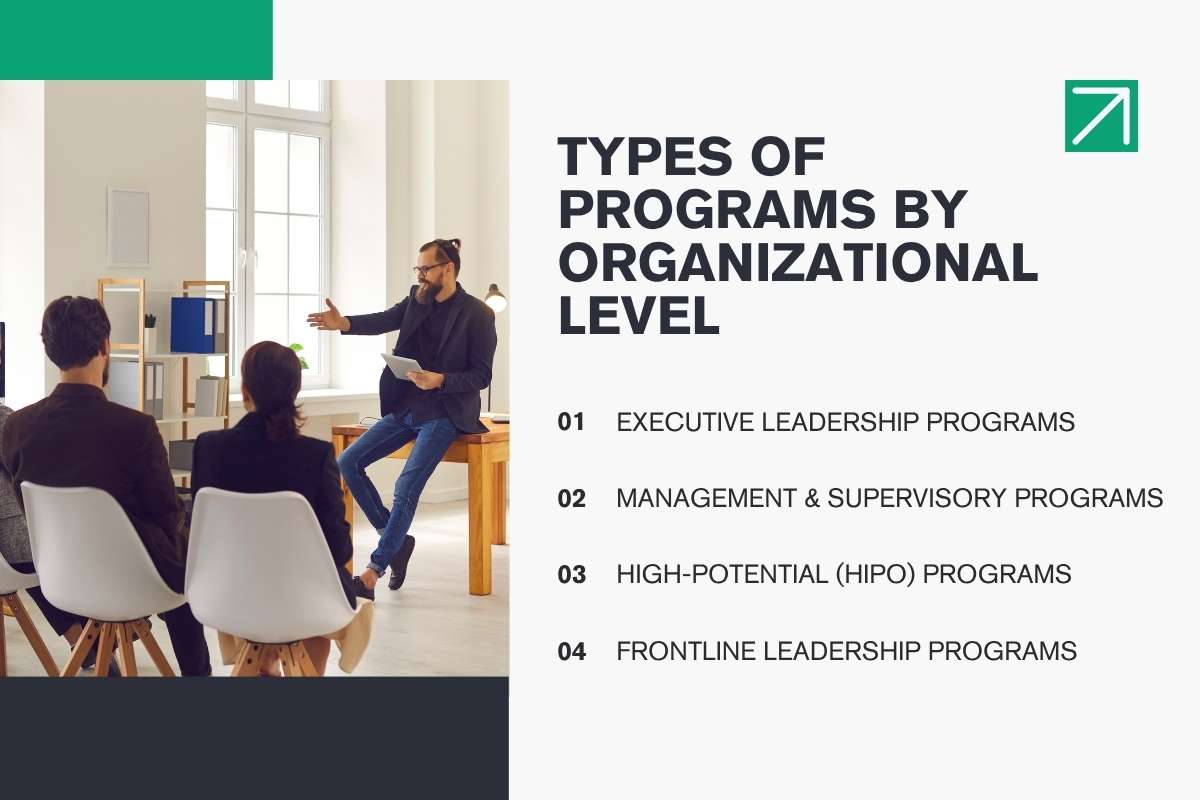
Leadership development programs also come in different forms based on who they’re built for and where that person sits in the company.
1. Executive Leadership Programs:
Built for senior leaders and C-suite executives. These focus on big-picture strategy, leading through major change, and long-term vision for the company.
2. Management & Supervisory Programs:
Made for new or mid-level managers. These cover team dynamics, conflict resolution, performance reviews, and daily operations.
3. High-Potential (HiPo) Programs:
Built for rising stars marked as future leaders. These often include rotations across departments to build broad business skills.
4. Frontline Leadership Programs:
Made for team leads and supervisors closest to daily work. These focus on coaching, hands-on problem-solving, and clear communication.
Leadership Skills Every Program Should Develop
A strong program builds a mix of practical and people skills. These include:
- Communication: Explaining ideas clearly and listening well. Leaders who communicate well avoid confusion and keep their team aligned.
- Decision-making: Weighing facts and risk under time pressure. Good leaders act fast without ignoring the data in front of them.
- Emotional Intelligence: Reading the room and managing reactions. This helps leaders stay calm and connect with their team, even in tense moments.
- Delegation: Handing off work based on strengths, not habit. This builds trust and frees leaders to focus on bigger priorities.
- Coaching: Helping others grow, not just handing out tasks. Strong coaches ask good questions and give honest, useful feedback.
- Conflict Resolution: Solving tension before it hurts morale. Leaders who handle conflict well keep teams focused and productive.
- Strategic Thinking: Linking daily choices to long-term goals. This keeps day-to-day work tied to what the company is trying to achieve.
Building Leadership Development Programs from Scratch: Where to Start?
Building a leadership program from scratch can feel like a big task. But it gets easier once you break it into clear parts. Below, we’ll walk through the training methods and frameworks that shape strong programs, then lay out the steps to design one that fits your team.
The Methods of Delivering Leadership Programs
There is no single right way to train leaders. Most strong programs blend a few methods:
- Instructor-led Training: Live sessions with a skilled facilitator. Many leaders still prefer this for depth and real discussion.
- Coaching and Mentoring: One-on-one guidance from someone more experienced.
- Action Learning: Leaders solve a real business problem in a small group, then share results.
- E-learning and Microlearning: Short lessons that fit into a busy day.
- Simulations and Role-play: Safe practice for tough talks, often using AI to set up real scenarios.
- 360-degree Feedback: Input from peers, managers, and direct reports that shows blind spots.
Blending formats matters more than picking one “best” method. Leadership development programs that mix live sessions with coaching and real projects help skills stick.
The Frameworks Behind Strong Leadership Programs

Frameworks give shape to what could be a random mix of workshops. A few common ones are:
- 70-20-10 Model: 70% of learning comes from real work, 20% from coaching, and 10% from formal training.
- Situational Leadership: Leaders shift their style based on a team member’s skill and confidence, instead of using one style for everyone.
- Competency-based Frameworks: These spell out the exact behaviors expected at each level. Training then targets those gaps.
- DDI’s Leadership Model: This model focuses on people skills, like listening, empathy, and bringing others into decisions.
Picking a framework early keeps a program steady instead of scattered.
With the right methods and frameworks in mind, here’s how to put it all together, step by step:
1. Assess Current Gaps:
Use surveys, performance data, and manager input to see where leadership is weak. This step shows you exactly where to focus.
2. Set Clear Goals:
Link the program to real results, like retention or succession planning, not just “better leaders.” Clear goals make it easier to measure success later.
3. Choose the Right Mix of Methods:
Blend training, coaching, and real projects to fit your team. No single method works alone, so mixing formats helps skills stick.
4. Build in Accountability:
Add check-ins, action plans, and manager follow-up so learning doesn’t stop after the last session. This keeps leaders applying what they learn on the job.
5. Measure Results:
Track things like retention, promotion readiness, and feedback scores over time. This proves the program is working and shows where to improve next.
This process matters because a poor fit is a top reason programs fail. Programs that line up closely with business goals see an 80% higher success rate.
How is AI Transforming Leadership Development?

AI is changing how leadership training gets built and delivered. Many of the organizations now use AI tools to shape training paths for each leader. Adoption is growing fast, too. Use of AI training tools is growing each year, and it works. AI-based training can boost skill gains compared to older methods.
In practice, this looks like AI chatbots that act out a tough talk with an employee. It also looks like tools that suggest the next lesson based on a leader’s gaps. Some firms are testing VR for high-stakes moments, like leading a layoff talk or handling a crisis. This lets leaders build confidence before the real thing happens. AI won’t replace human coaching. But it makes practice easier to access and feedback faster to get.
Why Do Leadership Development Programs Matter?
The case for these programs is strong. 75% of the companies that run them say they saw a positive impact on employee engagement scores. Firms that train leaders at every level, not just the top, are far more likely to lead their industry in results. Beyond the numbers, strong leadership shapes daily life at work. Teams led by trained managers show more trust, clearer expectations, and less burnout.
Skipping leadership training has a real cost, too. When companies wait too long to invest, profits tend to drop. Untrained managers make slower, costlier calls. They also lose good people who might have stayed under better leaders.
Where Do Leadership Development Programs Go Wrong?
Even well-funded programs run into trouble. The most common issues are:
- Poor fit with real business goals
- One-size-fits-all content that ignores different levels
- No follow-up, so skills fade fast
- Weak tracking makes it hard to prove results
- Low manager buy-in, when leaders see training as a checkbox
Most of these issues come down to one thing. Companies don’t treat leadership training as an ongoing habit. Budget is another hurdle. Smaller companies often can’t afford long programs or paid coaches. Even so, low-cost options can help. Peer mentoring and shadowing a senior leader both work well without a big budget.
Conclusion
Building strong leaders takes more than a title change. It takes real skills, the right training methods, a clear framework, and a program designed with intent. Get those pieces right, and the payoff shows up fast: better retention, stronger trust, and leaders ready before a crisis hits.
Take GE’s Crotonville program. It has lasted for decades, not because of fancy slides, but because it pairs real assignments with steady coaching. That’s the pattern worth copying.
So don’t wait for good leaders to simply appear. Build leadership development programs for your organization and test them. That first step is often the hardest part and the most worth taking.
FAQs
1. What are the 5 steps of leadership development?
The typical process includes checking current gaps, setting clear goals, picking training methods, adding accountability, and tracking results over time.
2. What are the 5 C’s of leadership development?
A common version lists character, competence, communication, commitment, and courage. Together, they shape strong, trusted leaders.
3. How to improve leadership skills?
Practice through real decisions, ask for honest feedback from peers and direct reports, and pair that experience with coaching or formal training.
4. How long should a leadership development program run?
Most strong programs run for several months. Skills like coaching and delegation need repeated practice to stick.
5. Who should attend leadership development programs?
Anyone who manages people, or plans to, should attend. This spans new supervisors to senior leaders, though the content should fit each level.