
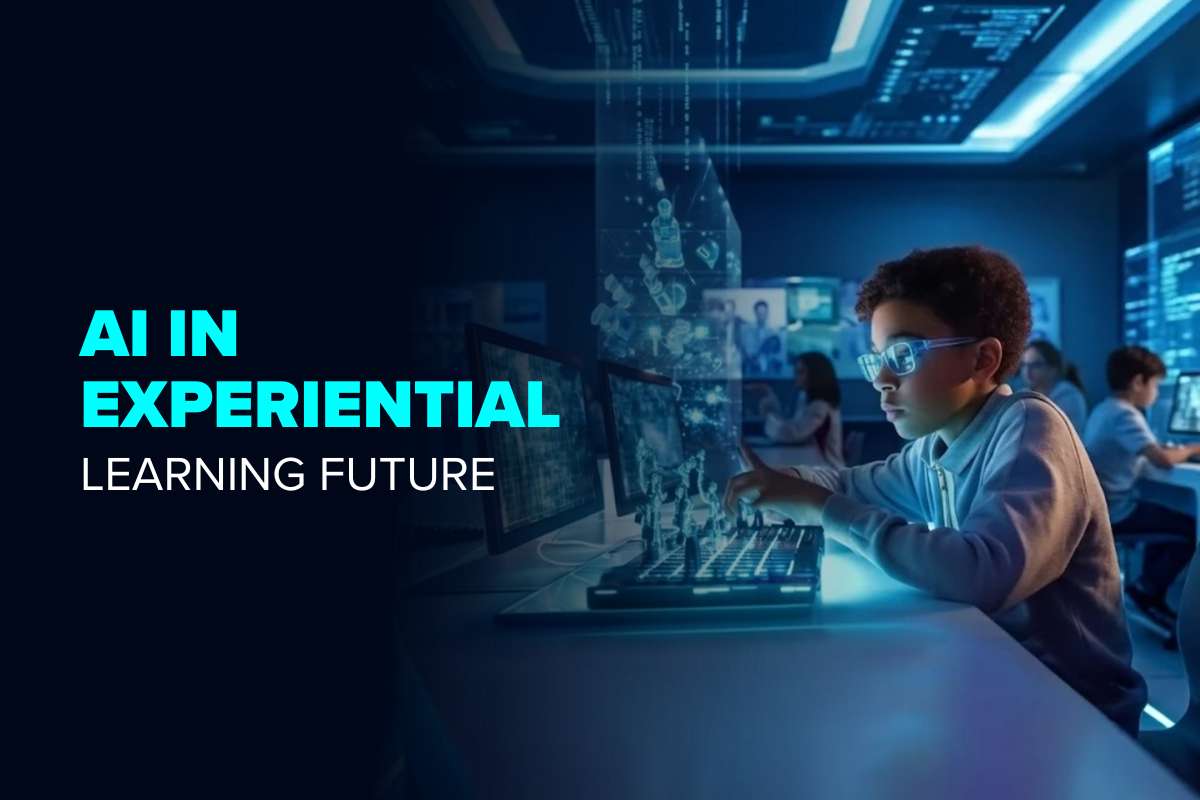
AI in experiential learning future is about AI-powered simulations, agentic tutors, and role-play tools that make hands-on practice safer, more personal, and easier to scale. This article covers what AI is already doing in training today, what is coming next, and the risks worth watching. Read it to plan training that keeps you ahead without losing the human touch.
A surgeon practices a rare surgery a hundred times before touching a real patient. A new manager rehearses a tough talk until her voice stops shaking. Neither left a classroom; both used a computer simulation built with AI.
Experiential learning means learning by doing. But real practice can be costly, risky, or hard to set up. You can’t let a med student practice on a real patient. This is where AI in experiential learning future work gets interesting, solving the problem at scale. This article won’t tell you AI is replacing hands-on learning. It isn’t, and it shouldn’t. AI makes learning safer, bigger in scale, and more personal. People still handle what matters most.
How is AI Changing Experiential Learning Right Now?
Most of today’s change falls into five groups. None of this is science fiction. Schools, hospitals, and companies use all of it today. Together, these five shifts show the near-term shape of AI in experiential learning future.
1. Simulations now replace risky, costly practice:
Medical schools use AI-driven virtual patients. These patients react differently based on the treatment a student picks. So learners can make mistakes with zero real risk. This is how AI is supporting experiential learning in higher education.
2. Learning paths are getting personal:
Instead of one lesson plan for thirty students, smart systems track where each learner gets stuck. They change the next step based on that. The goal is to build “A learning environment that is designed and adaptable to meet the unique needs of every student.”, as said by Dr. Sharon Shappley, owner of Sharon’s Classes.
3. AI powers role-play at scale:
Voice and text tools let one trainee rehearse a hard talk, like a review or a sales pushback, as many times as needed. The AI plays the other side. It also gives tips on tone, pace, and word choice. AI powers experiential learning activities.
4. Smart tools catch gaps early:
By tracking patterns across many learners, AI can flag which skills someone will likely struggle with next. This often happens before the learner even notices the gap.
5. AR and VR now team up with AI:
Headsets paired with AI let learners walk through a warehouse fire or a job-site safety check. No real danger involved at all. A PwC study found workers trained with AI-powered VR learned up to four times faster than those in normal classrooms, and felt up to 275% more sure of the new skill afterward.
The table below shows where this shift shows up most.
| Learning Method | Old Way | AI-Enhanced Way |
| Medical training | Cadavers, watched rounds | AI virtual patients with shifting outcomes |
| Sales/communication | Role-play with a coworker | AI partner, unlimited practice runs |
| Safety training | One lecture, one drill | VR drill with live AI feedback |
| Corporate leadership | One workshop a year | Ongoing AI-coached practice |
What Comes Next? AI in Experiential Learning Future
This is where things get interesting. The next wave of AI in experiential learning is about tools that build their own lessons, run their own scenarios, and adjust on the fly. Some of this is already live. Here’s what’s coming:
Agentic AI Tutors That Plan Ahead
Older AI tools waited for a learner to ask a question. Newer “agentic” tutors work differently. They watch how a learner does, spot the weak points, and build the next lesson before being asked. This is a clear sign of where AI in experiential learning future is headed.
Multi-agent Simulations with Several AI Characters at Once
Instead of one chatbot playing one role, some builders now use a few AI agents at once. Each plays a different part in the same scene. Researchers at Wharton built a prototype called PitchQuest, a pitch-practice simulator. It puts students in front of three agents at the same time: a Mentor, an Investor, and an Evaluator.
AI-guided Avatars and Long-term Mentors
Some platforms are building digital mentors a learner returns to for months. The mentor remembers past sessions and tracks growth across a whole program, closer to a real coaching relationship.
Career Test-drives, Personalized at Scale
New tools let a student try out a job for a day, like shadowing a nurse or an engineer, built around that student’s own interests. This turns career guidance from a one-time chat with a counselor into an ongoing, hands-on preview.
Built-in Reflection, Not Just Practice
A hard part of experiential learning has always been the reflection step, thinking through what a learner did wrong or right. New AI tools now walk learners through that step right after a simulation ends, based on Kolb’s Experiential Learning Theory.
Why This Matters for Staying Ahead:
Coursera’s 2026 Job Skills Report looked at millions of enterprise learners. It named agentic AI as the #3 fastest-growing skill area going into 2026. Groups that are leading AI in experiential learning future planning are the ones already testing agentic tutors, multi-agent simulations, or live AI-driven training.
The role of human guides is shifting. Teachers, coaches, and mentors will spend less time repeating steps. They’ll spend more time on the calls only a person can make: reading a struggling student’s body language, knowing when someone needs support, and showing the kind of care no simulation can fully copy.
Where AI in Experiential Learning Future May Still Fall Short?

Any fair look at future planning of AI in experiential learning must cover the downsides too.
1) Bias in AI Grading:
If an AI trains mostly on one type of learner’s data, its feedback may favor some accents or styles over others. A learner from a different background might get marked down for a style that’s just different, not wrong.
2) Data Privacy:
Simulations often collect private data: voice clips, facial cues, even stress signs from the body. Where that data goes, who sees it, and how long it stays are unanswered questions. As a fact, 96% of K-12 educational apps share children’s personal data with third parties, which increases data risk.
3) Skill Loss Over Time:
If learners only practice with AI, they may struggle when a real person doesn’t follow the script. Skills like reading body language still need real human practice.
4) The Human Part AI Can’t Replace:
Care built from real life. Mentorship shaped by shared history. Judgment earned through years of hard mistakes. None of this comes from an AI model.
5) Clear Rules Matter:
Schools and firms using AI for training need clear rules. This covers consent, how long data stays, and how a person checks AI feedback. Dr. Sharon Shappley, owner of Sharon’s Classes, says schools need to teach students how to use this technology responsibly, not just how to use it.
Conclusion
Here’s the clearest way to see AI in an experiential learning future. AI is not the teacher; it’s the practice partner that never gets tired, never loses patience, and never charges overtime. It lets a nursing student fail a hundred times safely before a real patient is at risk. It lets a new manager rehearse hard talks until the words feel natural. But the judgment, care, and hard-won wisdom that make someone a great mentor still come from people.
Groups that get this balance right will set the pace. They’ll use AI to widen access while keeping people in charge of meaning and mentorship. That’s how they’ll truly improve learning, not just add new tech for its own sake. As Dr. Sharon Shappley puts it, “Learning is the one journey where every step forward makes the path wider.”
FAQs
1. Will AI replace hands-on, experiential learning?
No. AI widens access to safe practice and gives clear feedback, but human mentorship and judgment still matter most.
2. What are agentic AI tutors, and how are they different from regular AI tutors?
Agentic AI tutors don’t just answer questions. They watch how a learner is doing and build the next lesson on their own, before the learner even asks.
3. Is AI-based training as good as in-person training?
Studies like PwC’s VR research show AI-trained learners often master skills faster and feel more sure of them than those trained by lecture alone.
4. What are the biggest risks of AI in experiential learning future?
The main risks are bias in AI grading, privacy issues with personal data, and learners leaning too much on AI instead of real human contact.
5. How will AI in experiential learning change in the next few years?
Expect AI tutors that build their own training tasks, group simulations with several AI characters, and tools that guide learners through reflection right after practice.