
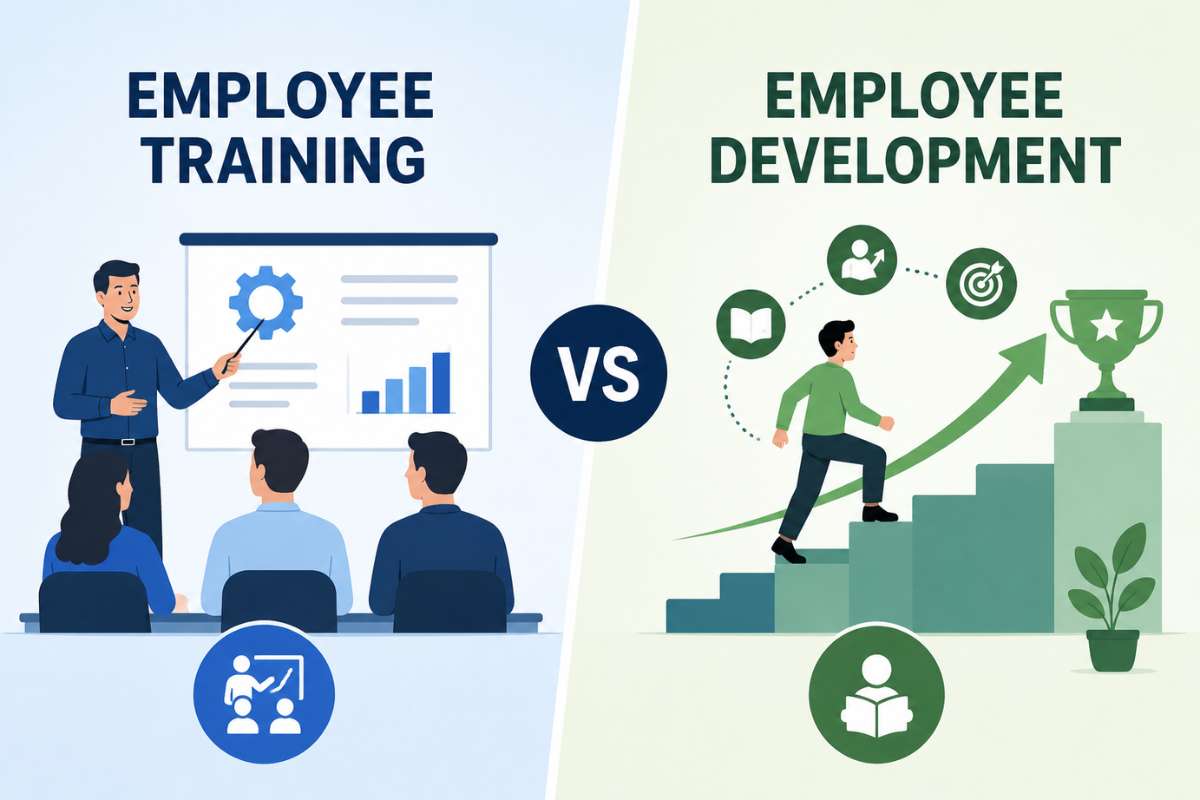
Most companies spend money on both, but only a few people know where one stops and the other starts. Ask a manager to explain employee training vs employee development, and you’ll often get a blank look. Both are different, and mixing them up costs businesses time, money, and good employees.
Training teaches someone to do their current job better. Development gets them ready for what comes next. They both solve different problems. Companies should know the difference clearly so skilled workers don’t leave for better jobs elsewhere. A CIPD-backed Essential Skills Tracker found that 56% of employees would consider changing jobs for better opportunities to build their skills.
This article breaks down the main differences, when to use each approach, and how smart companies combine both to build a team that sticks around.
What is Employee Training?

Employee training is short and focused. It teaches one skill needed for one job, right now.
Think of a new cashier learning the register. Or a factory worker learning to run a new machine. The goal is simple: get this person ready to do the task. Training has a clear start and end point. It also has a clear result you can measure.
Common training formats include:
- Onboarding sessions for new hires
- Software or tool tutorials
- Safety and compliance courses
- Sales scripts and product knowledge sessions
- Customer service role-play exercises
Training answers one question: “Can this person do the job in front of them?”
What is Employee Development?
Employee development is bigger and slower. It’s not about one task. It’s about growing a person’s overall skills, so they can handle more down the road. Development might include leadership coaching, cross-team projects, or mentorship. There’s no fixed end date.
It’s an ongoing investment in someone’s career rather than just their current role. The gap between current skills and career growth is significant. Only 24% of workers globally are confident they have the skills needed to advance to the next job level, while just 17% strongly agree their employers are investing in those skills. This is exactly why employee development programs matter.
Development answers a different question: “Where could this person go? And how do we help them get there?”
Employee Training vs Employee Development: A Detailed Comparison
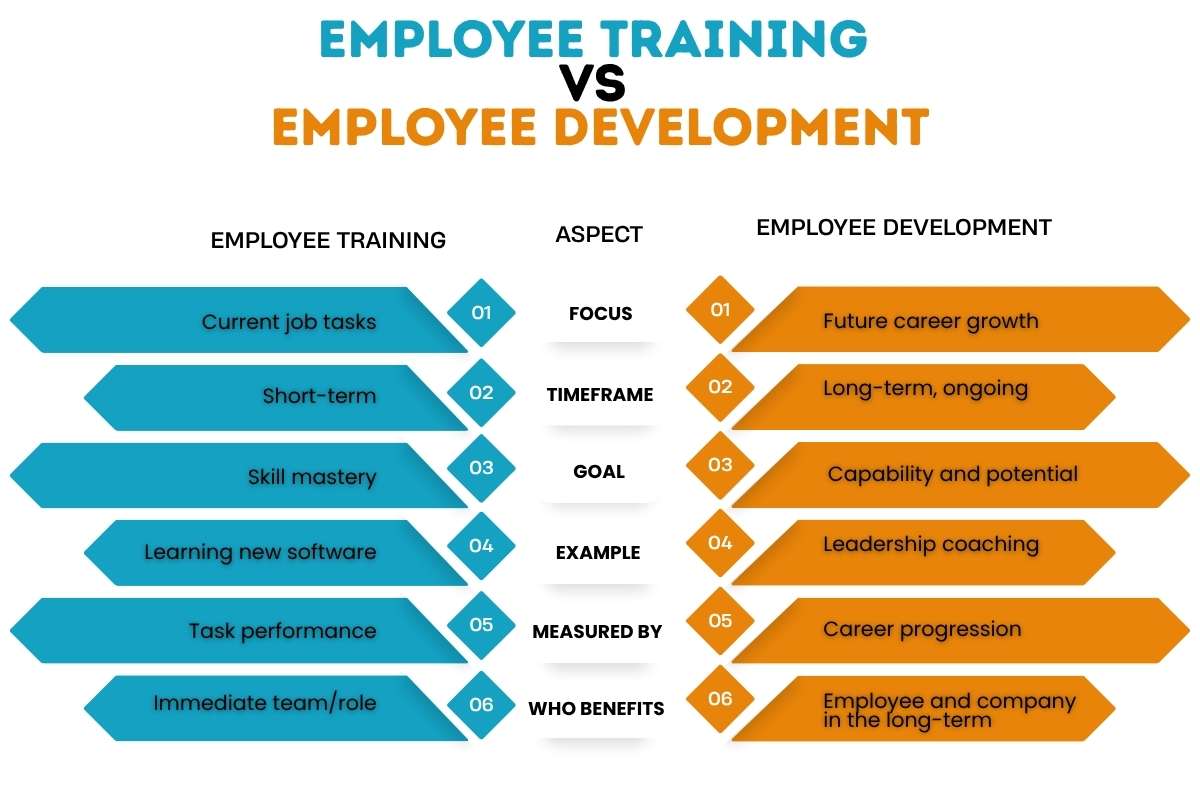
The fastest way to understand employee training vs development is to break it down piece by piece. Here’s a quick snapshot first:
| Aspect | Employee Training | Employee Development |
| Focus | Current job tasks | Future career growth |
| Timeframe | Short-term | Long-term, ongoing |
| Goal | Skill mastery | Capability and potential |
| Example | Learning new software | Leadership coaching |
| Measured by | Task performance | Career progression |
| Who benefits | Immediate team/role | Employee and company in the long-term |
Now let’s look closer at each aspect of employee training vs employee development.
1. Focus: Job Tasks vs Career Growth
Training zooms in on one thing. What does this person need to know to do their job well today? It’s narrow on purpose. A delivery driver learning a new GPS app is training. A warehouse worker learning new safety rules is training too.
Development looks past the current job title. It asks what skills and experience someone needs for a role they don’t have yet. Say a warehouse worker is being groomed for a supervisor job. They start learning how to schedule shifts and handle conflicts. That’s development.
Here’s another example. An accounting clerk learns new invoicing software. That’s a task-specific skill, so it’s training. That same clerk gets coached on budgeting and team leadership, with a plan to become a finance manager in two years. That’s development. It’s often linked with career development programs.
2. Timeframe: Short Bursts vs Ongoing Investment
Training is usually a one-time event. It has a start date and an end date. Also, there’s a certificate at the finish line. A two-day workshop on new software is training with a clear stop point.
Development rarely has a finish line. It plays out over months or years. It happens through repeated practice, feedback, and new chances to grow. A junior sales rep might spend three years in a development track before they’re ready to manage a team. That path includes mentorship and slowly growing responsibility.
This is one of the clearest ways to tell employee training vs employee development apart. Training is a sprint. Development is a marathon. “You must be able to answer at least one of these three questions: How will this initiative help you make money, save money, or mitigate risk for the company?” says Amanda Nolen, co-founder of the L&D consulting firm NilesNolen.
3. Goal: Mastering a Skill vs Building Potential
The goal of training is simple: competence. Can this person do the task safely and well? Success looks like a nurse who can correctly run a new piece of equipment after one training session. Or a call center agent who hits their targets after finishing a training module.
The goal of development is different: potential. It’s not “can they do this one thing.” It’s “how far can this person grow?” Picture an entry-level marketing coordinator. After two years of mentorship and new projects, they’re ready to lead a small team. No single course taught them everything; it built up slowly.
4. Real-World Examples Side by Side
Matching examples of employee training vs employee development from the same job make this easier to picture:
Retail Employee:
Training teaches the checkout system. Development means shadowing a store manager to learn inventory and staffing.
Software Developer:
Training covers a new coding tool the team just adopted. Development means mentoring newer developers and joining planning meetings to prepare for a senior role.
Nurse:
Training covers a new patient monitoring system. Development means a leadership program to prepare them to become a charge nurse.
Restaurant Staff:
Training covers food safety rules and the register. Development means rotating them through kitchen and floor roles so they understand the whole business before becoming a shift manager.
5. Measured By: Performance vs Progression

You can measure success right away in employee training vs employee development. Did mistakes drop? Did the employee pass the test? Are they hitting normal output within two weeks?
Development success shows up much later, often a year or more down the road. Did this employee get promoted? Are they ready to lead when a role opens up? Has their impact grown beyond their original job?
Because the timelines are so different, judging development with training-style numbers is a mistake. It almost always makes good programs look like they’re failing, even when they’re working just fine.
6. Who Benefits: Immediate Team vs Long-Term Company Health
Training mostly helps right now. The team gets a more capable coworker faster. The company avoids costly mistakes, and the customer gets better service today.
Employee development benefits everyone, but it takes longer to show. The employee builds a real career path instead of feeling stuck. The company builds its own pipeline of future leaders. That beats hiring expensive outside talent every time a role opens up.
External hires typically get paid 18 to 20 percent more than internal candidates promoted into the same role, according to Wharton research. This is why so many companies now treat employee training vs employee development as two investments that support each other.
How Do Training and Development Work Together?
Employee training and development should go hand in hand. Picture a new marketing hire. In week one, they go through training. They learn the email tool, how to format reports, and the brand style guide. That’s short and task-focused.
Six months later, once they know the basics, the company might add them to a leadership track. Or pair them with a mentor. Or send them to a conference. That’s development, and it prepares them for a role they don’t have yet.
Neither one replaces the other. Training builds the floor, and development raises the ceiling. Andy Lancaster, Chief Learning Officer and Consultant at CIPD, highlights the value of integrated learning, where formal training is combined with collaboration and learning in the flow of work for long-term development. He says, “L&D professionals need to be at the forefront of integrated learning, to ensure that learning is an ongoing process and not ad hoc.”
When Should a Company Prioritize Training vs Development?

The right choice between employee training vs employee development depends on where the employee is in their journey.
Lean toward training when:
- A new employee just joined and needs the basics
- The company rolls out new software or tools
- Safety or compliance rules require certain certifications
- The role has clear, repeatable tasks that rarely change
Lean toward development when:
- The employee keeps beating expectations in their current role
- There’s a clear next step they could grow into
- The company is planning for future leadership needs
- The employee has said they want to grow there
Most companies need both at once, just aimed at different people or different points in someone’s journey.
Conclusion
The difference between employee training vs employee development comes down to two things: time and purpose. Training builds the skills someone needs today. Development builds the person they’ll become over the next several years.
Companies that only train end up with skilled workers who still leave for growth elsewhere. Companies that only develop, without solid training first, end up with people who struggle with day-to-day tasks. The strongest workplaces do both.
Getting this balance right isn’t just good for keeping employees around; it’s what turns a job into a career. And that’s good for everyone.
FAQs
1. Is employee development the same as career development?
They’re closely related. Employee development usually means company-led growth efforts. Career development can also include an employee’s own goals outside of work.
2. How often should companies offer training vs development?
Offer training any time a role or task changes. Offer development continuously, through regular coaching and feedback.
3. Which costs more, employee training vs employee development?
Neither one is always more expensive. Training costs can spike with specialized certifications, while development can start cheap through mentorship and stretch projects.
4. Can small businesses afford both training and development programs?
Yes. Small businesses can start with informal mentorship and regular feedback talks. These cost little but still build skills and growth paths.
5. What’s the first step in creating an employee development plan?
Start with a conversation. Ask the employee where they want to grow. Then match that goal with real chances inside the company, like new projects or mentorship.