
Employees don’t always leave a job over salary. A lack of growth can leave people feeling stuck and disengaged. Clear development goals give them a path to build skills, take on new responsibilities, and prepare for future roles.
Well-designed employee development goals also help businesses build stronger teams by connecting what employees want to learn with what the organization needs. This guide covers what these goals are, the main types to use, and SMART examples for setting goals that support both employee growth and business needs.
What are Employee Development Goals?
These are specific targets that help a worker build new skills, close gaps, or grow toward a bigger role. They are different from performance goals Employee Training vs Employee Development), which focus on hitting a number or finishing a task.
Development goals look further ahead. They might involve learning a new tool, improving communication, or preparing for a leadership role. Good employee development goals connect what the employee wants for their career with what the business actually needs.
These goals usually fall into three buckets: skill-building, career growth, and personal effectiveness. Some are technical, like learning new software. Others are behavioral, like improving how someone communicates in meetings. Both matter, and the best plans usually include a mix of the two rather than focusing on just one type.
When done right, these goals benefit both sides. The employee gains new, marketable skills. The company gains a more capable, more confident, and more loyal team member.
What Types of Employee Development Goals Should You Set?
The best goals for employee development follow the SMART framework: Specific, Measurable, Achievable, Relevant, and Time-bound. A vague goal like “get better at leadership” rarely leads anywhere. A SMART version, like “lead one team project within 90 days,” gives a clear finish line.
Below are common categories of growth goals, grouped by the kind of development they support. Each one includes a sample SMART goal you can adapt for your own team.
Skill-Based Goals
These goals focus on upskilling employees through Employee Upskilling Programs. They build technical know-how employees can apply directly to their daily tasks.
1. Technical Skills
These goals help employees learn tools or platforms that make their day-to-day work faster or more accurate.
SMART Goal: Complete an intermediate Excel or Python course within 3 months to automate weekly reports.
2. Digital Literacy
This covers comfort with everyday workplace software. It is one of the most important employee development goals for teams that collaborate remotely or across time zones.
SMART Goal: Learn one new collaboration tool, such as Notion or Asana, within 30 days to improve remote teamwork.
3. Certifications
A formal credential can validate existing skills or open the door to new roles. 91% of employers say certification plays a key role in the hiring process and is a reliable predictor of a successful employee.
SMART Goal: Earn a PMP or industry-specific certification within 6 months to qualify for project-lead roles.
Leadership and Career Goals
These employee development goals prepare employees to take on more responsibility and move toward their next role.
4. Leadership Skills
These goals prepare employees to guide a team, make decisions under pressure, and take ownership of outcomes beyond their own tasks.
SMART Goal: Lead one cross-functional project by the end of Q3 to build hands-on people-management experience.
5. Career Advancement
This type focuses on the specific experience or exposure an employee needs before they’re ready for the next role.
SMART Goal: Shadow a senior manager for 4 weeks over the next quarter to prepare for a promotion within a year.
6. Mentorship
Mentorship: Employee mentorship programs build coaching ability on one side and confidence on the other.
SMART Goal: Mentor one junior team member for 6 months to strengthen coaching and delegation skills.
Communication and Interpersonal Goals
These goals sharpen how employees express ideas, handle relationships, and work with others.
7. Public Speaking
This helps employees get comfortable presenting ideas clearly in front of a group. Among the employee development goals listed, this one matters for almost any career path.
SMART Goal: Join a workplace speaking group and present at 3 meetings within 90 days.
8. Communication Skills

These goals target how clearly someone writes, listens, and explains ideas in day-to-day work, not just in front of an audience.
SMART Goal: Deliver two internal presentations this quarter to practice clear, concise messaging.
9. Emotional Intelligence
This type builds self-awareness and empathy, which shows up in how someone handles feedback, conflict, and stress at work. It strongly predicts performance and accounts for 58% of success across all job types.
SMART Goal: Complete a workplace EQ workshop within 6 weeks to improve feedback conversations with the team.
10. Networking
These goals push employees to build relationships outside their immediate team, which often leads to new ideas and opportunities.
SMART Goal: Attend two industry events this quarter and build relationships with at least five new contacts.
Personal Effectiveness Goals
These employee development goals help employees manage their time, decisions, and mindset to work smarter, not just harder.
11. Time Management
This type helps employees plan their day realistically and cut down on wasted effort or last-minute scrambling.
SMART Goal: Use a task-prioritization method for 30 days to reduce weekly overtime by 5 hours.
12. Problem-Solving
These goals build the habit of digging into the actual cause of an issue instead of just patching the symptom.
SMART Goal: Resolve three recurring customer issues within 60 days using root-cause analysis.
13. Diversity and Inclusion Awareness
This type helps employees recognize bias in everyday decisions and communicate more thoughtfully across different backgrounds.
SMART Goal: Complete an unconscious-bias training within 60 days to support more inclusive decision-making.
These thirteen types cover most of what shows up in a typical growth plan. Not every employee needs all of them at once. Picking two or three that matter most, right now, usually works better than a long wish list.
How to Set Employee Development Goals That Actually Work?
Setting useful growth goals starts with one question: what does this person need to grow, and what does the business need from them?
As goal-setting researcher Gary Latham puts it, “Objectives that are dictated from management are more likely to be achieved if contributors lower down on the corporate ladder have some degree of flexibility to contribute in ways that align with their own goals.”
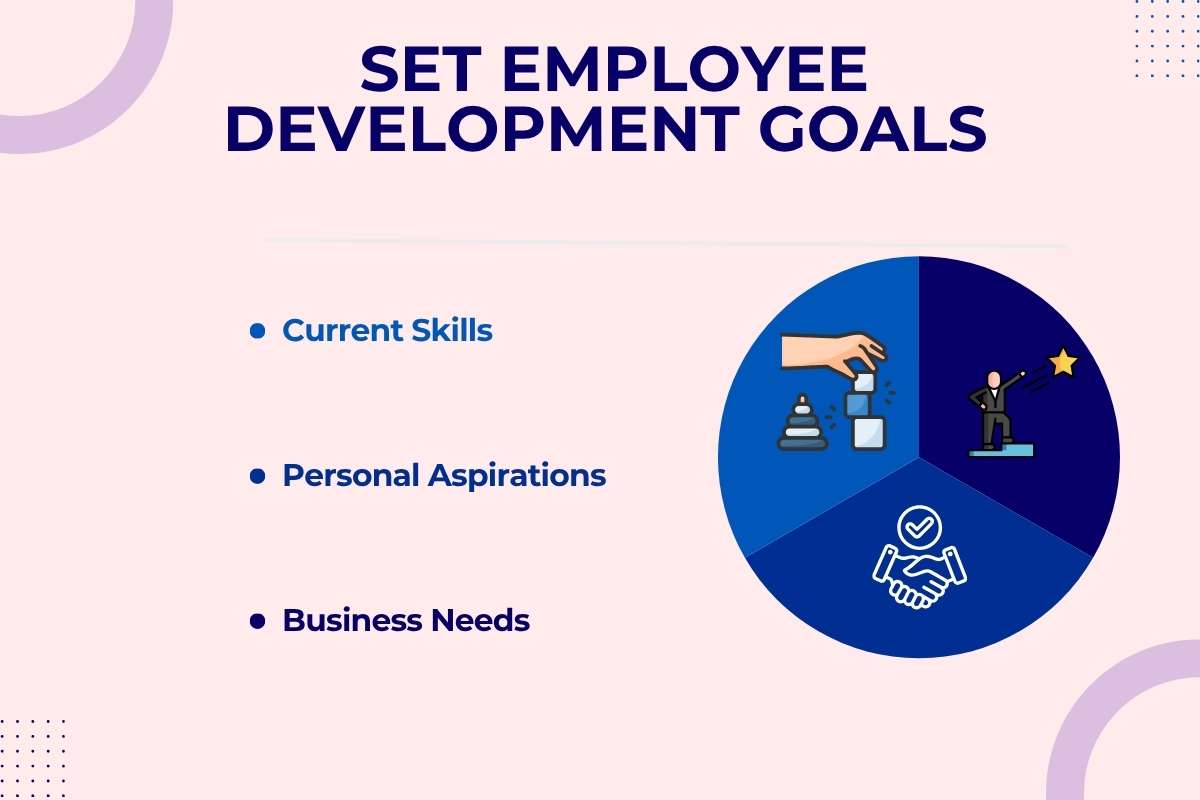
The strongest employee development goals sit at the intersection of three things:
1. Current Skills:
Start with an honest look at where the employee stands today. A quick skills assessment, a recent performance review, or even a simple self-rating can show where the gaps are.
2. Personal Aspirations:
Ask the employee directly where they want to be in one to three years. Someone who wants to move into management needs different goals than someone who wants to go deeper into a technical specialty. This conversation alone often reveals more than any formal assessment, and it shows the employee that their input actually shapes the plan.
3. Business Needs:
Growth plans work best when they also solve a problem for the company. If the team is expanding into a new market, language skills or client-facing training might matter more. Looking at where the department is headed over the next year helps you pick goals that stay useful.
Once you have these three pieces, follow a simple process:
- Pick one or two priority areas.
- Write each goal using the SMART format.
- Set a review date, usually every 30 to 90 days.
- Assign a resource or support, such as a course, mentor, or budget.
- Check in regularly and adjust if the goal no longer fits.
This approach keeps growth plans realistic. Regular check-ins, even short ten-minute ones, make a bigger difference than the goal-setting meeting itself.
Conclusion
Employee development goals work best when they are specific, realistic, and tied to something the employee actually cares about. They don’t need to be complicated. A single SMART goal, reviewed every few months, often does more for retention and skill-building than a long annual plan ever will.
Pick one goal per employee this quarter, write it clearly, and check in on it. That habit alone puts most teams ahead of where they were before, and it builds a culture where growth feels normal and not forced.
FAQs
1. What are some good development goals for employees?
Good examples include learning a new technical tool, leading a small project, improving public speaking, or earning a certification.
2. How often should employee development goals be reviewed?
Most teams review progress every 30 to 90 days, with a deeper check-in during quarterly or annual performance conversations.
3. What’s the difference between performance goals and development goals?
Performance goals measure current job output, like sales numbers. Development goals focus on building new skills for future growth.
4. How many development goals should an employee have at once?
One to three goals is usually enough. More than that tends to spread focus too thin and slows progress on all of them.