
Summative assessment measures what students have learned at the end of a lesson, unit, or course. It helps teachers check if students have met their learning goals. Common methods include written exams, projects, research papers, and practical tests. Teachers also use portfolios and presentations to check student skills.
However, a good test does more than give students grades. It should match learning goals and give each student a fair chance. This guide explains the main types, design steps, benefits, and limits. It also shows how digital tools can make tests easier.
Summative Assessment: Meaning, Types, and Examples
It is a way to measure student learning after a set period. It checks what students know and how well they use their skills. Teachers use the results to give grades, track progress, and check learning goals.
Unlike class quizzes and daily tasks, these tests focus on results. They show how well students have learned key topics. They also help schools review teaching plans and course content.
Teachers can use many types of tests to check student learning. The right choice depends on the subject and learning goals. Here are some common types and their examples.
| Type | What it measures | Examples |
| Written exams and tests | Knowledge, recall, and understanding of key topics. | Final exams, multiple-choice tests, and essay-based tests. |
| Projects and research papers | Research skills, problem-solving, and the use of subject knowledge. | A science project on clean energy or a history research paper. |
| Portfolios | Skills, progress, and the quality of work over time. | A collection of essays, artwork, lab reports, or coding tasks. |
| Presentations and performance tasks | Speaking skills and the ability to use knowledge in practice. | Group talks, debates, science demos, and music shows. |
| Certification and competency tests | Skill levels and the ability to meet set standards. | Language tests, coding exams, and nursing skill tests. |
Each type checks a different part of student learning. For example, a written test checks what students know. A practical task shows how well they use that knowledge.
How Can Teachers Create an Effective Summative Assessment?
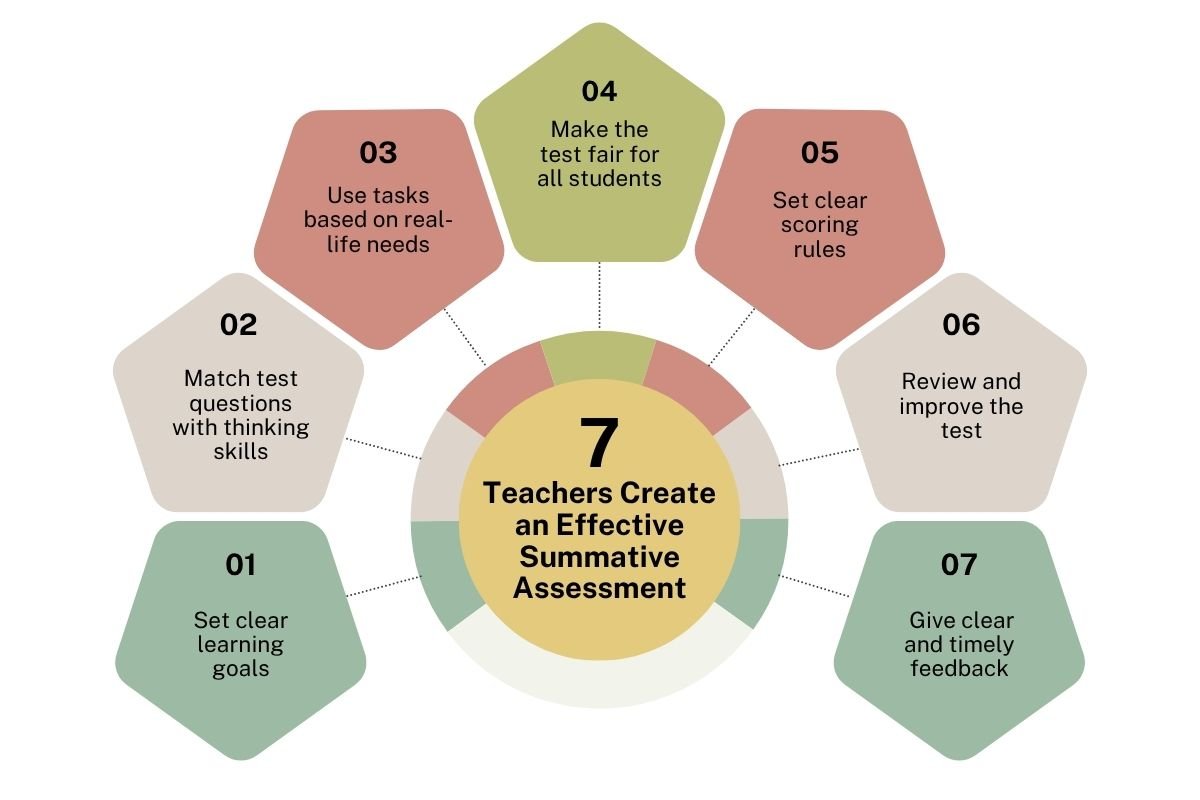
A good final assessment starts with clear learning goals. It should test the skills and knowledge that students must gain. Teachers must also set fair tasks, clear rules, and simple scoring guides. These steps help ensure that test results show real learning.
Here are seven steps to help teachers design better assessments.
1. Set clear learning goals
Start by listing what students should know or do by the end. These goals should guide every part of the test.
List the key topics, skills, and tasks that students must master. Then, match each goal with a suitable test or task.
For example, students may need to study past events and their causes. Ask them to compare two events and explain their impact. A test that only asks for dates will not check this skill.
2. Match test questions with thinking skills
Test questions should match the level of thinking in each goal. Bloom’s Taxonomy can help teachers plan these questions.
It covers six levels of thinking:
- Remember: Ask students to recall facts, terms, or key ideas.
- Understand: Ask them to explain a topic in their own words.
- Apply: Give them a problem that uses what they have learned.
- Analyze: Ask them to compare ideas or find key links.
- Evaluate: Ask them to judge facts and support their views.
- Create: Ask them to build a new plan, model, or product.
This method helps teachers test more than basic recall. It also shows if students can use what they know.
Also Read: 20 Learning Management System Features to Know Before Deciding on One
3. Use tasks based on real-life needs
Students should be able to use their knowledge beyond the classroom. So, give them tasks that link lessons to real-life needs.
For example, do not just ask students to define water pollution. Ask them to study a local water source and suggest ways to keep it clean.
Teachers can also let students choose how to present their work. They may write a report, build a model, or give a talk. Each choice must still test the same learning goals.
4. Make the test fair for all students
Every student should know what to do and how work will be judged. Give clear steps and share the goals before the test.
Also, think about the needs of each student. Make changes for students who need extra support. Use simple words and avoid terms that may confuse them.
Where possible, let students choose how to show their skills. This can help them present what they know with ease.
5. Set clear scoring rules
A scoring guide helps teachers grade student work in a fair way. It should show what each level of work looks like.
For example, a research paper may be graded on:
- Correct facts and depth of research.
- Quality of sources and proof.
- Clear thought and sound views.
- Good flow and clear writing.
- Proper use of sources.
Use clear terms to explain each score level. Avoid vague words such as “good” or “poor.” Tell students what they need to do to earn each grade.
Also, grade subject skills apart from work habits. For example, do not let late work affect a score for subject knowledge. This keeps grades fair and clear.
6. Review and improve the test
Check the test before giving it to students. Make sure each task matches the learning goals. Also, check if the test is fair, clear, and hard enough.
Ask other teachers to review the test and spot any gaps. Check if students can show all the skills that the test aims to measure.
After the test, look at the results. If many students miss the same question, check if it was too hard or unclear. Use these results to improve future tests.
7. Give clear and timely feedback
A grade alone does not show students how to improve. Good feedback tells them what they did well and what needs work.
Harrison Daka and his co-authors highlight the role of feedback in their study, Making Summative Assessment Effective:
“This form of feedback should be timely, detailed, and clearly explain how the student got the grade that they got, and if any improvement is to be made, this must be seen in the guiding comments so as to serve its purpose and be helpful to the learner.”
Use these tips to make feedback more useful:
- Point out the strong parts of each student’s work.
- Explain errors and why they matter.
- Give clear steps to help students improve.
- Share the rules used to grade their work.
- Let students fix their work when possible.
This makes a final test more than a way to give grades. It also helps students see where they need to improve.
What are the Advantages and Disadvantages of Summative Assessment?

Summative assessment helps teachers check learning, give grades, and track student progress. A study of university students and placement mentors found that 77% of students rated it as important or vital. Students also said it boosted their confidence and valued their time and effort. However, final tests can cause stress and may not show all student skills.
Advantages and Disadvantages at a Glance
| Advantages | Disadvantages |
| Measures learning: Shows how well students understand key topics and skills. | Causes test stress: High-stakes exams can create stress and affect student scores. |
| Helps with grading: Gives teachers a way to grade work and report results. | Misses some skills: Written tests may not show creative, speaking, or hands-on skills. |
| Finds learning gaps: Helps teachers spot topics that students find hard to understand. | Leads to rote learning: Students may focus on learning facts by heart to score well. |
| Improves course plans: Helps schools review lessons and improve teaching methods. | Limits chances to improve: Final grades may not give students time to fix mistakes. |
| Tracks student progress: Helps schools review learning results across classes. | May lead to unfair scores: Poor test design or a lack of support can affect results. |
How Does Technology Improve Summative Assessment?
Technology makes it easier to create, give, and grade tests. Digital tools help teachers build online quizzes and set time limits. They can also grade some answers and share results fast. This saves time and helps teachers find gaps in student learning.
Here are some ways digital tools help:
- Fast grading: Online tools can grade multiple-choice tests in less time.
- Quick feedback: Students can get scores and comments soon after a test.
- More test types: Teachers can use videos, online tasks, and live demos.
- Progress reports: Digital tools help teachers track scores and spot weak areas.
- Easy access: Students can take tests on digital devices, where access allows.
A 2024 ICT in Education survey by Brazil’s Cetic.br found that the use of digital tools for student tests rose from 54% in 2022 to 69% in 2024.
Still, digital tools should support good test design. They should not take the place of clear goals and fair rules. Teachers must also think about internet access, data safety, and tech issues.
Also Read: How Does a Learning Management System Work? A Practical Guide
Summative Assessment vs. Formative Assessment: What’s the Difference?

The main difference is when and why teachers use each type. Formative assessment takes place during the learning process. It helps teachers check student needs and adjust lessons. Summative assessment takes place at the end of a set period. It checks how well students have met the learning goals.
Both types help teachers track student learning. However, each serves a different purpose.
| Basis | Formative assessment | Summative assessment |
| Purpose | Helps improve learning during a course. | Measures learning at the end of a course. |
| Timing | During lessons or units. | After a lesson, unit, or course. |
| Focus | Finds gaps and guides growth. | Checks knowledge and skills gained. |
| Feedback | Given often during learning. | Often given after grading. |
| Grading | Often has no grade or a low-stakes grade. | Usually has a grade or a high-stakes result. |
| Examples | Quizzes, class talks, polls, and practice tasks. | Final exams, projects, papers, and skill tests. |
For example, a teacher may give weekly quizzes to check what students know. These are formative tests. At the end of the term, the teacher may give a final exam. This is a summative test.
Teachers should use both types during a course. Formative tests help students improve as they learn. Summative tests show what they have learned by the end.
Conclusion
Summative assessment helps teachers check student learning and track progress. It also helps them find gaps and review course plans. However, good tests need clear goals, fair rules, and useful feedback. Digital tools can also make grading and tracking easier. Use a mix of test types to get a full view of student skills. Review your tests today and find ways to make them more useful.
FAQs
1. How do teachers know if an assessment is reliable?
Teachers can check if scoring rules are clear and results remain consistent across students.
2. What is the role of rubrics in student assessment?
Rubrics set clear grading standards and help teachers judge student work fairly.
3. Should students know the grading criteria before an exam?
Yes, sharing criteria helps students understand expectations and prepare with confidence.
4. How does summative assessment support school improvement?
It helps schools review learning outcomes, spot weak areas, and improve teaching plans.
5. Can group projects be used for final grading?
Yes, teachers can grade group projects using individual contributions and shared learning goals.