
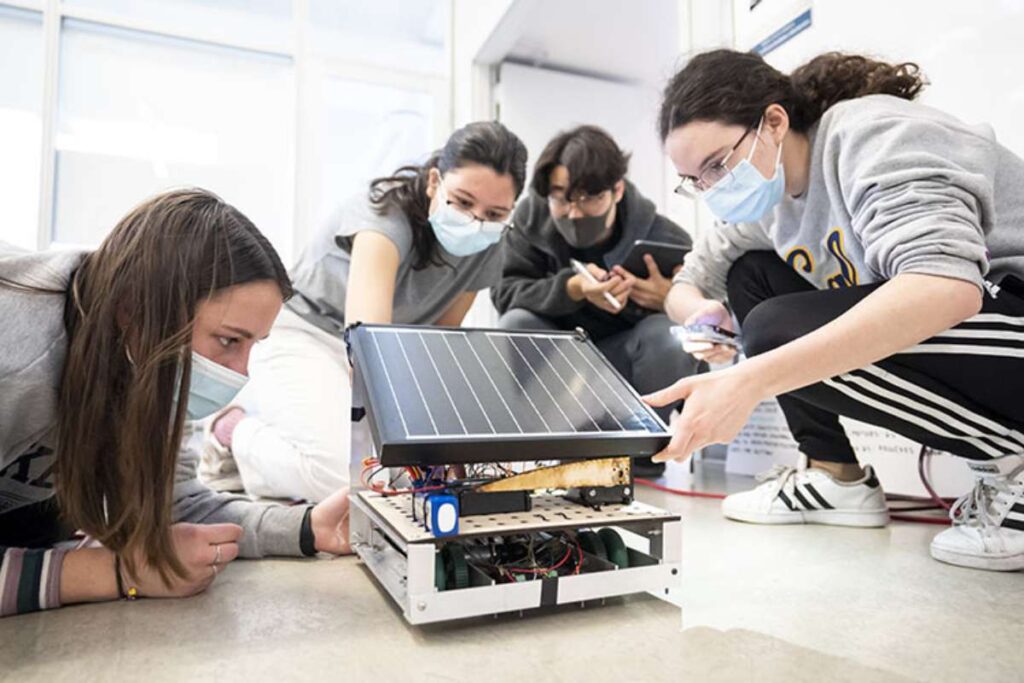
Experiential Learning in Higher Education is a teaching approach where students learn by doing. They learn through internships, simulations, and real projects, not just lectures. This article covers different models colleges use today and how they drive employability. You’ll learn why institutions that ignore this shift are falling behind. Read on to see what specific programs like Northeastern University and MIT are doing.
Data from the National Association of Colleges and Employers (NACE) survey shows that most employers these days don’t focus on degrees alone. Instead, they’re hiring based on skills that focus on practical, real-world execution.
This is exactly where experiential learning in higher education helps. It is a teaching approach where students learn by doing. Think internships, lab simulations, and community projects. It also includes real client work, not just slides in a lecture hall.
Today, that idea is becoming a requirement, not a bonus. This article covers the different models colleges are using for experiential learning. You’ll also learn how experiential learning drives employability and how technology helps scale it.
What Models Are Colleges Using for Experiential Learning in Higher Education?
Colleges and universities use several models of Experiential Learning to bring experience into education. Each one takes a different approach to hands-on, real-world learning. Here are the most common ones, with real examples:
1. Cooperative Education (Co-op):
In a co-op model, students alternate between full semesters of academic study and paid work. They work full-time in their chosen field, in addition to studying. This is not a summer job; it is a structured part of the degree. Students apply what they just learned in class to a real workplace. They then return to campus with questions and context that make the next semester more meaningful.
Example:
Northeastern University has run this model since 1909. Today, most of its graduating class completes co-ops. The university holds the #1 spot for internships and co-ops by U.S. News & World Report (2025). Students typically finish 2–3 rotations of six months each before they graduate.
2. Project-Based Learning (PBL):
Here, students work on real problems for real clients through Project-Based Learning activities that are part of their graded coursework. Instead of writing a report that only a professor reads, they deliver an actual output. It could include sharing a product design, a business plan, or a prototype with an external organization. This model connects classroom theory to live workplace constraints like deadlines.
Example:
MIT’s MISTI (MIT International Science and Technology Initiatives) is a strong example. It places students in hands-on global projects with industry and research partners. Their travel expenses are covered, and a stipend is provided.
3. Service Learning:
Service learning ties academic coursework directly to community-based work. A public health student might run outreach programs at a local clinic. A law student might assist underserved families with legal paperwork. The key difference from volunteering is structured reflection. Students connect what they observe in the field back to what they are studying in class.
Example:
Stanford’s Haas Center for Public Service combines service learning into its courses. They do it for courses from all departments. This makes it a cross-disciplinary part rather than a niche elective.
4. Undergraduate Research:
Students in this model work with faculty on active research projects. They do it from their first or second year. This is a good way to include experiential learning in higher education, as students learn how to ask questions and help with published work. These skills are hard to teach in a lecture.
Example:
The University of Michigan’s Undergraduate Research Opportunity Program (UROP) connects students with research positions. The faculty lead these positions. They give students early exposure to analytical and problem-solving work. Many employers rank these skills as their top priority.
5. Clinical and Field Placements:
In fields like nursing, social work, education, etc., real experience is required for certifications. Students work at workplaces under the close guidance of licensed professionals. The learning happens through direct client contact, not case studies.
Example:
A nursing student at Johns Hopkins spends several hours on hospital floors before taking their licensing exam. This is because there is no simulation that fully replaces that experience.
6. Simulation-Based Learning:
Simulation puts students into real high-stakes scenarios in a controlled environment. Mistakes are safe to make here. Medical schools use mannequins and standardized patients to practice procedures. Business schools use live trading simulations for finance students. Law schools run moot court exercises.
Example:
Harvard Medical School’s simulation labs allow students to practice emergency responses, patient communication, and surgical procedures. They do this before they ever step into a real operating room. As AI and VR improve, simulation is becoming a scalable way to deliver hands-on learning.
How Does Experiential Learning Drive Employability?

The connection between hands-on learning and getting hired is not accidental. Experiential Learning in Higher Education works through specific gaps that classrooms leave open. Real-world experience fills that directly.
| What students gain | How does it improve employability? |
| A track record | Employers can’t verify what was learned in a lecture. They can verify a portfolio, a project, or a published paper. Evidence speaks louder than a transcript. |
| Interpersonal skills | Most workplace failures are not technical; they are interpersonal. Working in real teams teaches students to navigate disagreement and shared deadlines in ways a textbook cannot. |
| A professional network | An internship or co-op leaves students with references and industry contacts. In many fields, that network is how jobs are found, not job boards. |
| Interview confidence | Students who have done the job can answer “tell me about a time you…” with a real story. Those who haven’t can only offer a hypothetical. |
A 2024 NACE survey found that Gen Z graduates who completed internships had better job placement outcomes than those who did not. This was largely because they were already known inside organizations that were hiring.
How AI and Technology Help in Experiential Learning in Higher Education?
Technology is making hands-on learning more accessible, even for students who cannot do an in-person internship.
1) Virtual Reality (VR) Simulations:
Medical and engineering programs use VR to let students practice before working with real patients or equipment. A 2026 study in Education and Information Technologies (Springer) found that AI-powered VR adapts to each student’s pace and gives real-time feedback. Static lectures cannot match these outcomes.
2) AI-Adaptive Learning Platforms:
At Texas A&M University, students using Adaptive Learning Platforms such as the ALEKS platform in chemistry showed clear improvement compared to non-users. The platform adjusts the difficulty based on each student’s live results.
3) Virtual Internships:
Virtual internship platforms let students work with global teams from home. This builds cross-cultural skills and adaptability without needing a visa or travel budget.
4) AI Tutors and Feedback Tools:
Tools like Khanmigo, GitHub Copilot, and AI writing assistants give students personal feedback. One professor with 200 students cannot always do that.
Technology does not replace experiential learning in higher education. It scales it and removes the access barriers that hold many students back.
Why Experiential Learning in Higher Education is No Longer Optional?
Three big pressures are forcing universities to change right now:
The Skills Gap:
What students learn in class does not match what jobs actually require. Many core job skills are shifting quickly. Universities that only teach old theories are leaving graduates unready for the real world.
The Cost vs. Value:
College has become very expensive, and most students have to take out loans. Families want to know if a degree will actually help them get a good job. They want a clear return on their investment.
No Degree Required:
Big companies like Google, Apple, and IBM do not require college degrees for many jobs anymore. They care more about what you can actually do and what is in your portfolio than your school grades.
Because of these changes, some forward-thinking colleges are ditching standard lectures. Instead, they are grading students on the actual skills they can prove. This is driving a shift toward experiential learning in higher education to ensure students are truly ready for the workforce.
Traditional Learning vs. Experiential Learning: What’s the Real Difference?
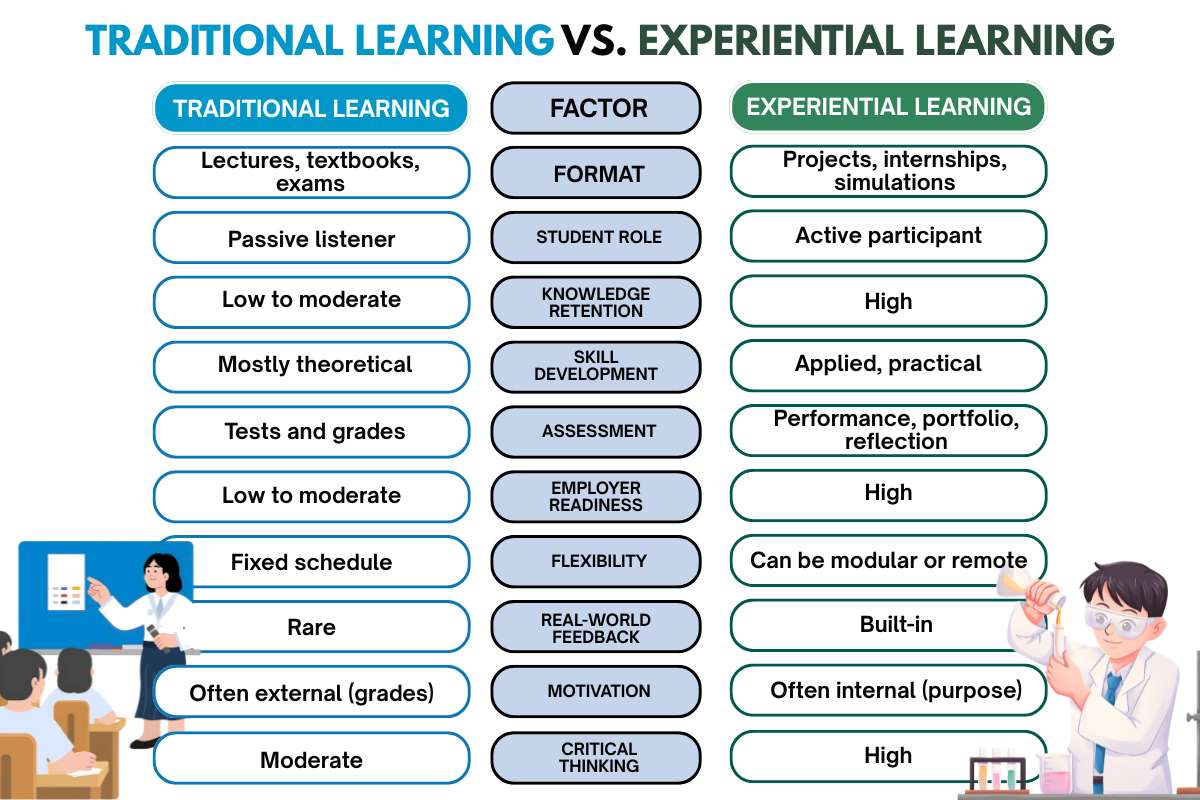
| Traditional Learning | Feature | Experiential Learning |
| Lectures, textbooks, exams | Format | Projects, internships, simulations |
| Passive listener | Student role | Active participant |
| Low to moderate | Knowledge retention | High |
| Mostly theoretical | Skill development | Applied, practical |
| Tests and grades | Assessment | Performance, portfolio, reflection |
| Low to moderate | Employer readiness | High |
| Fixed schedule | Flexibility | Can be modular or remote |
| Rare | Real-world feedback | Built-in |
| Often external (grades) | Motivation | Often internal (purpose) |
| Moderate | Critical thinking | High |
It is worth noting that traditional learning is not useless. Foundational knowledge (theory, history, and core concepts) is still best taught in a structured way. The ideal model blends both approaches. But for most programs today, passive learning is more common.
You may also like: What is Kolb’s Experiential Learning Theory? Definition, Learning Cycle, and Styles
Conclusion
Experiential Learning in Higher Education is no longer a “nice to have.” It is a proven driver of graduate employability, student motivation, and real-world readiness.
The evidence is clear. Many institutions have already integrated some form of Experiential Learning into their curriculum. Employers want it. Students benefit from it. Technology now makes it scalable.
The institutions that treat experience as a core part of the curriculum will thrive. Whether through co-ops, labs, or internships, the path forward is action-based education. The question is not whether to shift. The question is: how quickly can your institution get there?
Frequently Asked Questions
1. What exactly is experiential learning in higher education?
It is a way of teaching where you learn by doing. Instead of just reading textbooks and listening to lectures, students get hands-on experience.
2. Is hands-on learning better than traditional learning?
Yes, when it comes to getting ready for a job. Research shows that doing real work builds better career skills than just sitting in a classroom. However, the best colleges use a mix of both styles.
3. How does technology help with hands-on learning?
Technology makes it easier for everyone to get real-world practice. For example, students can use Virtual Reality (VR) headsets to practice high-tech jobs.
4. Can this type of learning work for online students?
Absolutely. Online students do not have to miss out. They can do online internships and work on projects for companies from anywhere in the world.