
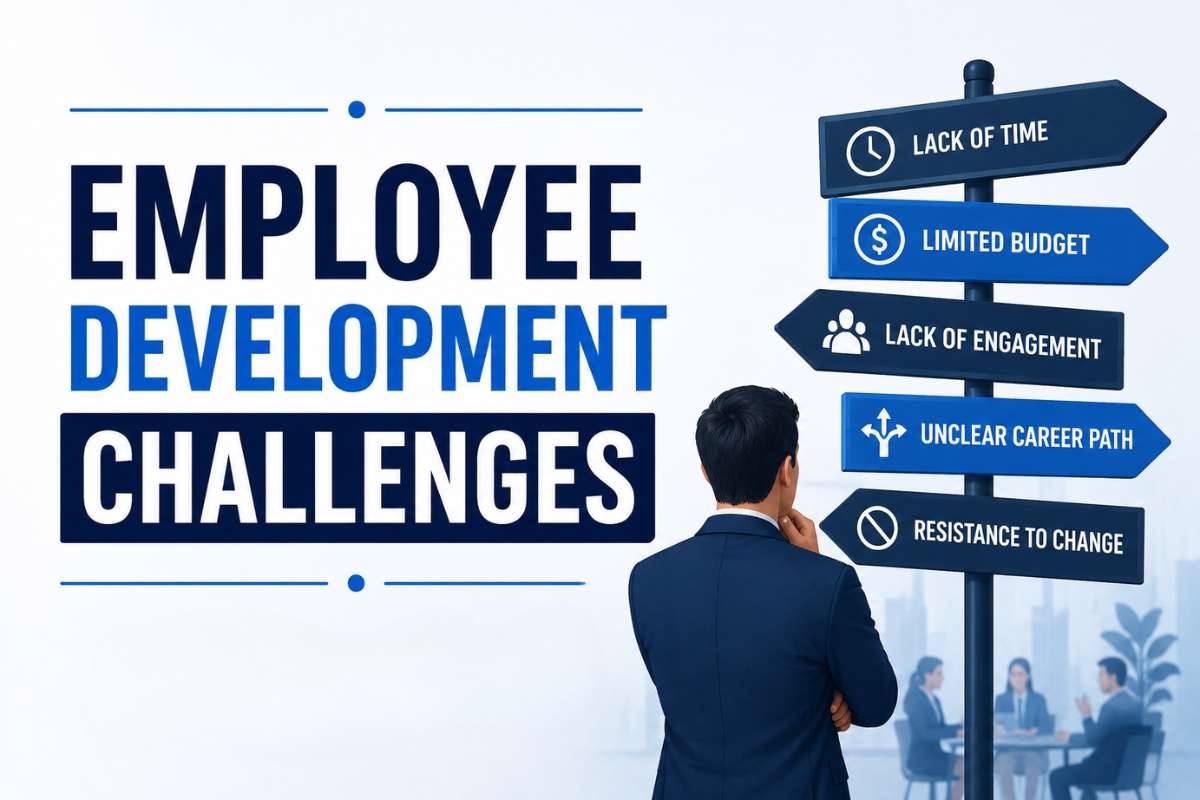
Employee development challenges can start before a student enters the workforce. Academic success does not always translate into workplace readiness, where communication, problem-solving, teamwork, adaptability, and practical experience matter just as much.
The gap is measurable. NACE’s 2025 Student Survey found that only 55% of graduating seniors felt their education prepared them well for their careers. Meanwhile, 88.3% of employers sought problem-solving skills and 81% sought teamwork skills on new graduates’ resumes.
The pressure will only increase as work evolves. The World Economic Forum estimates that 39% of workers’ existing skill sets will be transformed or outdated by 2030.
For students, development cannot wait until the first job. Building real-world experience, communication skills, leadership, digital fluency, feedback habits, and continuous-learning practices during education can turn potential gaps into career-ready strengths.
The goal is simple: graduate with more than a degree; graduate with evidence that you can learn, adapt, and contribute.
What Is an Employee Development Challenge?
An Employee Development Challenge is a gap or obstacle that limits a person’s ability to build the skills, behaviors, and professional capabilities needed to perform and grow at work. For students, these gaps often become visible when academic knowledge must be applied in practical settings.
The need is clear. NACE’s 2025 Student Survey found that nearly 9 in 10 graduating seniors had participated in an activity to develop career-relevant skills, yet fewer than 40% were familiar with the term “skills-based hiring.”
This highlights an important distinction: developing skills is not enough; students also need to understand how to apply, communicate, and demonstrate them. Understanding why employee development programs matter can help students see development as more than a collection of courses or credentials; it is a process for building capabilities that translate into workplace performance.
The most valuable development challenges are therefore the ones that turn classroom learning into observable professional capability. A well-structured employee development program can support this process by giving students opportunities to practice skills, receive feedback, and demonstrate measurable progress.
For students, these challenges commonly appear in ten areas, from applying theory and handling feedback to building leadership, managing priorities, and staying adaptable. Recognizing these employee development challenges early gives students more time to address them before they affect their transition into work.
10 Employee Development Challenges Students Should Address Early

1. Translating Theory to Practice
Knowing a concept in an exam is different from applying it to an unfamiliar problem. Students can close this gap by working on real-world projects, case studies, research assignments, and practical simulations that require them to make decisions rather than simply recall information.
2. Bridging the Experience Deficit
The familiar “need experience to get experience” problem can limit early-career opportunities. Internships, campus organizations, competitions, volunteering, freelance projects, and job shadowing can provide evidence of what students can actually do. NACE reports that employers continue to value experiential learning and the ability to connect coursework and extracurricular activities to professional skills.
3. Mastering Professional Communication
Strong communication extends beyond speaking confidently. Students need to write clearly, listen actively, present ideas, ask relevant questions, and adapt their communication to different audiences. NACE’s Job Outlook 2025 found that 77.1% of employers sought written communication skills and 69.3% sought verbal communication skills on candidates’ resumes.
Communication-related employee development challenges can become particularly visible during interviews, group projects, internships, and early workplace interactions.
4. Navigating Feedback Dynamics
Feedback can reveal gaps that grades cannot. Instead of treating criticism as a judgment, students can use it to identify specific behaviors to change, implement the recommendation, and track whether their performance improves.
Learning to respond constructively to feedback can prevent smaller employee development challenges from becoming long-term professional habits.
5. Developing Self-Awareness
Career growth requires knowing both strengths and limitations. Regular self-assessments can help students identify skill gaps, recognize patterns in their performance, and choose development goals based on evidence rather than assumptions.
6. Cultivating Titles-Free Leadership
Leadership does not always require a formal position. Coordinating a group assignment, organizing a student initiative, resolving disagreements, or taking responsibility for a project can demonstrate initiative and accountability. Students can also build these capabilities through leadership development programs that provide structured opportunities to practice decision-making, collaboration, and ownership. NACE found that 73.7% of employers sought initiative and 52.5% sought leadership on graduate resumes.
7. Prioritizing Work and Time Management
Students often balance coursework, projects, extracurricular activities, internships, and personal commitments. Learning to prioritize tasks, estimate effort, meet deadlines, and communicate early when plans change creates habits that transfer directly into professional settings.
Poor prioritization can become one of the most overlooked employee development challenges, particularly when students move from structured academic schedules to workplaces with competing priorities and greater autonomy.
8. Building Resilience Amid Career Uncertainty
Career paths rarely unfold exactly as planned. Students can build resilience by experimenting with different roles, learning from setbacks, and treating early career decisions as opportunities to gather information rather than permanent choices.
9. Building Fluency in Emerging Technology and AI
Technology skills are becoming increasingly relevant to entry-level work. NACE’s 2026 Job Outlook Spring Update reports that 13.3% of entry-level job postings now require AI skills, highlighting why students should develop practical and responsible technology fluency alongside their core discipline.
Keeping pace with technological change is increasingly central to employee development challenges, especially for students entering industries where tools and workflows are changing rapidly. Students can respond by participating in employee upskilling programs and pursuing targeted learning opportunities that build practical technology capabilities alongside their core discipline.
10. Committing to Continuous Learning
A degree provides a foundation, not a finish line. Microlearning, certifications, professional communities, learning and development programs, independent projects, and regular skills audits can help students maintain a habit of updating their knowledge as roles and industries evolve.
Continuous learning also helps students respond to emerging employee development challenges instead of waiting until a skill gap affects their performance or employability.
Why Do Employee Development Challenges Happen?

Employee development challenges rarely come from a single weakness. They often develop when students have limited opportunities to connect academic learning with workplace expectations.
Several factors can contribute to these gaps:
Limited practical exposure:
Classroom assignments may not always replicate workplace problems, deadlines, collaboration, or decision-making.
Insufficient feedback:
Students may receive grades without detailed guidance on how to improve professional behaviors and skills.
Unclear career direction:
Without a target role or industry, it can be difficult to determine which skills deserve priority. Career development programs can help students understand potential career paths, identify relevant competencies, set development goals, and gain exposure to the expectations of different industries.
Passive learning habits:
Memorizing information without applying it can make knowledge harder to transfer into professional situations.
Limited professional networks:
Students who rarely interact with professionals may have less insight into workplace expectations and career pathways. Employee mentorship programs can provide opportunities to learn directly from experienced professionals, ask questions, receive feedback, and better understand workplace expectations.
Rapid technological change:
Emerging technologies can change the skills employers expect faster than traditional curricula can adapt.
Limited access to development opportunities:
Not every student has equal access to internships, mentoring, extracurricular activities, or industry exposure.
Understanding why employee development challenges emerge is important because the solution is rarely limited to taking another course. Effective employee training and development can combine structured learning with practice, feedback, mentorship, and real-world experiences. Students often need a combination of practice, feedback, mentorship, reflection, and real-world exposure.
This is why employee development should begin before employment. Students can reduce these challenges by deliberately seeking experiences that require them to apply knowledge, collaborate with others, receive feedback, and solve unfamiliar problems.
The objective is not to eliminate every gap before graduation. It is to become capable of recognizing a gap and knowing how to address it.
The Employee Development Challenge Strategy Matrix
Knowing the challenge is only the first step. Students need practical employee development strategies to turn each gap into a measurable development goal. Experiential learning is particularly valuable here: NACE’s 2025 Student Survey found that 84% of the Class of 2025 participated in an internship, co-op, or other experiential learning program, and students identified internships as their top method for developing skills.
A simple strategy matrix can help students move from recognizing a gap to building evidence of progress:
| Employee Development Challenge | Student-Focused Strategy | Target Outcome |
| Theory-to-practice gap | Build projects using real-world problems or datasets | 2+ practical projects |
| Communication gap | Practice presentations, writing, and active listening | Regular feedback |
| Limited experience | Pursue internships, shadowing, or competitions | 1+ experiential role |
| Feedback resistance | Schedule regular feedback with mentors or instructors | Trackable improvements |
| Leadership gap | Lead a campus project or student team | Demonstrated ownership |
| Technology gap | Complete relevant AI or technology projects | Updated skills portfolio |
| Self-awareness gap | Conduct quarterly skills assessments | Clear development goals |
| Time-management gap | Use weekly priorities and deadline tracking | Consistent completion |
| Career uncertainty | Test different roles through projects or internships | Better career direction |
| Continuous-learning gap | Set a recurring learning goal | New skill or credential each term |
The goal is not to eliminate every weakness at once. It is to identify one development gap, choose a relevant action, measure the result, and repeat the process. NACE similarly emphasizes connecting experiential learning with competency development and helping students translate those experiences into career evidence.
Using a matrix also makes employee development challenges easier to prioritize because students can connect each challenge with a specific action and measurable outcome rather than treating development as a vague long-term goal.
The Student Execution Playbook

Recognizing an employee development challenge is useful only when it leads to action. Students need a simple system for deciding what to improve, how to practice it, and how to measure progress. An employee development plan can provide this structure by connecting specific skill gaps with development goals, practical activities, timelines, and measurable outcomes. NACE emphasizes that career readiness develops through a combination of coursework, experiential learning, reflection, and competency-building rather than through a single activity.
Build a Personal Development Plan
A practical 5-step PDP can keep development focused:
Employee development tools can make this process easier by helping students assess their skills, set goals, track progress, and document evidence of improvement.
Assess → Target → Goal-Set → Execute → Review
| Assess | Identify strengths and specific skill gaps. |
| Target | Choose one or two areas that matter for your intended career. |
| Goal-Set | Create measurable objectives with deadlines. |
| Execute | Practice through projects, internships, courses, or leadership roles. |
| Review | Seek feedback and adjust the plan based on results. |
A PDP is particularly useful when several employee development challenges appear at the same time because it prevents students from trying to improve every skill simultaneously.
Turn Experience Into Learning
An internship or project becomes more valuable when students reflect on what they actually learned from it. NACE research links experiential learning with stronger early-career outcomes, including faster career progression, greater career satisfaction, stronger workplace networks, and higher salaries.
Use the 5 Cs as a Self-Audit
During an internship, project, or campus role, students can regularly evaluate:
| Clarity | Do I understand what is expected? |
| Communication | Do I keep others informed? |
| Coaching | Do I actively seek feedback? |
| Consistency | Can I deliver reliably? |
| Continuous Improvement | What am I doing better than I was a month ago? |
Build a Proof-of-Work Portfolio
Don’t let development remain a list of claims on a resume. Save the evidence: project reports, presentations, research, designs, code, writing samples, case studies, or measurable outcomes. This gives students concrete examples to discuss with employers and makes their developing capabilities easier to demonstrate.
A proof-of-work portfolio can also show how students have addressed employee development challenges over time, turning improvement into visible career evidence.
Turning Development Into Career Evidence
Building skills is valuable, but students also need to show how those skills developed. This becomes especially important as employers increasingly evaluate candidates through evidence rather than skill lists alone. NACE’s 2026 Job Outlook found that employers most commonly seek teamwork (85%), problem-solving (82%), and verbal communication (78%) on graduate resumes.
Master the STAR Method
The STAR method—Situation, Task, Action, Result— helps students turn everyday academic or extracurricular experiences into clear evidence of capability.
For example, instead of saying “I am a good team player,” a student could explain how they resolved disagreement during a group project, what action they took, and how the team’s outcome improved.
Frame Areas for Growth Positively
An area for improvement does not have to weaken an interview response. Students can show self-awareness by identifying a genuine development area and explaining what they are doing about it.
Weak: “I am not good at public speaking.”
Stronger: “Public speaking was an area I needed to improve, so I began volunteering for presentations and seeking feedback after each one.”
Show Progress With Proof
Keep evidence of development throughout college:
- Projects completed
- Feedback received and implemented
- Leadership responsibilities
- Certifications earned
- Measurable project outcomes
- New tools or technologies learned
NACE specifically recommends that students provide examples demonstrating their skills, rather than simply listing them.
The strongest career story is therefore not “I have these skills.” It is “Here is where I used them, what I learned, and how I improved.”
This evidence-based approach can help students demonstrate how they have actively addressed employee development challenges rather than simply acknowledging that those challenges exist.
Early-Career Behaviors That Can Stall Development
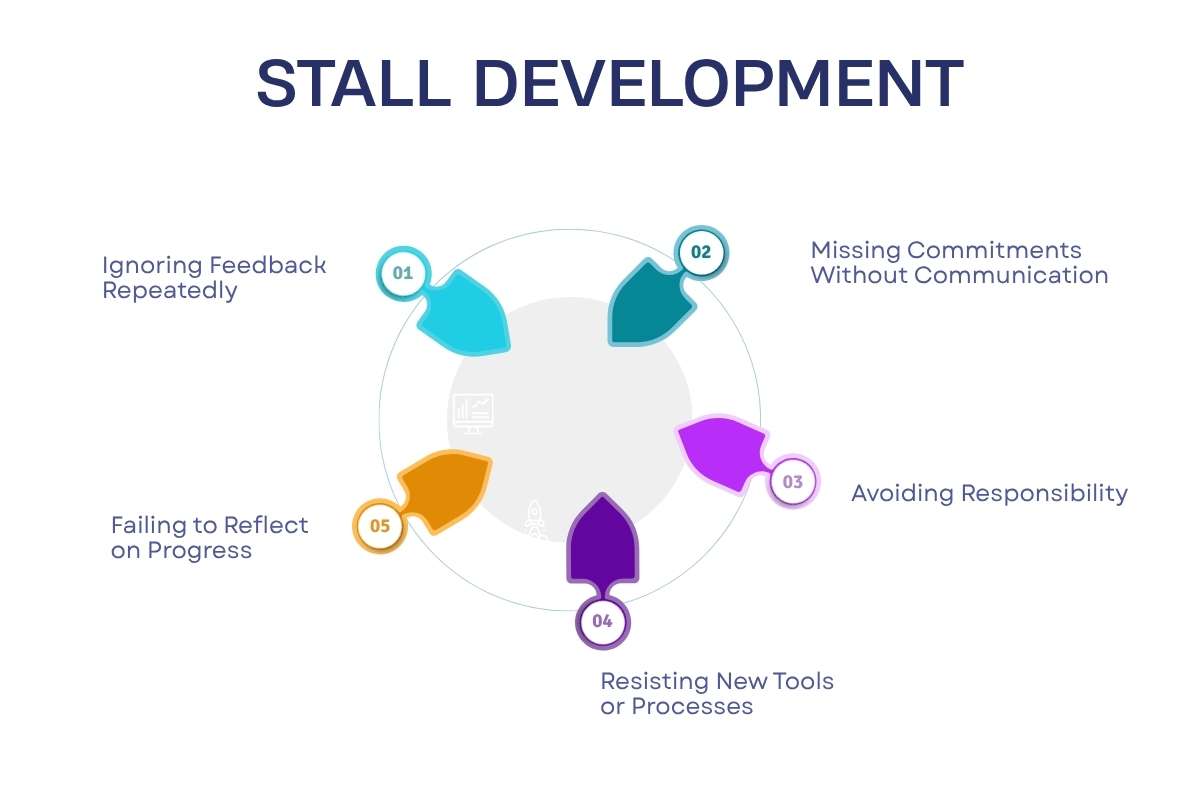
Skills can grow quickly when students are willing to act on feedback and take responsibility. The opposite is also true: certain habits can quietly slow professional growth. NACE identifies professionalism, career and self-development, communication, leadership, and teamwork as core career-readiness competencies, making these behaviors important well before a student’s first full-time role.
1. Ignoring Feedback Repeatedly
Receiving feedback without acting on it creates a pattern of stalled improvement. Students should identify one specific change after each review and track whether their performance improves.
2. Missing Commitments Without Communication
Deadlines can shift, but disappearing when something goes wrong can damage trust. Professionalism includes dependability, accountability, and completing responsibilities as expected.
3. Avoiding Responsibility
Waiting for someone else to solve every problem can limit opportunities to demonstrate initiative. Taking ownership of a task, asking for guidance when necessary, and following through can build professional credibility.
4. Resisting New Tools or Processes
Technology and workplace practices will continue to evolve. Students who remain curious and willing to learn unfamiliar tools are better positioned to adapt rather than become dependent on skills that quickly become outdated. NACE specifically includes the ability to adapt to new technologies within its technology competency.
5. Failing to Reflect on Progress
Development becomes difficult to sustain without reflection. A simple monthly review: What improved? What went wrong? What feedback did I receive? What will I change next? It can keep professional growth intentional rather than accidental.
Recognizing these behaviors early can prevent employee development challenges from becoming recurring patterns after graduation.
Turning Development Into a Long-Term Career Habit
Employee development should not end when students secure their first role. The strongest career trajectories are built by treating development as an ongoing process rather than a one-time preparation exercise. NACE defines career and self-development around continual learning, recognizing strengths and weaknesses, applying feedback, setting career goals, and actively seeking development opportunities.
For students and early-career professionals, that habit can be simple:
| Review | Assess what you learned and where you struggled. |
| Refine | Choose one skill or behavior to improve. |
| Practice | Apply it through work, projects, or learning. |
| Measure | Look for tangible evidence of progress. |
| Repeat | Set the next development goal. |
This approach also aligns with how hiring is changing. NACE reports that 70% of employers now use skills-based hiring, making the ability to continuously build and demonstrate relevant skills increasingly important.
The takeaway is straightforward: career development is not a milestone to complete after graduation. It is a habit that compounds throughout a career.
Start Measuring Your Development Before You Graduate

Development becomes more meaningful when students can see whether their efforts are actually working. NACE’s career-readiness framework recommends assessing competencies through observable behaviors, including awareness of strengths and weaknesses, applying feedback, setting career goals, and actively seeking development opportunities.
A simple monthly review can help:
- What did I improve?
- What feedback did I receive?
- Where did I struggle?
- What evidence shows my progress?
- What should I work on next?
Students can also rate themselves on key areas such as communication, teamwork, leadership, professionalism, technology, and career self-development, the same broad competencies NACE identifies as important for career readiness.
The objective is not to achieve perfection. It is to make progress visible, identify the next gap, and keep developing before that gap becomes a workplace problem.
Regular measurement is especially valuable for managing employee development challenges because it helps students identify whether an improvement strategy is actually producing results.
Your First 90 Days as a New Employee
The transition from student to employee creates a new set of employee development challenges. The first few months are an opportunity to understand expectations, build relationships, identify gaps, and demonstrate reliability.
A simple 90-day framework can help.
Days 1–30: Learn
Focus on understanding the role and organization.
- Clarify responsibilities and expectations.
- Learn the team’s workflows and communication norms.
- Ask questions when requirements are unclear.
- Observe how experienced colleagues approach problems.
- Identify the skills you need to strengthen.
Days 31–60: Apply
Start turning what you have learned into action.
- Take ownership of smaller responsibilities.
- Apply feedback to your work.
- Volunteer for appropriate projects.
- Practice unfamiliar tools or processes.
- Ask for feedback before problems become recurring patterns.
Days 61–90: Demonstrate
Use the knowledge and experience gained during the first two months to demonstrate progress.
- Take on greater responsibility where appropriate.
- Show measurable improvements.
- Document completed work and outcomes.
- Discuss development priorities with your manager.
- Set goals for the next stage of your career.
The purpose of the first 90 days is not to prove that you know everything. It is to demonstrate that you can learn, apply feedback, adapt, and become increasingly independent.
The same principle applies to employee development challenges after graduation: identify the gap, seek support, practice deliberately, and demonstrate measurable improvement.
Building a Career Development Habit
Measuring progress gives students a starting point, but sustainable growth requires consistency. NACE identifies career and self-development as a core career-readiness competency, emphasizing continual learning, awareness of strengths and weaknesses, feedback, goal-setting, and actively seeking development opportunities.
Students can turn these principles into a simple routine:
- Learn: Add one relevant skill or area of knowledge.
- Apply: Use it in a project, internship, or campus activity.
- Reflect: Identify what worked and what needs improvement.
- Document: Save evidence of progress.
- Repeat: Set the next development goal.
This creates a cycle where every experience, successful or challenging, becomes an opportunity to build stronger professional capabilities.
The objective is not to be career-ready once. It is to keep becoming more capable as your career evolves.
Conclusion:
Employee development challenges are easier to overcome when students start addressing them before their first job. Practical experience, communication, feedback, leadership, digital fluency, and continuous learning can turn academic knowledge into workplace-ready capability.
The goal is not to graduate without gaps, but to graduate knowing how to identify them, act on feedback, build evidence of progress, and keep learning. By making development a consistent habit rather than a last-minute career task, students can enter the workforce with greater confidence, adaptability, and a stronger foundation for long-term career growth.
FAQs:
1. What is an Employee Development Challenge?
An Employee Development Challenge is a gap that prevents a person from strengthening the skills, behaviors, or capabilities needed for professional growth. For students, it may involve limited practical experience, difficulty accepting feedback, weak communication, or uncertainty about career direction.
2. How can students overcome a lack of professional experience?
Start by creating opportunities to apply your skills. Internships, research, campus leadership, competitions, freelance projects, volunteering, and practical coursework can all provide evidence of capability. The key is to document what you contributed and what you learned.
3. How can I discuss a weakness in an interview?
Choose a genuine but manageable development area, then explain the action you are taking to improve it. For example, instead of simply saying you struggle with public speaking, explain how you have taken on presentations and used feedback to become more confident.
4. How do I know if I am stagnating during an internship?
Look for signs such as repeating the same mistakes, receiving the same feedback without improvement, avoiding unfamiliar responsibilities, or learning very little over time. A monthly review of your skills, feedback, responsibilities, and accomplishments can help identify whether you are progressing.
NACE’s career-readiness framework similarly encourages students to recognize their strengths and development areas, apply feedback, set career goals, and actively seek learning opportunities.
5. What should students do when they identify an Employee Development Challenge?
Don’t try to fix everything simultaneously. Identify one gap, set a measurable goal, practice through a real experience, seek feedback, and track the result. Repeating this cycle turns development into a habit rather than a last-minute response to career pressure.